The Market Profile &
How Markets Work
1.1 The Information Overload Problem
Before introducing the Market Profile, the authors describe the environment traders operated in: a flood of competing signals from magazines, personal advisors, moving averages, channel models, foreign currency models, and technical analysis. The market was in an upswing, and all these sources were calling for further gains.
A key observation: a statistical study linking market price activity to time revealed the market had already reached the top of its upward movement. This is a crucial point — no human analyst spotted it; the data did. This sets up the core argument: objective, data-driven market listening beats subjective opinion.
1.2 What the Market Profile IS (and Is Not)
The Market Profile is defined precisely in the text in two ways:
- It IS — a conduit for listening to the market. It plots time on one axis and price on the other to give a visual impression of market activity.
- It IS — simply a way of organizing market activity as it unfolds — real-time pattern recognition.
- It IS NOT — a predictive system. It does not predict tops and bottoms or tell you which direction the trend will continue.
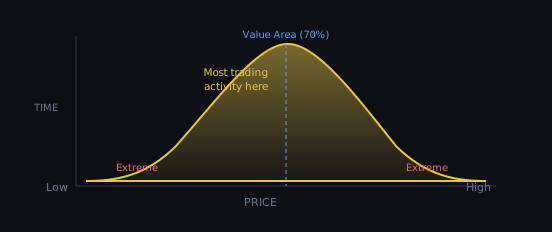
The analogy used is a teacher's grade chart. A bell curve of student grades shows where most students scored (middle — Bs and Cs) and where few scored (extremes — As and Fs). Similarly, the Market Profile shows where most price activity occurred during a trading day and where the extremes are. The bell curve is a visual, statistical truth — not an opinion.
1.3 Why This Matters
The authors frame the Market Profile within a broader philosophy: markets are not random. They have structure — just like grades form a bell curve naturally, price activity forms recognizable patterns when organized by time. The goal of the book is to teach traders to read this structure rather than rely on external opinion.
The bell curve metaphor is extended deliberately. In school, most students land in the middle (average). Similarly, in markets, most price transactions happen near a "fair value" zone. Outlier prices (extremes) occur rarely — and when they do, they represent important signals.
★ Structured Study Notes
Chapter 1 — Key Concepts
- The Information Problem
- Markets flooded with opinions: magazines, moving averages, channel models, personal advisors
- All these were derivative sources — they react to the market, not reveal it
- A statistical study correctly identified a market top that no analyst caught
- Market Profile — Definition
- A graph plotting time on one axis and price on the other
- Produces a statistical bell curve of market activity
- It is a conduit for listening to the market — not a prediction engine
- Simply organizes market activity as it unfolds
- The Bell Curve Analogy
- School grades: most students get Bs/Cs (middle), fewer get As/Fs (extremes)
- Market: most price transactions happen near fair value (center)
- Price extremes = rare, high-signal events (like straight-A students)
- What the Profile Is NOT
- Not a system that predicts tops and bottoms
- Not a trend continuation signal
- Not superior to overall student intelligence (it's a tool, not an oracle)
- Core Philosophy
- Markets have inherent structure, revealed by organizing price + time data
- The market itself is the best indicator of what the market is doing
- Listening > Predicting
Novice — Learning
Market Mechanics
2.1 The Novice Stage — What It Means
The authors open Chapter 2 by situating the "Novice" as the first stage in any skill-acquisition process. No one begins as an expert. A beginner must first learn the objective, measurable facts and features of their craft — the tools.
Two analogies are offered: (1) A carpenter learns the function of a saw, hammer, and plane before attempting to build anything. (2) A pianist memorizes scales and music theory before performing. In trading, the novice must memorize the Market Profile's basic structures before making any decisions.
An important caveat is introduced: the reader may already carry a mix of fundamental, technical, and market-generated beliefs about trading. This noise must be managed — the goal is to maintain an open mind and actively apply new knowledge to real market observation.
2.2 Market Profile Mechanics
The authors then teach the literal mechanics of how a Market Profile is constructed, using Treasury bonds as their example instrument.
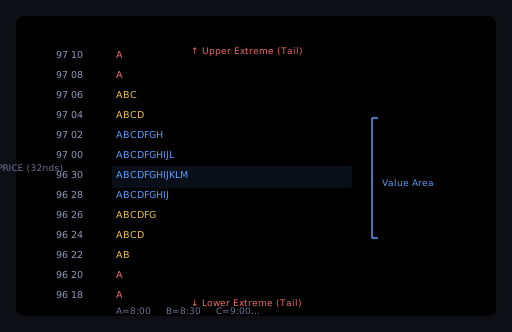
Each half-hour period of the trading day is assigned a letter (A through L and beyond). Within each half-hour, every price traded is marked with that period's letter. As the day progresses, letters accumulate next to each price level. The resulting column of letters, when read horizontally, shows how many half-hour periods each price was traded — producing the bell curve shape organically.
One tick in Treasury bonds equals 1/32nd of a point, and one point equals $1,000. So one tick = $31.25 in value. This precision matters because the vertical axis of the Market Profile is price in 1/32nd increments.
2.3 The Initial Balance — The Foundation
The Initial Balance (IB) is one of the most critical concepts in the entire book. It refers to the price range established during the first hour of trading (the A and B half-hour periods combined).
The IB is set primarily by locals — the floor traders who provide liquidity and set prices. The authors use an analogy: the IB is like the base of a lamp. The wider the base, the harder it is to knock the lamp over. A wide IB = strong support and resistance → the extremes are more likely to hold. A narrow IB = more fragile → price is more likely to break beyond the IB extremes as the day develops.
Using the IB as your base gives you a "confidence gauge". Wider IB = higher confidence that extremes will hold. Narrower IB = expect range extension and less predictable movement.
2.4 The Six Day Types
This is the heart of Chapter 2. The authors describe six distinct types of trading days, each with its own structural characteristics (shape, Initial Balance width, range extension pattern) and underlying dynamics (what drives the price movement). Recognizing the day type early gives a trader critical directional confidence.
Normal Day
Wide Initial Balance established quickly. Most of the day's range is set in the first hour. Range extensions are small or absent. Price stays within the IB. Two-sided, balanced trade throughout.
Normal Variation of Normal Day
Narrower IB than Normal Day. One side of the IB is exceeded (range extension), driven by the Other Timeframe participant. Less balanced — one side dominates slightly. More dynamic than a Normal day.
Trend Day
Very narrow Initial Balance. The Other Timeframe controls the entire day. Price auctions in one direction continuously — higher or lower — never looking back. Highest directional conviction. "One-timeframe" activity all day.
Double-Distribution Trend Day
Begins like a Trend day but establishes a second balance area far from the opening. Two distinct bell-curve distributions separated by a gap (single prints). Important reference points for future days.
Nontrend Day
Complete lack of directional conviction. Very narrow range. No meaningful range extension. Usually on holidays, pre-big-news days, or after a Trend day exhausts itself. Locals balance; Other Timeframe absent.
Neutral Day
Falls between Trend and Normal. Both buyer and seller are active but neither wins — both extend the range from opposite extremes. Two types: Neutral-Center (closes in middle) and Neutral-Extreme (closes at one extreme, indicating potential directional move).
2.4a TPO Profile Shapes — Visual Reference
Each day type produces a distinctly shaped Time Price Opportunity (TPO) profile. Letters A–L represent successive 30-minute periods. Reading the shape of the profile in real time is how a trader identifies the day type as it unfolds. A·B = Initial Balance (first hour). Letters beyond A·B = range extension by Other Timeframe participants.
2.5 Day Type Dynamics — The Deeper "Why"
For each day type, the authors provide not just the structural description but the market forces driving it. The key dynamic concept is the relationship between two types of participants:
- Locals (Floor Traders) — Provide liquidity. They set initial prices. They are short-term, two-sided traders who profit from the spread. They are price facilitators, not direction takers.
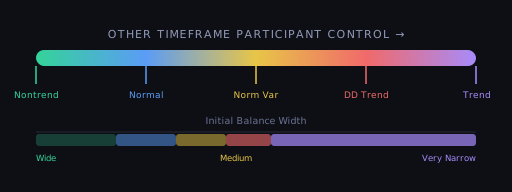
- Other Timeframe Participants (OTF) — Institutional buyers and sellers trading for longer-term value. When they enter, they move price directionally with conviction and volume. They are the drivers of range extension.
The day type is determined by the degree of OTF involvement. A Nontrend day = OTF absent. A Trend day = OTF completely in control. Normal days = moderate OTF influence, balanced by locals.
2.6 Normal Day — Detail
The Normal day's wide IB is set by the auction process of locals and Other Timeframe participants in the first hour. The market establishes a broad value area immediately, and for the rest of the day, trade is two-sided — meaning both buyers and sellers actively participate at these prices.
The key structural feature is the IB being as wide as the entire day's range — no meaningful range extension occurs. The key dynamic is that neither buyers nor sellers gain sustained control. Market confidence is moderate on both sides.
The authors warn: "Normal days often fly in the face of the most recent market activity." Traders should not try to buy the bottom or sell the top aggressively — the best trades often come from fading the extremes back toward value.
2.7 Trend Day — Detail
A Trend day begins with an extremely narrow IB — often just one or two price ticks. This is a red flag that something is different. The Other Timeframe participant, operating from a position of strong directional conviction (e.g., responding to news, economic data, or a large institutional mandate), enters with volume and begins auctioning prices in one direction.
Two subtypes exist: the standard Trend Day and the Double-Distribution Trend Day. In the standard version, price moves uniformly from open to close with minimal pullback. The auction process itself becomes one-sided — every new period pushes further in the trend direction.
The Double-Distribution Trend Day is more nuanced. It begins trending but then establishes a new balance area — a second bell-curve distribution — far from the open. The two distributions are separated by single prints (prices only printed once), indicating rapid price movement through that zone. These single prints become important reference points for future sessions.
2.8 Nontrend Day & Neutral Day — Detail
The Nontrend Day is characterized by a complete absence of directional conviction. Market participants balance their positions in anticipation of an external stimulus (news release, holiday, etc.) that has not yet arrived. Trade is minimal, ranges are tiny, and the profile is extremely narrow. There is no usable signal in a Nontrend day — the market is waiting.
The Neutral Day sits at a crossroads. Both buyers and sellers are active — the range extends from both sides of the Initial Balance (range extension up and down). Neither wins. The day closes with price somewhere in the middle.
However, there is an important variant: the Neutral-Extreme Day. On this day, price also extends on both ends, but ultimately closes at one of the extremes. This closing at an extreme signals that while the battle was two-sided all day, one side ultimately won — indicating potential directional follow-through in the next session.
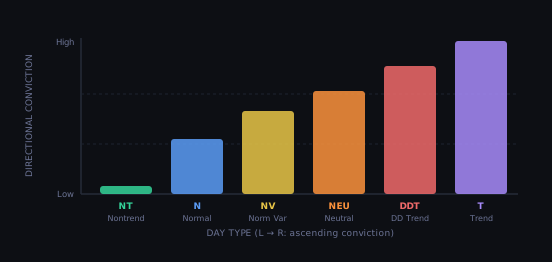
2.9 Day Types & Directional Conviction
★ Structured Study Notes
Chapter 2 — Key Concepts
- The Novice Stage
- First stage of skill acquisition — learn tools before applying them
- Analogies: carpenter, pianist, bird feeder builder
- Rote memorization of Profile mechanics comes first
- Derivative learning (books/teachers) → must be supplemented by observation
- Key warning: pre-existing beliefs (fundamental/technical/market) create noise — keep an open mind
- Market Profile Mechanics
- Each half-hour period = one letter (A, B, C… L)
- Each price traded in that period is marked with the letter
- Multiple letters at a price = traded in multiple periods = more time = value
- Treasury bonds: 1 tick = 1/32nd point = $31.25; 1 full point = $1,000
- Profile letter segments: A–B = first hour (Initial Balance)
- Initial Balance (IB)
- First hour's range (A + B periods combined)
- Set primarily by locals (floor market makers)
- Lamp analogy: wider base = harder to tip = more stable extremes
- Wide IB → extremes likely to hold → Normal Day characteristics
- Narrow IB → easily broken → Trend Day potential
- IB = confidence gauge for the entire day's trading
- The Two Key Participant Types
- Locals (floor traders): provide liquidity, set spreads, two-sided trade, short-term horizon
- Other Timeframe (OTF) participants: institutional buyers/sellers, directional conviction, longer horizon — drive range extension
- Day type = measure of OTF control vs. Local balance
- The 6 Day Types
- Normal Day
- Wide IB; range mostly set in first hour; balanced two-sided trade; no major range extension
- Best trades: fade extremes back to value; don't chase
- Normal Variation of Normal Day
- Narrower IB; one side extends beyond IB; slight directional bias
- Closes near but slightly outside IB on one side
- Trend Day
- Very narrow IB (critical early warning sign!)
- OTF in total control; price auctions one direction all day; single-timeframe activity
- Most profitable if recognized early; most dangerous if fought against
- Double-Distribution Trend Day
- Starts narrow like Trend Day, establishes second balance area far from open
- Two bell curves separated by single prints (rapid transit zone)
- Single prints = important future support/resistance reference
- Nontrend Day
- Complete absence of conviction; extremely narrow range
- OTF absent; market waiting for catalyst
- No tradeable signal; common before major announcements or on holidays
- Neutral Day
- Range extends both above and below IB; neither buyer nor seller wins
- Neutral-Center: closes in middle → no follow-through expected
- Neutral-Extreme: closes at one extreme → directional follow-through possible next session
- Normal Day
- Key Principle: Day Type Recognition
- Identify day type as early as possible (often within first 2–3 periods)
- IB width is the primary early signal
- Each day type demands a different trading approach
- The best trades often fly in the face of the most recent market activity
- Never buy just after a large rally or sell just after a large drop without context
2.10 Day Type Comparison
All six day types compared side by side. Use the filter tabs to highlight a specific day across the TPO profiles, attribute table, and quick-reference cards.
Attribute Comparison Matrix
| Attribute | Normal | Norm. Var. | Trend | DD Trend | Nontrend | Neutral |
|---|---|---|---|---|---|---|
| IB Width | ||||||
| OTF Control | Moderate | Partial | Full | Full | Absent | Both sides |
| Range Extension | None / minimal | One side | Entire range | Entire range | None | Both sides |
| Profile Shape | Symmetric bell | Skewed bell | Diagonal slash | Two bells + gap | Fat short column | H-shape |
| Directional Conviction | ||||||
| Single Prints? | Rare | Possible | Many | Yes — key zone | None | At extensions |
| Trading Approach | Fade extremes | Fade IB extreme; follow ext. | Trade with trend only | Trade 2nd distribution | Avoid / wait | Neutral-Extreme = follow close |
| Follow-Through Next Day | Low | Possible | High | High if SP holds | None expected | If Neutral-Extreme |
| Frequency | Common | Most common | Rare | Rare | Occasional | Occasional |
QR Quick-Reference Cards
📊 Normal Day
📊 Normal Variation
📊 Trend Day
📊 Double-Distribution Trend
📊 Nontrend Day
📊 Neutral Day
Advanced Beginner —
Reading the Market
3.1 The Advanced Beginner Stage
The Advanced Beginner has mastered the mechanics of the Market Profile — the letters, the Initial Balance, the day types — and now begins to apply them to developing, live markets. The key shift here is from recognizing patterns after the fact to reading patterns as they form.
The authors describe this stage as analogous to a medical student who has memorized anatomy but is now seeing real patients for the first time. The knowledge is there, but integrating it with a live, changing situation requires a new layer of skill: contextual pattern recognition.
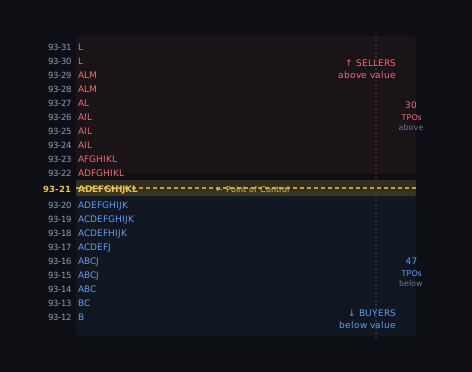
3.2 Point of Control (POC)
The Point of Control (POC) is the single price level at which the most TPO letters appear in a day's profile — the widest row. It represents the price at which the market spent the most time, and therefore the price the market perceived as fairest value for that day.
The POC is the axis of the entire day's bell curve. It divides the profile into two halves:
- Above POC — prices above fair value. Other timeframe sellers are comfortable staying short here — they believe price is too high.
- Below POC — prices below fair value. Other timeframe buyers are comfortable staying long here — they believe price is too low.
Because it is the most-visited price of the day, the POC is also a powerful magnet for future price action. Price often returns to the previous day's POC before deciding on direction.
3.3 The TPO Count — Buyer/Seller Imbalance
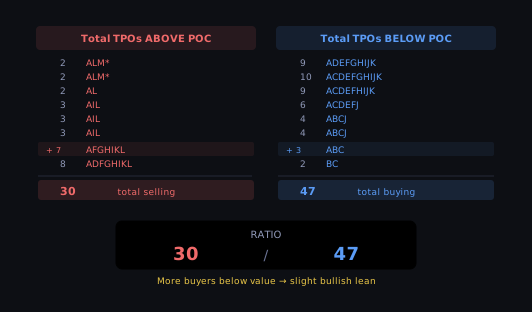
The TPO Count is a quantitative measure of the balance of power between buyers and sellers within the value area. It works by counting the total number of TPO letters above the POC versus below it.
Single-print rejections (tails) are not counted — they represent extreme, one-time price rejection and would distort the ratio. Only letters within the value area distribution count.
3.4 The Developing Market Profile
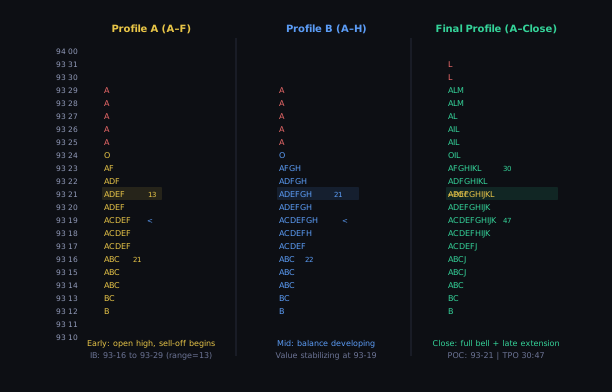
One of the most important skills the Advanced Beginner must develop is reading a profile in progress — not just the completed end-of-day shape. The profile tells a story that unfolds period by period, and early recognition of that story is how a trader gains a positional edge.
Figure 3.2 from the book shows the same trading day (Treasury Bonds, Jan 29, 1988) at three snapshots in time: after the first six periods (A–F), after eight periods (A–H), and at the final close. The day opened substantially higher than the previous close — gapping up — and then an early sell-off began as the market attempted to auction prices down.
3.5 Initiative vs. Responsive Activity
This is one of the most important conceptual distinctions in the entire book. Every TPO — every letter on the profile — can be classified as either initiative or responsive depending on where it occurs relative to the previous day's value area.
New territory — conviction
Initiative buying = buying below the previous day's value area. The OTF buyer believes price is cheap and pushes it aggressively lower looking for new value.
Initiative selling = selling above the previous day's value area. The OTF seller believes price is expensive and pushes it aggressively higher.
Signal: Strong directional conviction. Market is seeking NEW value.
Reacting to excess — fading
Responsive buying = buying below the previous day's value area — BUT in response to price falling too far. The buyer fades what they see as excessive selling.
Responsive selling = selling above the previous day's value area — in response to price rising too far. The seller fades excessive buying.
Signal: Market is returning to known value. Mean-reversion in play.
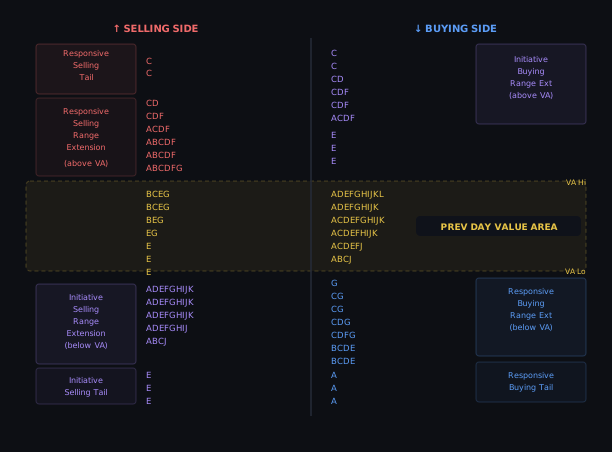
The authors emphasize a critical asymmetry: initiative activity carries far more weight than responsive activity. When the OTF participant enters new territory (initiative), they are making a strong statement about value. When they respond to excess (responsive), they are simply expressing that price has moved too far from a known reference.
3.6 Classifying the Entire Value Area
Not just individual TPOs but the entire day's value area can be classified as either initiative or responsive relative to the previous day. This gives the trader a high-level read on market conviction:
- Value migrating higher = initiative buying day. The market is discovering new value above the old range. Bullish continuation signal.
- Value migrating lower = initiative selling day. The market is discovering new value below the old range. Bearish continuation signal.
- Value area overlapping with previous day = responsive day. The market is rotating back within established territory. Mean-reversion, no new information.
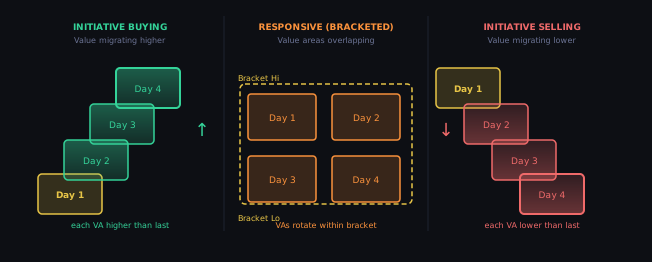
3.7 Trending vs. Bracketed Markets
The authors describe this as "one of the most difficult auction market concepts to grasp" because it requires synthesizing all profile knowledge — day types, value areas, initiative/responsive activity — into a single macro-level judgment about the market's current state.
Value migrating in one direction
Day-by-day value areas do not overlap (or barely overlap). Price is discovering new value with each session. The market is like a person walking — each step takes them further from where they started.
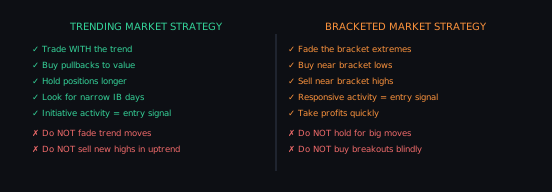
Strategy: trade with the trend. Buy pullbacks, sell rallies in direction of trend only.
Value oscillating within a range
Day-by-day value areas heavily overlap, bouncing between defined upper and lower bracket boundaries. The market is like a pendulum — oscillating back and forth without net movement.
Strategy: fade the extremes. Buy bracket lows, sell bracket highs.
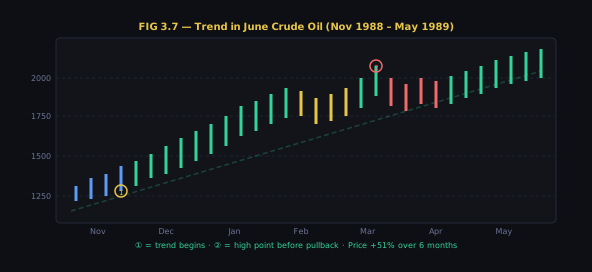
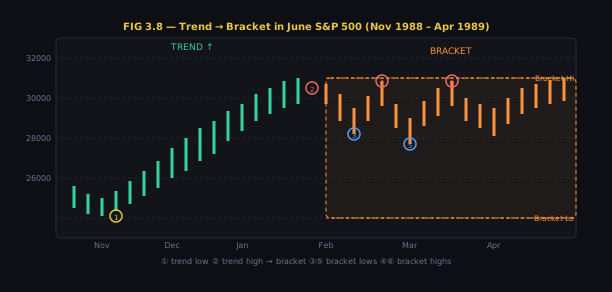
★ Structured Study Notes
Chapter 3 — Key Concepts
- The Advanced Beginner Stage
- Transition from pattern recognition after the fact → reading patterns as they form
- Requires integrating mechanics with live, changing context
- Every profile feature must be interpreted contextually — not in isolation
- Point of Control (POC)
- Price level with the most TPO letters = widest row in the profile
- Represents the market's fairest price / greatest perceived value for the day
- Divides profile: above POC = seller territory; below POC = buyer territory
- Powerful magnet for future price — market often revisits prior POC
- TPO Count
- Count letters above POC (sellers comfortable staying short) vs. below POC (buyers comfortable staying long)
- Single-print tails are excluded from the count
- Produces a ratio: e.g. 30:47 = more buyers below value → bullish lean
- Does NOT explicitly calculate value area — value is implied by the methodology
- The Developing Profile
- Same day shows radically different shapes at A–F vs. A–H vs. close
- Early profile (A–F): shows initial direction, IB, early balance area
- Mid profile (A–H): value area stabilizing, POC becoming clearer
- Final profile: complete bell curve, full TPO count, final value area
- Advanced Beginner learns to read the profile as it builds — not just at close
- Initiative vs. Responsive Activity
- Reference point = previous day's value area
- Initiative buying: OTF buyer pushing price below previous value → seeking new lower value
- Initiative selling: OTF seller pushing price above previous value → seeking new higher value
- Responsive buying: buyer entering below previous value because price fell too far → fade the excess
- Responsive selling: seller entering above previous value because price rose too far → fade the excess
- Tails = most extreme form of responsive activity (one-time rejection)
- Initiative activity carries more weight — indicates new information / conviction
- Entire value area can be classified: migrating = initiative; overlapping = responsive
- Trending vs. Bracketed Markets
- Trend: consecutive value areas NOT overlapping, migrating in one direction
- Strategy: trade WITH trend, buy pullbacks, hold longer, watch for narrow IB days
- Initiative activity is the entry signal
- Bracket: consecutive value areas heavily overlapping within defined boundaries
- Strategy: fade extremes, buy bracket low, sell bracket high, take profits quickly
- Responsive activity is the entry signal
- Trend example: Crude Oil Nov 1988 – May 1989 (+51% sustained uptrend)
- Bracket example: S&P 500 Feb–Apr 1989 (oscillated between ~28000 and ~30000)
- A trend often ends by transitioning into a bracket — watch for value areas starting to overlap
Competent —
Reading the Open & Range
4.1 The Opening — Four Types
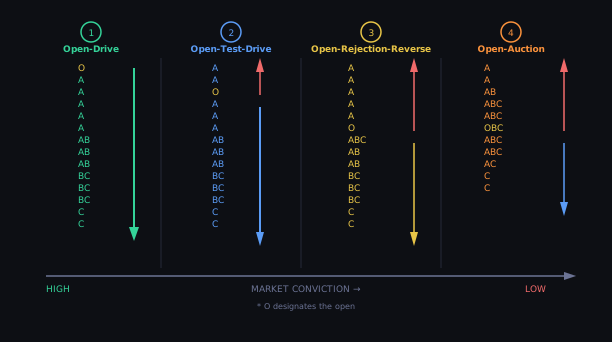
The open is the single most important moment of the trading day. It is where the market first expresses its directional conviction — or lack of it. The authors identify four distinct opening types, ordered from highest to lowest market conviction. Learning to recognize the opening type within the first 30–60 minutes gives the trader a significant edge in anticipating the day's structure.
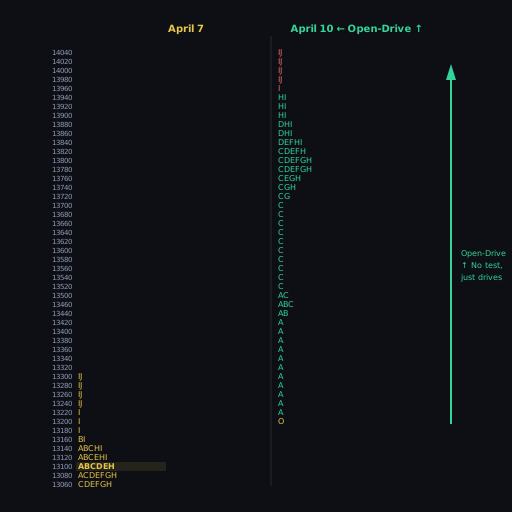
Open-Drive
Market opens and immediately drives in one direction without testing the other side. The OTF participant has made a decisive commitment before the open. No hesitation — price just goes.
Signal: Follow the drive. Do not fade.
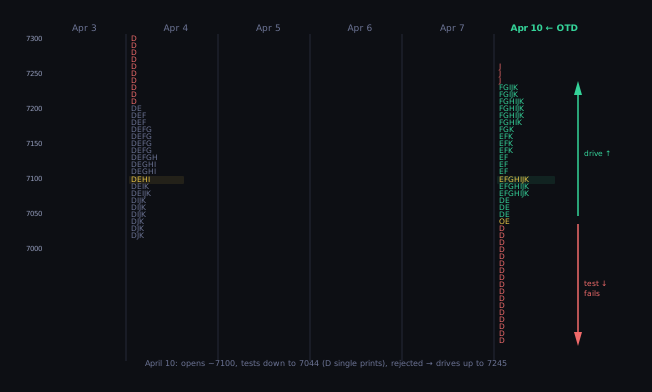
Open-Test-Drive
Market opens, probes one direction to test for conviction, finds none (gets rejected), then drives powerfully in the opposite direction. The test confirms which side has control.
Signal: Wait for test to fail, then follow the drive.
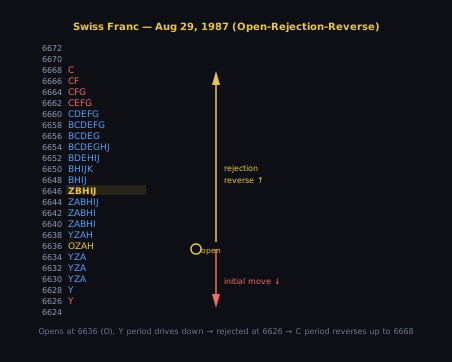
Open-Rejection-Reverse
Market opens, moves in one direction, gets rejected and reverses — but without the strong drive of OTD. Lower conviction than above. Often traps less experienced traders who jump on the initial move.
Signal: Wait for reversal confirmation. Do not chase the initial move.
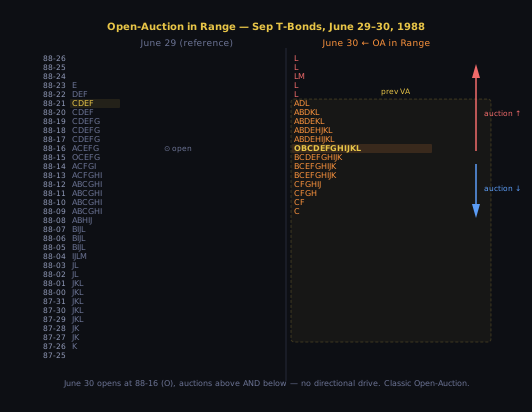
Open-Auction
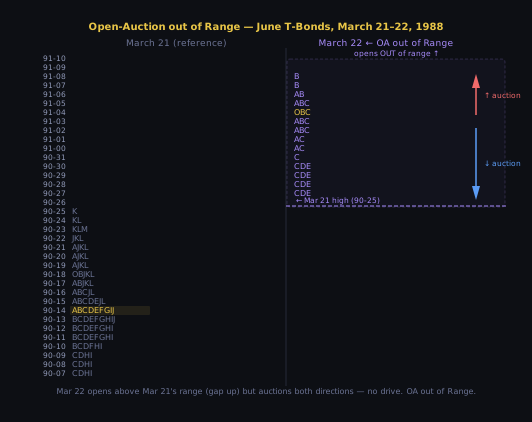
Market opens and auctions both above and below the opening range with no clear directional bias. Two sub-types: in range (within previous day's range) and out of range (outside previous range, but still no drive). Likely a Nontrend or Normal day.
Signal: Fade the extremes. Expect bracketed activity.
4.2 Open-Drive
An Open-Drive occurs when the Other Timeframe participant arrives at the open with a fully formed opinion and immediately begins moving price without any pause or test. The early letters of the profile all stack in one direction — the market has no interest in exploring the other side.
The key diagnostic: look at period A. If the entire A period is a single-direction string of TPOs with no reversal, and period B continues in the same direction, you are likely witnessing an Open-Drive.
4.3 Open-Test-Drive
The Open-Test-Drive is arguably the most tradable of the four opening types. The market opens, immediately probes one direction to test whether there is conviction — and when that probe fails (no responsive activity on the tested side), it reverses and drives the opposite way with full conviction.
The failed test is the signal. As the book states: "participants need the security of knowing what is below the lows or above the highs before they can move the market with confidence." The market needs to confirm that the other side is empty before committing.
4.4 Open-Rejection-Reverse
The Open-Rejection-Reverse resembles the Open-Test-Drive but carries lower conviction. The market opens, moves in one direction, gets rejected, and reverses — but the reversal does not develop into a strong sustained drive. Less experienced traders often get caught by jumping on the initial move, only to be caught in the reversal.
The key difference from OTD: in an ORR, the initial move often generates some activity before reversing, whereas in an OTD the test is quickly and decisively rejected. Patience is the key skill here.
4.5 Open-Auction
The Open-Auction is the least decisive opening type. The market opens and auctions both above and below the opening range — there is no dominant participant with a strong directional view. This type of open most commonly leads to a Nontrend or Normal day. There are two sub-types distinguished by where the opening occurs relative to the previous day's range.
Open-Auction in Range
Market opens within the previous day's range and then auctions both directions. No new information about value is being generated — the market is comfortable in known territory.
Expect: Nontrend or Normal day. Responsive activity.
Open-Auction out of Range
Market opens outside the previous day's range but still auctions both directions around the open. The gap itself signals something, but the lack of drive means conviction is uncertain.
Expect: Monitor — gap may fill or hold. Watch for drive to develop.
4.6 Opening Type Summary
The four opening types form a spectrum from highest to lowest market conviction. This diagram (Fig 4.6) shows the schematic TPO structure of each type side by side, with the conviction arrow running left to right.
4.7 Opening's Relationship to Previous Day — Estimating Daily Range Potential
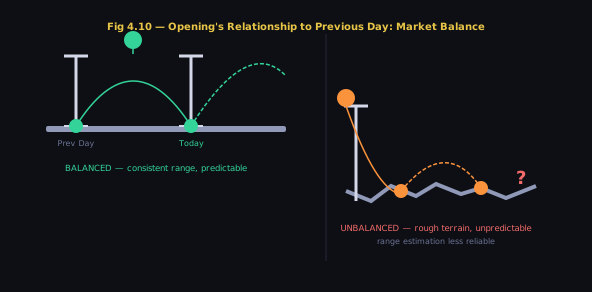
In the large majority of cases, activity during any given day has direct and measurable implications on the following day. It is only on the relatively rare occasion when a market moves extremely out of balance that there is no correlation between two consecutive days. Understanding these relationships allows the trader to estimate the likely range of the current day before it fully develops — a powerful edge at the open.
The framework is organised around where the market opens relative to the previous day's value area and range. There are four scenarios, each carrying different implications for range potential and risk.
Open within Value — Acceptance
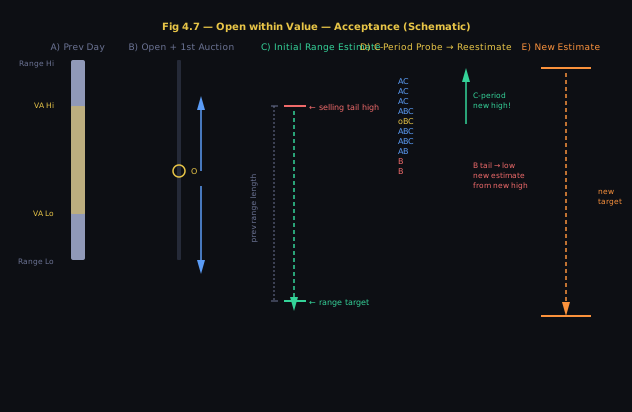
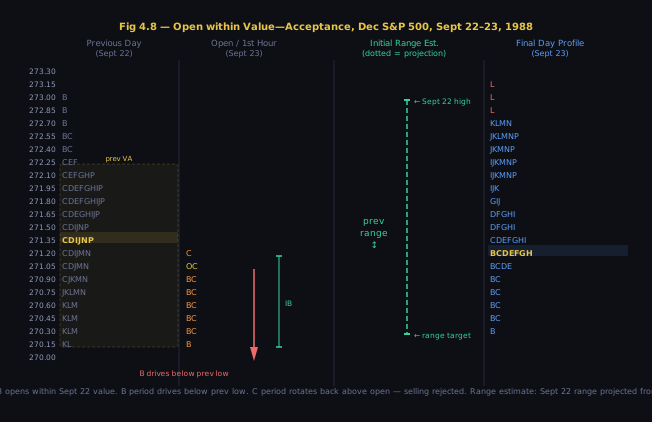
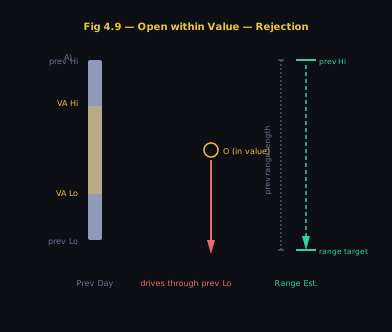
Market opens inside the previous day's value area and accepts that location. Conditions are unchanged overnight. Range potential ≈ previous day's range, projected from the first developing extreme.
Open within Value — Rejection
Market opens inside value but immediately drives out. The rejection signals the OTF participant is active. Range potential extends beyond prior range — treat like a drive opening.
Open outside Value, within Range — Acceptance
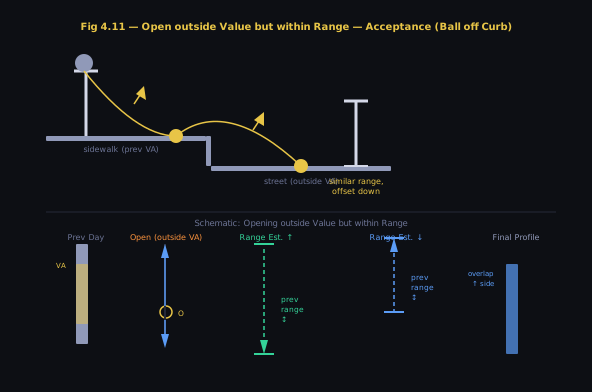
Opens outside value but within the prior range. Still relatively balanced. Range ≈ previous day's but offset — overlapping to the direction of the open.
Open outside Range
Opens completely outside the prior day's range — a gap. Highest risk scenario. If the gap holds and is accepted, it signals a strong directional statement. If rejected, expect a full gap fill.
4.8 Open within Value — Acceptance
When a market opens within the previous day's value area and the early auction accepts that location (no immediate drive out), conditions have not materially changed overnight. The market is like a ball bouncing on a flat surface — it will travel roughly the same distance as the previous day.
The range estimate process works as follows: identify the first extreme left behind by the early auction (which may become a tail), then project the previous day's range length from that extreme. This gives an initial target zone. The estimate must be continuously updated as the day develops — any probe that breaks the initial extreme requires a new calculation.
4.9 Open within Value — Rejection
When the market opens within value but immediately drives out, it is rejecting the prior value area as fair. This is a fundamentally different situation from acceptance. An OTF participant has arrived with conviction and is moving price away from yesterday's equilibrium zone before the market even has a chance to settle.
This open type produces greater range potential than the acceptance scenario. The range estimate still uses the previous day's range length as the measuring rod, but the drive itself signals that the day is likely to move further. Treat this similarly to an Open-Drive opening type.
4.10 Open outside Value but within Range — Acceptance
A market that opens outside the previous day's value area but still within the prior range is slightly out of balance — but still bouncing on flat pavement. The authors use the analogy of a ball bouncing over a curb to land in the street: it still travels approximately the same net distance, but the height is reduced by the offset of the new surface. The ball bounced over the curb.
Openings outside of value but within range indicate a market slightly out of balance and usually result in value that overlaps to one side. The same range estimation method applies — the resulting range will usually extend beyond the previous day's high or low, because the market opens closer to one of those extremes.
The risk on this type of day is slightly greater than the previous open relationships, but the opportunity is greater as well.
4.11 Open outside Value but within Range — Rejection (Breakout)
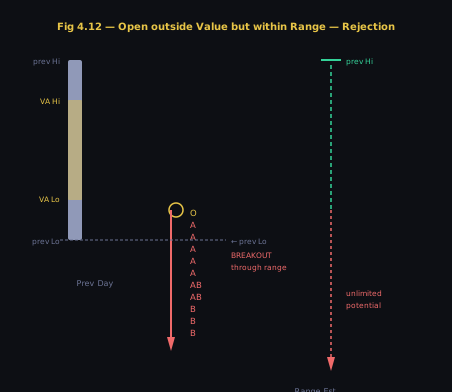
On this type of day, the market opens above or below the previous day's value area but still within the previous day's range. If the market subsequently breaks out beyond the extremes of the previous day's range, then the market is coming out of balance and range potential is unlimited in the direction of the breakout.
This is the most dangerous scenario for traders who are fading the move. A breakout from within range signals that conditions have changed — the OTF participant is not just probing, they are committing. The previous day's range is no longer the container.
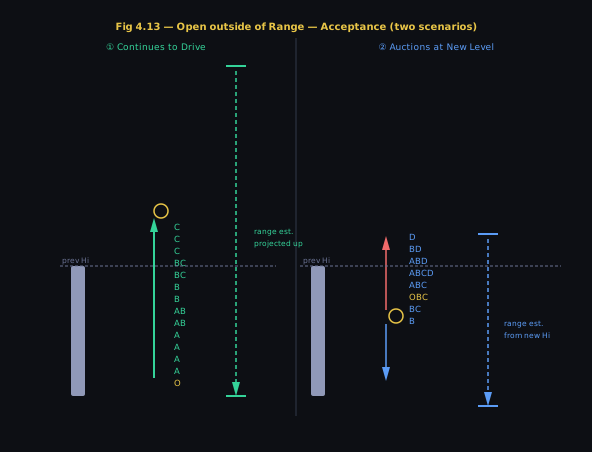
4.12 Open outside of Range — Acceptance
When a market opens outside of the previous day's range and is accepted at that level, conditions have clearly changed — the market is out of balance. At this point, one of two scenarios is possible:
- The market will continue to drive in the direction of the breakout (scenario 1 — Open-Drive)
- The market will begin to auction back and forth at the new price levels (scenario 2 — Open-Auction from the new position)
In both cases, the opening is outside range, which means the previous day's value area is no longer a reliable reference for range estimation. New value is being established.
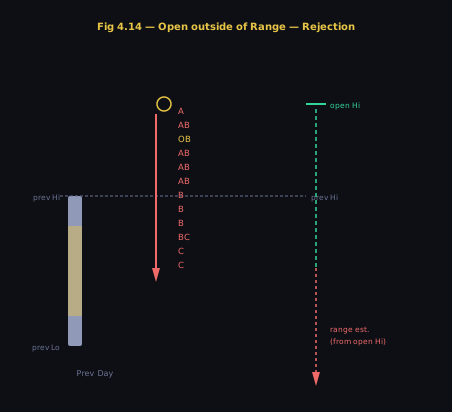
4.13 Open outside of Range — Rejection
When a market opens outside the previous day's range but is rejected at those levels, it signals that the gap or extension is not accepted by the market. The OTF participant who drove it there found no follow-through. Price typically reverses sharply and fills back toward the previous day's range or beyond.
Combining the opening's relationship to the previous day with other market-generated elements — such as the opening type and initiative/responsive activity — gives the trader a more objective understanding of the big picture.
4.14 April 13, 1989 — Case Study
April 13, 1989 serves as a live summation of the concepts introduced in this section. Before the market opened, traders knew that the Retail Sales number would be announced at 7:30 AM. In addition, five major economic figures were due the following day: Merchandise Trade, Producer Price Index, Business Inventories, Capacity Utilization, and Industrial Production. The anxiety and conflicting speculations created conditions where different markets responded very differently to the same macro backdrop — each exhibiting a distinct opening/value relationship.
Five markets are shown side by side, each with April 12 (previous day) and April 13 profiles. Read each one in terms of: where did April 13 open relative to April 12's value area and range? What opening type developed? What does that imply for the day's range potential?
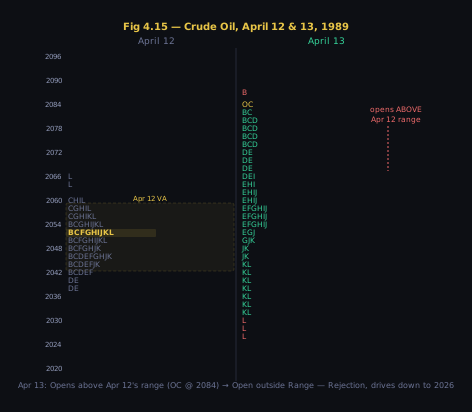
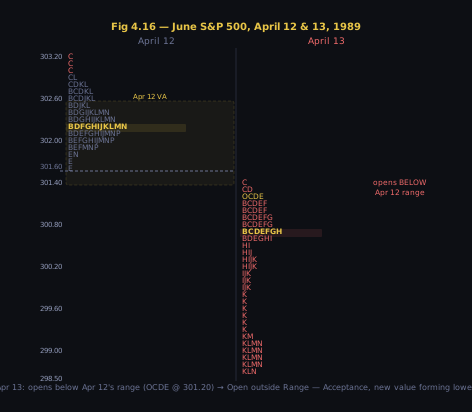
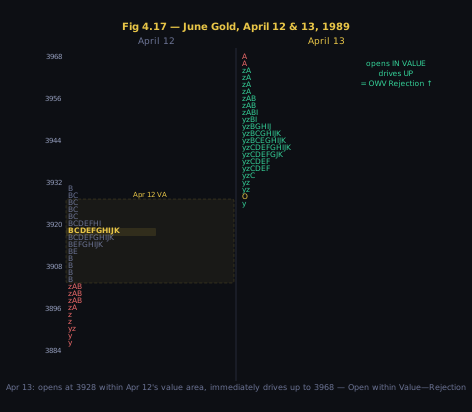
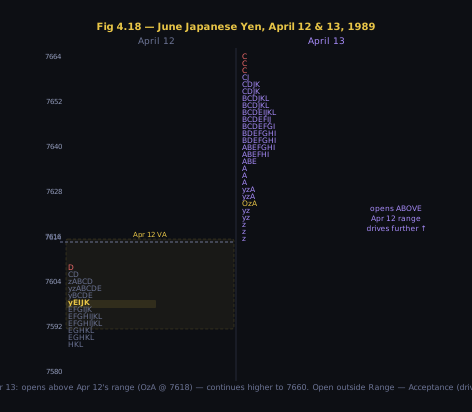
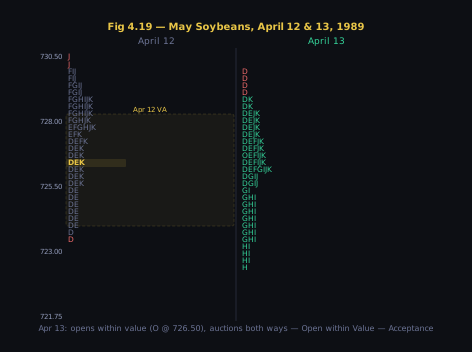
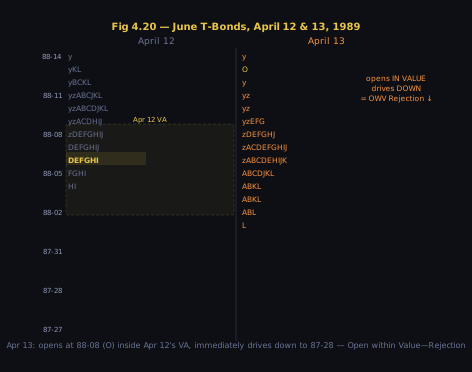
The day was best to stand aside in markets without clear directional conviction and follow the drive in those that showed it clearly.
∑ Chapter Summary
We have now completed the discussion of the market's open: from the opening call to the actual open and its relationship to the previous day. As you proceed farther into the day, remember to consider each new piece of learning in relation to the whole. The big picture continues to unfold — and more of the fogged window is becoming clear as you move closer to becoming a competent trader.
The two key contributions of this chapter are:
1. The four opening types give you an immediate read on OTF conviction before the day is even an hour old. Match the opening type against what you expect from the context (trending vs. bracketed, prior value area) and you already have a working hypothesis for the day's structure.
2. The opening's relationship to the prior day gives you a range estimate before price moves. Use the previous day's range as your measuring rod, anchored from the first significant extreme. Update the estimate whenever a new extreme forms. The estimate is a guide — not a guaranteed target — and the further price opens from the prior value area, the less reliable that estimate becomes.
4.15 Other Timeframe Control — Structure
In the Advanced Beginner chapter, structural features — TPO count, tails, and singles — were introduced as monitors of other timeframe activity. As a Competent trader, you use these same features in real time to answer one question: who currently controls the market?
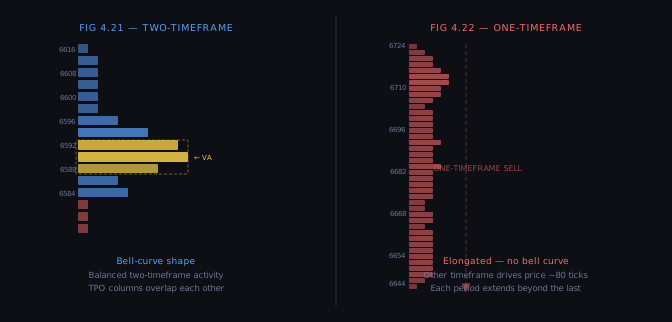
The most fundamental structural read is the distinction between a two-timeframe market and a one-timeframe market. The shape of the developing profile tells you which mode the market is in — before the day has ended.
Overlapping TPO Structure
Each period's range significantly overlaps the prior period. Both the day timeframe and the other timeframe are active, rotating price back and forth near a common value area. Profile shape: balanced, bell-curve. Neither side dominates.
Sequential, Non-Overlapping TPOs
Each period's range extends directionally beyond the previous, with no overlap. The other timeframe has seized control and is driving price in one direction. Profile shape: elongated, thin. Day timeframe traders must follow, not fade.
4.16 Other Timeframe Control — Market Time
Structure tells you the shape of control. Time tells you the intensity. These two inputs work together — you cannot fully evaluate other timeframe activity by looking at structural features alone.
When a market spends an extended amount of time at one extreme of the range — multiple periods building at the high or low — the other timeframe is actively facilitating business there. This is time working for price at that level. Conversely, when a market moves quickly through a price level and never returns (a single TPO, a tail), that represents time rejecting price at that level.
A market that is spending significant time at the upper end of its range, with multiple periods printing new highs, is advertising higher prices. A market that is spending significant time at the bottom of its range but failing to close there, or quickly reverting, may be setting up for a sharp reversal. Time is the evidence behind the structure.
4.17 Timeframe Transitions
Markets rarely remain in a single timeframe mode for an entire day. Recognizing when a market is transitioning — and in which direction — is one of the most powerful real-time skills a Competent trader can develop. Four transition types cover the full range of daily structures:
Two-TF → One-TF (one direction)
Market opens with balanced, rotating activity, then the other timeframe seizes control and drives directionally for the remainder of the session. Result: Trend Day or Normal Variation day.
One-TF → Two-TF
Market opens with a strong directional drive (one-timeframe), but conviction fades and price drifts back to a balanced two-timeframe rotation. Result: Normal day or Non-Trend day.
Two-TF → One-TF → Two-TF
Balanced early, then a strong one-timeframe drive, then a return to balance at a new level. Result: Double Distribution Trend day. The first distribution and the second distribution are separated by a clear transition period.
One-TF (dir A) → One-TF (dir B)
Market drives strongly in one direction under other timeframe control, then reverses and drives with equal force in the opposite direction. Result: Neutral day. Wide range, poor location for day traders caught on the wrong side.
Not only do structure and time help determine who is in control, they are also useful in identifying when control may be shifting. To demonstrate the interplay between time and structure when evaluating timeframe transition, we examine the December Swiss Franc on October 12, 1987.
December Swiss Franc — October 12, 1987
Activity on this day was characterized by early-morning one-timeframe buying, a midmorning transition to one-timeframe selling, followed by a late-session return to buying. The segmented profile (Fig 4.23) is the analytical tool: by examining successive time-segment composites, the transition becomes visible in real time.
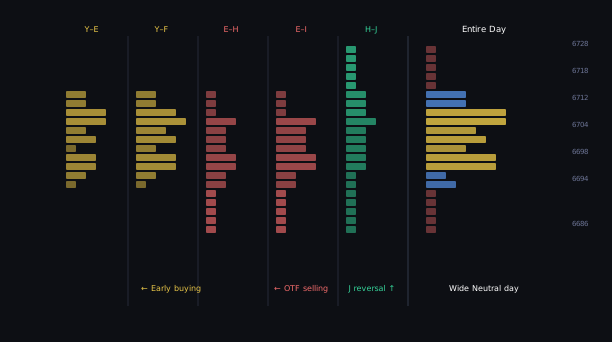
The key lesson of the Swiss Franc example: the entire day composite appears relatively wide and balanced — but the segmented analysis reveals a classic Type 4 transition (one-timeframe buying flipping to one-timeframe selling, then back). A trader reading only the final profile would have missed three distinct trade opportunities. A trader monitoring the segments in real time could identify each transition as it unfolded.
4.18 Auction Failure
An auction failure occurs when price probes beyond a known reference point — a recent high or low, a balance area extreme, a long-term structural level — and fails to attract responsive activity in that direction. Instead, the opposite timeframe enters aggressively, and price reverses sharply. The failed auction creates excellent trade location, because the market has provided a clear signal that the probe was rejected.
Auction failures occur on multiple timeframe levels. Long-term failures (at multi-week or multi-month reference points) produce larger, more sustained reversals. Short-term, day-timeframe failures produce quicker but still significant intraday moves.
Long-Term Auction Failure — May Soybeans
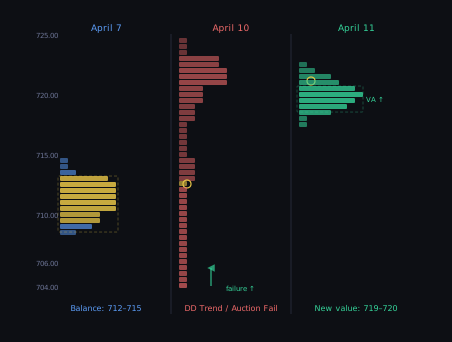
Over the autumn and winter of 1988–89, May Soybeans established a long-term balance area with a well-defined lower reference point near the 708 level. A multi-month low had formed there, and the market's participants had repeatedly used it as a support reference. On April 3, 1989, price auctioned below 708 — probing outside the long-term range. However, sellers did not follow through. Buyers, recognizing the probe as an auction failure below a known long-term reference, entered aggressively and drove price higher.
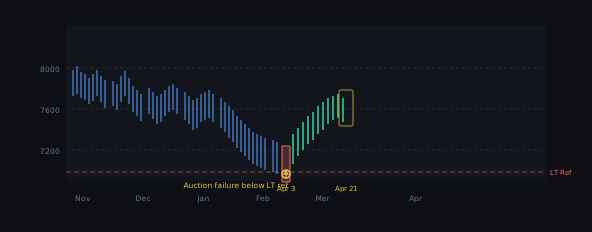
Examining the detail across April 7–11 (Fig 4.25) shows the mechanism at the day timeframe level. On April 10, price opened well below the April 7 balance area, drove down through prior lows (one-timeframe selling), then buyers responded explosively once the auction failure at the long-term reference was confirmed. The result was a Double Distribution Buying Trend day — one of the most powerful bullish structures in the Market Profile.
Day-Timeframe Auction Failure — September T-Bonds
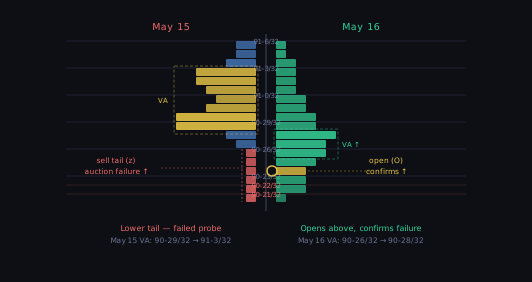
Auction failures at shorter timeframe reference points are more subtle but can still create swift and substantial intraday price movements. Figure 4.26 shows a day-timeframe auction failure in September Treasury Bonds on May 15–16, 1989.
On May 15, a prominent sell tail (z) probed below 90-22/32 — the lower edge of the session's activity. The probe found no sellers willing to continue the auction lower. On May 16, price opened at the upper end of the prior day's value (around 91-0/32 to 91-5/32), confirming that the May 15 probe had failed and buyers now controlled the market. The entire May 16 session traded at or above the prior day's value area — classic day-timeframe auction failure confirmation.
4.19 Signs of Excess
The market must auction too high to determine when prices are above value, and too low to determine when they are below value. This overshooting is not a flaw — it is the market's natural process for locating the boundaries of the value area. Excess is created when the other timeframe recognizes an opportunity and aggressively enters the market, returning price to the perceived area of value.
By definition, excess is identifiable only in hindsight — you cannot know that a price level represents excess until the market has already reversed away from it. However, many of the structural characteristics reflected by the Profile help identify excess quickly after it has formed. Tails, for example, are simply day timeframe auction excess: a single-period probe that the other timeframe immediately rejected.
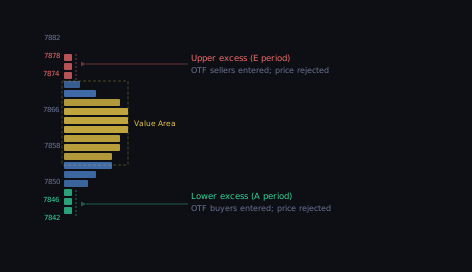
In Figure 4.27, the other timeframe was active on both ends of the range — entering aggressively to create day timeframe excess on both extremes. Price auctioned lower in the A period and was met by a strong other timeframe response. Price auctioned higher in the E period and was equally rejected. The result is a classic Normal day with well-defined excess on both ends and a tight, clearly bracketed value area in the middle.
4.20 The Rotation Factor
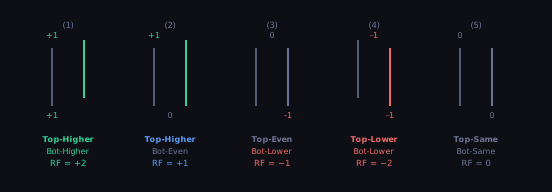
The Rotation Factor is a quantitative tool for tracking the directional bias of auction rotations as the day unfolds. It attempts to answer the first of the two Big Questions: which way is the market trying to go? A simple scoring system is applied to each successive time period:
- If a period's high is higher than the previous period's high → +1
- If a period's high is lower than the previous period's high → −1
- If the highs are equal → 0
- Same process applied independently to the lows
The sum of the top scores is the Top Total; the sum of the bottom scores is the Bot Total. The Overall Rotation Factor = Top Total + Bot Total. A positive RF indicates sustained buyer attempts; a negative RF indicates seller dominance.
The Rotation Factor for the T-Bonds day shown in Figure 4.29 — where Top Total = +3 and Bot Total = +3 for an Overall RF of +6 — exhibits consistent buyer attempts throughout the session. Every upward rotation in the tops and bottoms contributed to the bullish score, reflecting sustained OTF buying conviction.
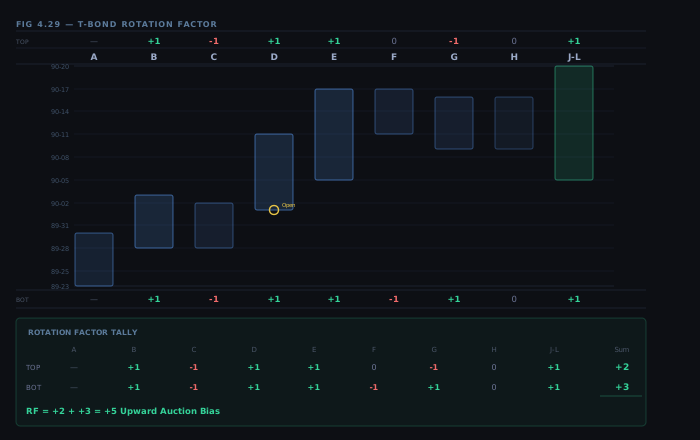
It is important to keep in mind that the Rotation Factor only answers one of the two Big Questions — that is, which way the market is trying to go. Before any conclusions can be drawn, you must also determine if the market is doing a good job in its attempts to auction in that direction. This requires analysis beyond the RF: day type identification, opening type, relationship to the prior day's value, and the overall context of the larger auction in progress.
4.21 Point of Control
The Point of Control (POC) is the price level at which the most time was spent during the trading session — the longest TPO line, or, when two lines share the longest length, the one closest to the centre of the range. It represents the fairest price for the day: the level at which both buyers and sellers agreed to do the most business.
The POC is not fixed. It develops and migrates intraday as new time periods print and range extension occurs. A Competent trader monitors the evolving POC in real time, using it as the single most important reference point for evaluating where value is forming. The POC's position relative to the prior day's POC tells you whether other timeframe control is pushing value higher, lower, or maintaining it — without requiring a full value area calculation.
The following five snapshots track a single day in Treasury Bonds from the 9:30 a.m. open through the 2:00 p.m. close, showing how the POC moves as the day develops.
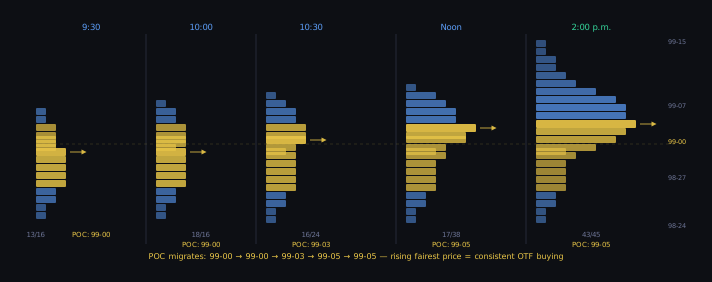
A continual rise in the fairest price level indicates consistent other timeframe buying throughout the day. Conversely, a falling POC indicates persistent other timeframe selling. A POC that remains anchored suggests balance — the market has found fair value and neither side is pressing the auction aggressively.
Range extension changes the POC calculation. After range extension, take the total day range and divide by two to find the geometric centre; the POC is the longest line closest to that centre. If the market has spent too much time at a single level, range extension alone may not shift the POC — but a combination of time and range extension can. Always recalculate the POC after any significant range extension.
4.22 The Close
The last indication of day timeframe market sentiment is embodied in the day's close. Far too much emphasis is often placed on the close and what it portends for the following day. The close does, however, often greatly influence overnight traders — participants who continue to trade in the direction of the close and carry positions overnight.
The close is best understood in relation to the day's value area and POC, not in isolation:
Close above Value Area
Price closes above the value area high. Suggests the other timeframe buyer was active into the close. Overnight traders are likely to continue buying, expecting the next session to open at or above prior value.
Close within Value Area
Price closes inside the value area — near the POC or between the VA high and low. Neither side has clear conviction. The following day is most likely to open near value and probe for new information.
Close below Value Area
Price closes below the value area low. Suggests the other timeframe seller was active into the close. Overnight traders are likely to continue selling, expecting the next session to open at or below prior value.
4.23 Short Covering & Long Liquidation
Two of the most treacherous intraday movements for day traders are short covering rallies and long liquidation breaks. Both can produce sharp, fast price moves that look like genuine other timeframe activity — but are in fact driven by old business being unwound, not new business being initiated.
Understanding the distinction is critical. A move driven by new other timeframe participation represents real change in the perceived value equation. A move driven by covering or liquidation (old shorts covering, or old longs bailing out) is self-limiting: once the position-unwinding is complete, the market reverts, often sharply.
Short Covering
A short covering rally occurs when traders who are short are forced (or choose) to buy back their positions. The key structural signature: the profile develops the shape of a letter P — a fat top with a thin, elongated sell tail below. The rally stalls almost as quickly as it got started. Short covering is caused by old business, not by new participants entering the market.
Figure 4.35 shows day timeframe short covering occurring simultaneously in three markets: COMEX Gold (February 24, 1988), March Treasury Bonds (February 19, 1988), and March Japanese Yen (February 18, 1988). In each case a sharp upward probe is followed by stalling — the hallmark of short covering rather than genuine other timeframe buying.
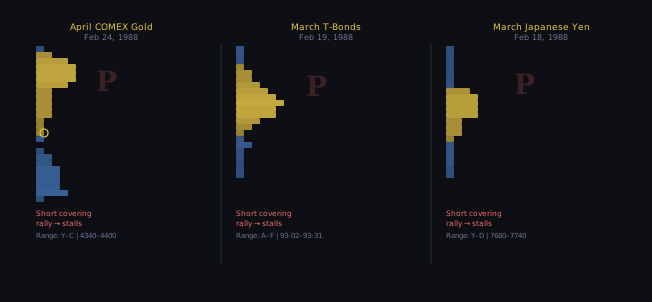
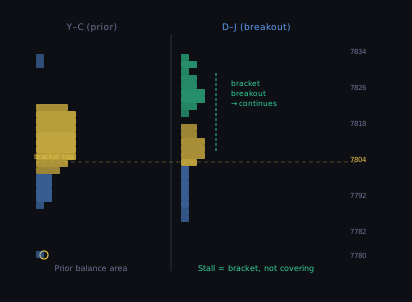
This is not to say that every time a market rallies quickly and stalls it is the result of short covering. The top of a bracket can offer sufficient resistance to slow price after a strong rally. Once price breaks through the bracket, however, the rally will generally resume with renewed force. Figure 4.36 demonstrates this exception — the Japanese Yen on March 7, 1988.
Identifying Short Covering: The S&P 500
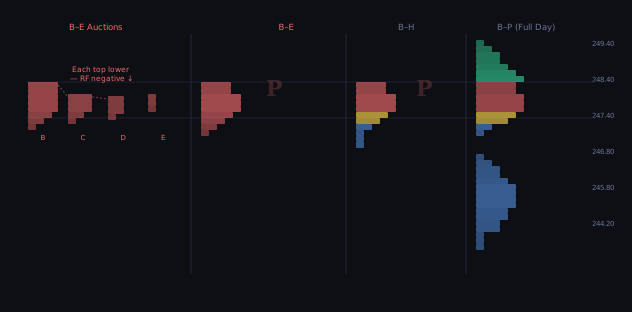
Figure 4.37 shows short covering developing in the March S&P 500 on January 20, 1988. The individual half-hour auctions for the B through E periods are separated to show the short covering rotations, followed by the B-to-H composite and the completed day. After the initial rally in B period, each subsequent half-hour auction did a worse job of facilitating trade with the buyer — nearly every successive higher auction high was lower than the previous auction high. The Rotation Factor for the top would be significantly negative, even though price was initially moving up.
Long Liquidation
The mirror image of short covering is long liquidation. Here, longs exit their positions en masse, driving price sharply lower. The structural signature is a letter b (lowercase) — a fat lower distribution with a thin upper stem. Once the liquidation is complete, price reverts upward. Figure 4.38 shows long liquidation in the March S&P 500 on February 2, 1988.
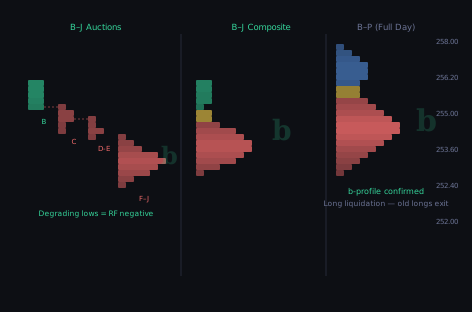
4.24 Summary — Short Covering & Long Liquidation
A Profile beginning to develop the shape of a P or a b does not by itself confirm that short covering or long liquidation is occurring. All facts are multi-contextual: the same structural feature means different things in different contexts.
Key Identification Criteria
Structure: Fat upper distribution, thin lower stem. Profile shape = P.
Rotation Factor: Each successive auction high is lower than the previous, even as price appears to be moving up. The RF for the top rotations is negative.
Time: The rally phase is fast; the market spends little time near the highs. Buyers disappear quickly.
Context: Prior trend was down (shorts are in profit). Often occurs at the open or after a fast one-timeframe sell.
Key Identification Criteria
Structure: Fat lower distribution, thin upper stem. Profile shape = b.
Rotation Factor: Each successive auction low is lower than the previous. The RF for the bottom rotations is negative, even though the market looks like it's selling off.
Time: The break phase is fast; price spends little time at the lows. Sellers disappear once liquidation is complete.
Context: Prior trend was up (longs are in profit or stressed). Often occurs after extended one-timeframe buying, when other timeframe no longer supports the move.
The ability to visualize promotes the objectivity that is so necessary for developing a holistic view of the marketplace. When involved in the minute-to-minute price movements, it is easy to fall victim to tunnel vision. The Profile's structural pictures cut through the noise — making P and b formations identifiable in real time, before they complete, giving the alert trader an edge in positioning against (or with) the self-limiting move.
4.25 The Ledge
A ledge (sometimes called a shelf) forms when two or more consecutive TPO periods record the exact same price extreme on one side of the developing Profile. The ledge creates a flat edge — a temporary form of two-timeframe activity at that level — indicating that the market has found at least short-term acceptance there.
The ledge is a reference point, not a target. Its value lies in defining a clear level of rejection: if the market is unable to sustain trade beyond the ledge, the break confirms that one side of the two-timeframe balance has been resolved. The longer the ledge (the more periods that print at the same extreme), the more significant the reference.
Ledge vs. Tail
Both ledges and tails mark extremes, but they have different implications. A tail is a single-period probe that is quickly rejected — it marks excess in one direction. A ledge involves multiple periods holding at the same extreme, suggesting equilibrium rather than excess. When the ledge eventually breaks, it represents a resolution of that equilibrium.
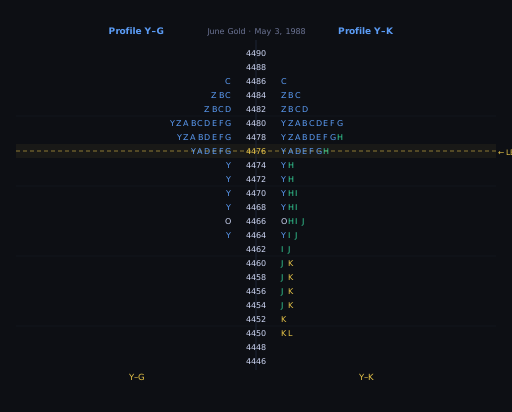
Fig 4.39 — Ledge Pattern in June Gold, May 3, 1988. Left profile (Y–G): the market prints YADEFG at 4476 across multiple periods — a shelf forms at 4476. Right profile (Y–K): H period drops below 4476 to 4472. That two-tick break off the ledge is the entry signal for shorts. The pattern illustrates how a multi-period flat extreme creates a clear, actionable reference level.
Two or more periods with identical high (or low). The flat edge is visible in the developing Profile.
Do not act on the first tick through. Wait for price to trade more than a few ticks beyond the ledge level.
Once confirmed, the break resolves the equilibrium. Trade with the breakout unless news or extraneous conditions contradict.
In Figure 4.39, shorts should have been placed at 4472 when gold dropped off the 4476 ledge in H period. The ledge (4476) acted as the day's reference for the upper extreme of the initial balance — the break below it indicated that buyers had exhausted their support of that level.
4.26 Volume: High-Volume Areas
Volume is the ultimate measure of market activity. While the Profile's TPO structure reveals where price traded and for how long, volume data tells us how much business was actually conducted at each price level. The Liquidity Data Bank (LDB) provides price-by-price volume breakdowns that allow traders to identify high- and low-volume concentrations with precision.
Reading the LDB for High Volume
The primary indicator is the %Vol column — the percentage of the day's total volume transacted at each price. Prices with asterisks (*) in the LDB mark concentrations that exceed the average distribution. Secondary measures include tick volume patterns (the horizontal bar chart of the Profile) and structural features such as multiple-period TPO prints.
High-volume zones are also identified by examining how the %Vol is distributed relative to the value area. A cluster of prices accounting for 10%+ of daily volume each typically forms a "high-volume node" — a price region where the market found genuine two-way facilitation.
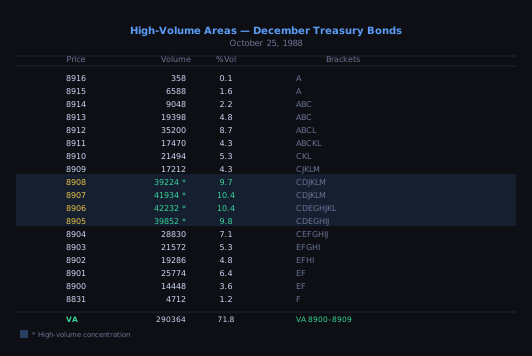
Fig 4.40 — High-Volume Areas. December Treasury Bonds, October 25, 1988. The asterisked prices (8905–8908) account for roughly 40% of the day's volume combined, each exceeding 9.5% individually. This high-volume node around 8905–8908 represents the market's area of greatest acceptance — the zone where buyers and sellers most agreed on fair value.
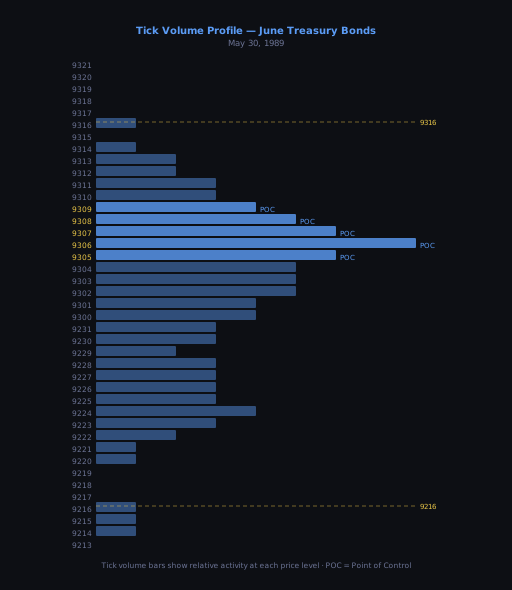
Fig 4.41 — Tick Volume Profile in June Treasury Bonds, May 30, 1989. The horizontal bars represent tick volume (the number of individual trades) at each price level. The thick concentration around 9305–9308 forms the tick-volume POC — the price level with the greatest trading activity. Reference lines at 9316 and 9216 mark the prior bracket boundaries.
Example 1: Up Auction — Probe into High-Volume Area
When a market in an up auction approaches a prior high-volume zone, the auction typically slows as it enters that zone. Traders who are short may cover (adding buying pressure), while new sellers may emerge at levels where they previously found value. The result is a "cushion" effect — price decelerates rather than continuing at its prior pace.
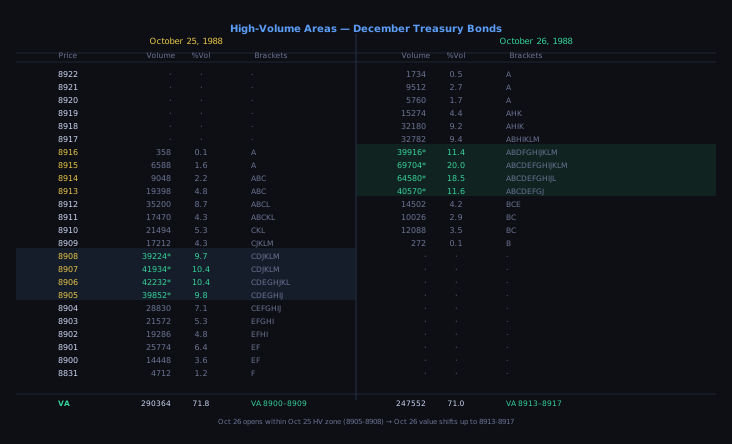
Fig 4.42 — High-Volume Areas. December Treasury Bonds, October 25 and 26, 1988. October 25's high-volume node (8905–8908, asterisked) becomes the context for October 26. The 26th opens and auctions higher — but note how the day's new value area (8913–8917) established above the prior high-volume zone. The prior HV area provided support; October 26's value built on top of it.
Example 2: Down Auction — Probe up into High-Volume Area
The same logic applies in reverse for a down auction. If price is trending lower and then probes upward into a prior high-volume zone, the zone will slow the counter-trend rally. The A, B, C period rotations within the prior high-volume area provide "time" — offering traders an opportunity to establish short positions at favorable prices before the down auction resumes.
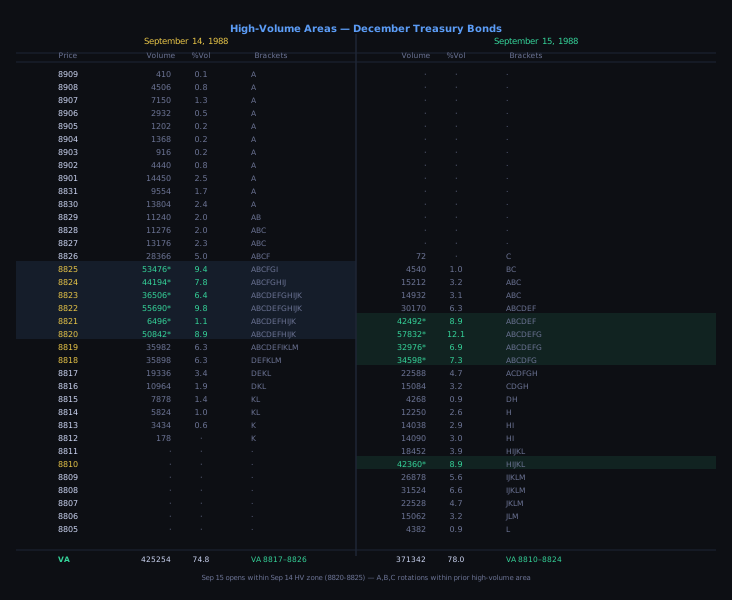
Fig 4.43 — High-Volume Areas. December Treasury Bonds, September 14 and 15, 1988. September 14 shows a Normal Variation selling day with a strong selling tail and late range extension — high-volume concentrations at 8820–8825. On September 15, the market opens within that prior high-volume zone. The early-period rotations (A, B, C) within 8820–8825 gave traders time to enter short positions. Once price broke below the HV zone, the down auction resumed.
What to Expect
Price slows and oscillates within the HV zone. Do not chase entries at the centre of the zone — wait for price to either establish above it (confirming continuation) or fail at it (confirming resistance).
Strategy: Use the HV zone as a target for profit-taking on longs, or as a reference for new short entries if the market cannot sustain value above it.
What to Expect
Counter-trend rally enters HV zone and loses momentum. The time spent rotating within the HV area is the window for short entry — high volume provides "slowing" that gives you executions.
Strategy: Place short orders within the HV zone. The inability to auction through the zone confirms seller control. Stops go beyond the far edge of the HV concentration.
4.27 Volume: Low-Volume Areas
Low-volume areas are price regions where very little trading activity occurred — the complement of high-volume zones. Rather than slowing price, low-volume areas accelerate it. When price enters a zone where few participants previously traded, there is little activity to slow the auction — price moves through these regions quickly, like traveling through a vacuum.
Identifying Low-Volume Areas
The same tools used for high-volume identification apply here, inverted. The primary measure is again the %Vol column of the LDB — low-percentage prices, often with asterisks marking below-average concentrations. Secondary indicators include:
- Tails — single or double TPO prints at extremes that were quickly rejected; the thin region of the tail is a structural low-volume area
- Single TPO prints ("singles") — price levels where only one period's bracket appears, indicating a rapid traverse with no return
- Tick volume — very thin bars in the horizontal profile at specific price levels
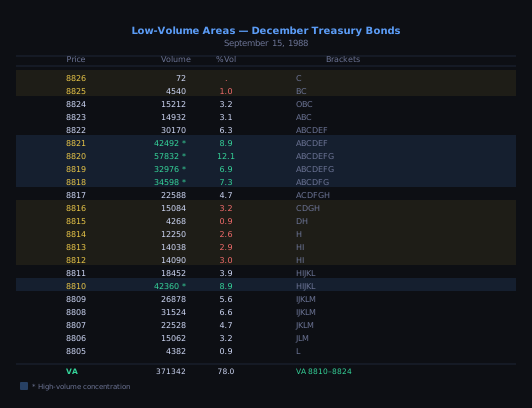
Fig 4.44 — Low-Volume Areas. December Treasury Bonds, September 15, 1988. The asterisked prices mark below-average volume concentrations. Note the structural gap between the two distributions: 8812–8816 shows thin volume (with asterisks), separating the upper distribution (8817–8826) from the lower one (8805–8811). This low-volume region between the two distributions will act as support/resistance on subsequent days.
The "Balloon" Concept
A useful mental model for low-volume areas is to think of them as a balloon: price can probe into the balloon and may be briefly rejected, but if it builds acceptance beyond the far edge of the low-volume zone, the balloon has been pierced — and the strategy based on that low-volume reference must be abandoned. Once price trades substantially through the zone and builds time there, the zone has been absorbed.
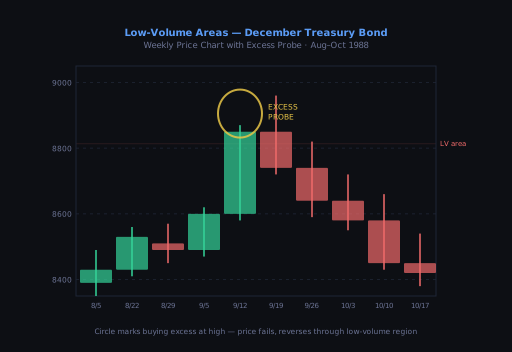
Fig 4.45 — Low-Volume Areas. December Treasury Bond — Excess Probe. The circled area marks buying excess at the high (early September). After this excess probe, responsive sellers entered and price reversed back through the low-volume region between distributions. The shaded band near 8812–8815 represents the low-volume zone that provided resistance on the way back down.
Example 1: Down Auction — Probe up into Low-Volume Area
On September 15 (Figure 4.44), the bond market's two separate distributions created a visible low-volume zone at 8812–8816 — only thin volume and asterisked prices at those levels. The upper distribution's value area was 8817–8826; the lower distribution's was 8810–8824 overall, but the structural gap was clear.
September 16 demonstrated how this zone functioned: the market opened and immediately tried to probe into the low-volume area from below. The failure to auction back through 8812–8816 offered traders an excellent opportunity to establish short positions — the low-volume area held as resistance.
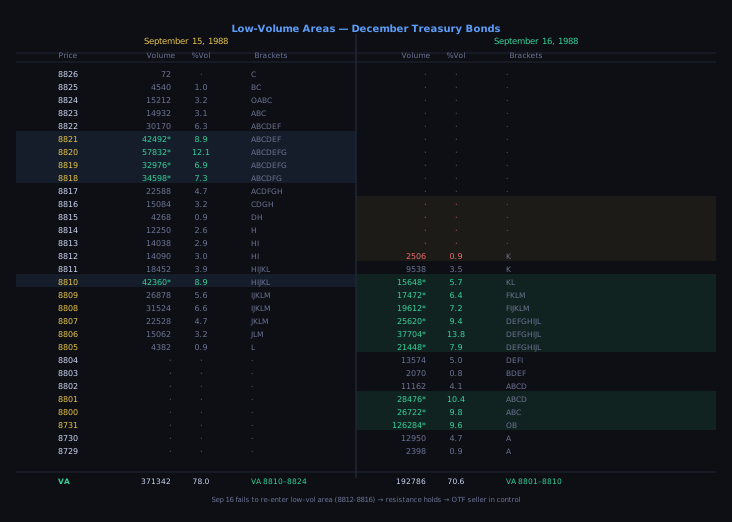
Fig 4.46 — Low-Volume Areas. December Treasury Bonds, September 15 and 16, 1988. The low-volume zone at 8812–8816 (yellow shading on Sep 15) becomes the key reference for Sep 16. The 16th opens lower and attempts a probe back into this zone — but fails. Day timeframe resistance was found just below the low-volume area and the single print from the prior day's Trend structure. Sep 16's value area (8801–8810) confirmed the OTF seller remains in control.
Example 2: High and Low Volume Used Together
September 19 integrates both concepts. The market opened at 88-09 and found early rejection just below 88-11 and 88-12 — the low-volume prices that formed the highs of September 15's lower distribution (the floor of the low-volume zone). The inability to trade back into the low-volume area from below confirmed that other timeframe sellers remained in control.
Simultaneously, the high-volume areas from September 14–15 (around 8820–8825) remained as overhead resistance — the market never came close to re-entering that zone. The combination of low-volume resistance below and high-volume resistance above trapped buyers in a deteriorating market.
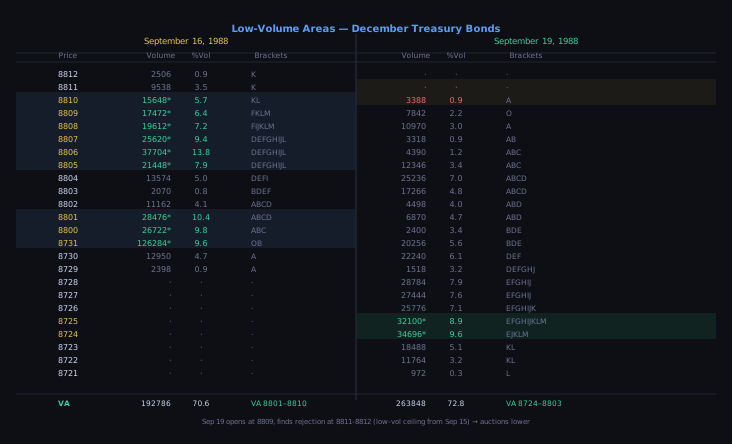
Fig 4.47 — Low-Volume Areas. December Treasury Bonds, September 16 and 19, 1988. September 19 opens at 88-09 and immediately encounters rejection at 88-11/88-12 — the bottom edge of the Sep 15 low-volume zone. Unable to re-enter the LV area, the market auctions lower all day, establishing a new value area at 8724–8803. The LV zone acted as a ceiling; the prior HV areas remain as distant overhead resistance.
Four Keys to Trading Low-Volume Areas
Track Where They Are
Low-volume zones must be recorded precisely — by price level. The LDB provides this data, but it requires discipline to maintain a running log of significant low-volume references across multiple days and timeframes.
Know Which Side to Expect Rejection
The current trend and other timeframe context determine which direction price will likely be rejected from the LV zone. Monitor actively for signs of that rejection — do not assume it; confirm it in real time.
Place Orders Ahead of Time
Because price moves quickly through low-volume regions, attempting to enter once price is already in the zone often leads to poor fills. Place limit orders at the LV zone edges ahead of time to insure execution at good trade location.
Exit Strategy if Acceptance Builds
If price trades substantially through the low-volume area and begins building acceptance beyond it (multiple periods, value forming), the "balloon" has been pierced. Abandon the low-volume strategy immediately — the zone has been absorbed.
★ Structured Study Notes
Chapter 4b — Competent Trader: TF Control & Advanced Concepts
- OTF Control — Structure (§4.15)
- Two-timeframe market: overlapping TPO columns, balanced bell-curve — neither side dominates
- One-timeframe market: sequential non-overlapping TPOs — other timeframe drives directionally
- Never fade a one-timeframe market; always follow the drive
- OTF Control — Market Time (§4.16)
- Extended time at an extreme = OTF facilitating business there (continuation)
- Brief probe + reversal = tail = rejection (excess)
- Two Big Questions: (1) which way is market trying to go? (2) is it succeeding?
- Timeframe Transitions (§4.17) — Four Types
- Type 1: Two-TF → One-TF = Trend/Normal Variation day
- Type 2: One-TF → Two-TF = Normal/Non-Trend day
- Type 3: Two-TF → One-TF → Two-TF = Double Distribution day
- Type 4: One-TF (A) → One-TF (B) = Neutral day. Entire Day composite masks intraday transitions
- Swiss Franc Oct 12, 1987: segmented profile reveals Type 4 drama invisible in the completed profile
- Auction Failure (§4.18)
- Price probes beyond known reference, fails to attract continuation, reverses sharply
- Long-term failures produce larger, more sustained reversals than day-timeframe failures
- May Soybeans April 10, 1989: auction below 708 LT ref → DD Buying Trend day
- T-Bonds May 15-16, 1989: z-period sell tail fails; May 16 confirms failure with open above value
- Signs of Excess (§4.19)
- Tails = day timeframe excess: OTF enters aggressively, price rejected from that level
- Excess vs. continuation: tail + reversal = excess; multiple periods at extreme = continuation
- Japanese Yen March 8, 1988: A-period lower tail + E-period upper tail → Normal day excess on both ends
- Rotation Factor (§4.20)
- Scores each period: higher high = +1, lower high = −1, equal = 0 (same for lows)
- Overall RF = Top Total + Bot Total. Positive = buyer attempts; negative = seller dominance
- T-Bonds: Top = +3, Bot = +3, RF = +6 = consistent buyer attempts
- RF answers Question 1 only (direction) — not Question 2 (effectiveness). Context always required
- Point of Control — POC (§4.21)
- POC = longest TPO line closest to range centre = fairest price for the day
- POC migrates intraday — track it to monitor where other timeframe value is forming
- Rising POC = consistent OTF buying; falling POC = consistent OTF selling
- T-Bonds example: POC migrates 99-00 → 99-03 → 99-05 as buyers press value higher all day
- After range extension: recalculate POC using new total range ÷ 2 to find geometric centre
- The Close (§4.22)
- Close above VA high = bullish (OTF buyer active into close)
- Close within VA = neutral (neither side pressing)
- Close below VA low = bearish (OTF seller active into close)
- Always evaluate close within the day's full structure context — not in isolation
- Short Covering — P-Profile (§4.23)
- Shape: fat upper distribution, thin lower stem = letter P
- Driven by old shorts covering, not new buyers — self-limiting rally
- RF signature: each successive auction high is lower than previous (negative top RF) despite apparent rally
- Examples: COMEX Gold Feb 24, T-Bonds Feb 19, Yen Feb 18, 1988
- Exception: bracket resistance can also produce stall that looks like short covering; breaks out after clearing bracket (Yen March 7, 1988)
- Long Liquidation — b-Profile (§4.23)
- Shape: fat lower distribution, thin upper stem = letter b
- Driven by old longs exiting, not new sellers — self-limiting break
- RF signature: each successive auction low is lower than previous (negative bottom RF) despite apparent sell
- S&P 500 Feb 2, 1988: B-J composite shows b-shape; full day confirms long liquidation pattern
- P vs b — Key Distinction (§4.24)
- Both are self-limiting. Rotation Factor is the key real-time identifier
- Short covering/long liquidation: each rotation does a worse job extending price in the move direction
- Genuine OTF activity: each rotation does an equal or better job — value migrates in the direction of the move
- Visualizing structure = objectivity. Prevents tunnel vision in fast-moving markets
- The Ledge (§4.25)
- Ledge = 2+ consecutive periods printing at the same price extreme → flat edge in the developing Profile
- Trading rule: wait for price to move more than a few ticks off the ledge, then trade in the breakout direction
- Ledge ≠ tail: tail = single-period excess/rejection; ledge = multi-period equilibrium that eventually resolves
- June Gold May 3, 1988: ledge at 4476 (YADEFG across multiple periods); H period drops to 4472 → short entry confirmed
- High-Volume Areas (§4.26)
- High-volume zones = price regions with concentrated past business; attract and slow future price movement
- Primary identification: %Vol column in LDB; asterisked (*) prices mark above-average concentrations
- Secondary: tick volume horizontal bars, multi-period TPO prints
- Up auction probe into HV: price decelerates; use zone edges for profit-taking (longs) or new short entries
- Down auction probe into HV: counter-trend rally loses momentum; rotations within zone = entry window for shorts
- T-Bonds Oct 25-26, 1988: Oct 26 opens within Oct 25 HV zone (8905-8908), builds new value above → continuation confirmed
- T-Bonds Sep 14-15, 1988: Sep 15 A/B/C rotations within Sep 14 HV zone (8820-8825) = short entry window before resumed sell
- Low-Volume Areas (§4.27)
- Low-volume zones = price vacuum; price moves rapidly through them; edges act as support/resistance
- Identification: low %Vol in LDB (asterisked), tails, single TPO prints, thin tick volume bars
- "Balloon" model: probe into LV → likely rejection; if price builds acceptance beyond LV zone, balloon pierced → abandon strategy
- Four keys: (1) keep accurate notes; (2) know expected rejection direction; (3) place orders ahead of time; (4) abandon if price builds acceptance beyond zone
- T-Bonds Sep 15: LV zone at 8812-8816 between two distributions; Sep 16 fails to re-enter → resistance holds → short entry
- Sep 19: opens at 8809, rejected at 8811-8812 (LV zone floor) → auctions lower all day to VA 8724-8803
- Context: structural buying preference does not override OTF seller control — day-TF vs. other-TF distinction critical
4.28 Range Extension
Range extension occurs when the market auctions beyond the initial balance range established in the first hour of trading. When other timeframe participants enter after the opening rotations and push price outside the A-B period range, the day is extending its range — and this extension signals that one side of the market has gained directional control.
In the multi-day context, range extension is equally significant: when each successive day's range extends beyond the prior day's extreme in the same direction, it signals a developing one-timeframe market — other timeframe activity is driving a sustained directional auction. The Swiss Franc example (Figure 4.48) illustrates this over five trading days.
Day-Timeframe Range Extension
Within a single day's profile, range extension typically occurs after the initial balance (A and B periods) is established. Extensions carry specific implications:
OTF Buyer Taking Control
Price auctions above the A-B period high. Other timeframe buyers are entering and driving price higher. The extension validates the up-auction. The further price extends, and the more time it spends at new highs, the stronger the OTF buying signal.
Day type: Likely Trend day (if extension is large) or Normal Variation day (if extension is moderate).
OTF Seller Taking Control
Price auctions below the A-B period low. Other timeframe sellers are entering and driving price lower. The extension validates the down-auction. Watch for the extension to hold — if price quickly returns into the initial balance, the extension may be a probe rather than a true range extension.
Day type: Likely Trend day (large) or Normal Variation (moderate).
Multi-Day Range Extension — Swiss Franc Case Study
Figure 4.48 shows the Swiss Franc from October 22 to October 28, 1987. Over five consecutive trading sessions, the market demonstrated a classic pattern of multi-day range extension in an up auction:
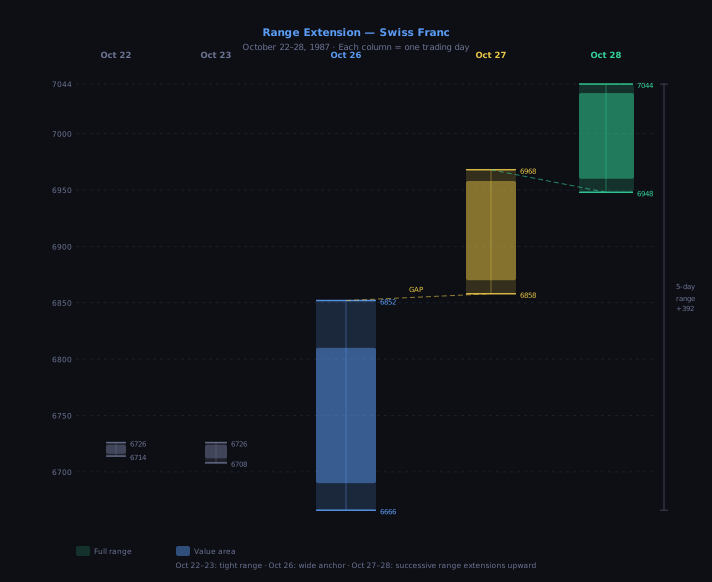
Fig 4.48 — Range Extension Occurring in the Swiss Franc, October 22–28, 1987. October 22 and 23 show tight, overlapping ranges — two-timeframe market, balanced. October 26 produces a wide anchor day. October 27 extends the range significantly upward (gap from Oct 26 high). October 28 extends further still. Each successive day's high exceeds the prior day's high — a classic multi-day one-timeframe up auction.
Two-Timeframe Balance
Tight, overlapping ranges. Neither side dominating. Market is in balance — waiting for directional information.
Anchor Day
Wide range establishes the value context. OTF activity beginning to show. Range well above Oct 22–23, establishing new higher reference.
Extension Confirmed
Successive range extensions upward. Oct 27 gaps above Oct 26. Oct 28 extends further. One-timeframe market: OTF buyer in control.
The practical implication: once multi-day range extension is confirmed (two or more consecutive days each extending beyond the prior day's extreme), the trader's bias should align with the extension. Fading a confirmed multi-day one-timeframe market is among the most dangerous mistakes a day trader can make.
4.29 Long-Term Excess
Earlier, short-term excess was defined as the aggressive entry of the other timeframe participant as price moves away from value, creating a tail in the day timeframe. A tail — a single or double TPO print at a price extreme — signals that the other timeframe has rejected that level, providing a day-timeframe reference for future trade.
The concept extends beyond the single day. Long-term excess is caused by the same forces that create day timeframe excess, but on a larger scale. When a price level is perceived to be too low (or too high) in the longer term, the other timeframe participant enters aggressively, forcing price to quickly auction in the opposite direction. The result is a structural feature visible on the daily or weekly bar chart that marks a long-term turning point.
Short-Term Excess as Pivot Point
Consider gold on May 2, 1989 (Figure 4.49). The six-tick buying tail in I period was generated by strong responsive buyers who quickly took advantage of a selling price probe (range extension) below value. This day timeframe excess provided a reliable reference: the low established by the I-period tail supported the market during subsequent trading sessions — it became a pivot point for future price activity.
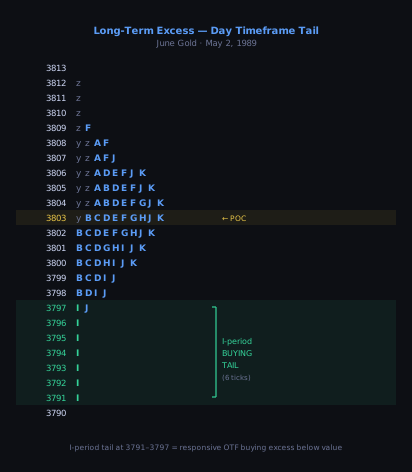
Fig 4.49 — Long-Term Excess: Day Timeframe Tail Occurring in June Gold, May 2, 1989. The I-period buying tail extends from 3797 down to 3791 — a six-tick probe below the day's distribution that was immediately rejected. The tail marks the level where other timeframe buyers entered aggressively, establishing a long-term support reference. The strong buying tail supported the market during subsequent trading sessions.
4.29b Three Types of Long-Term Excess
Prices deemed below long-term value generally form one of three structural types of long-term excess. Each type is identifiable on the daily bar chart and provides a long-term reference point for future price activity:
Isolation
A single day (or cluster) that is completely isolated from surrounding price activity — gaps on both sides. Visible as a "floating island" on the bar chart. Represents extreme other timeframe conviction that price is outside long-term value.
On chart: Square box annotation in the figures.
Extended Probe
A day (or several days) that probes to an extreme and closes near the opposite end of its range — visually creating a long tail on the bar chart. Unlike day-timeframe tails, the long-term tail may take a day or more to form and confirm.
On chart: Open circle annotation.
Price Vacuum
Price gaps away from a level — leaving an area of no trading. The gap itself is a low-volume area (no transactions occurred there). Gaps attract price back toward them as future reference points, and when price fails to fill the gap, the original directional move is confirmed.
On chart: Filled circle (●) annotation.
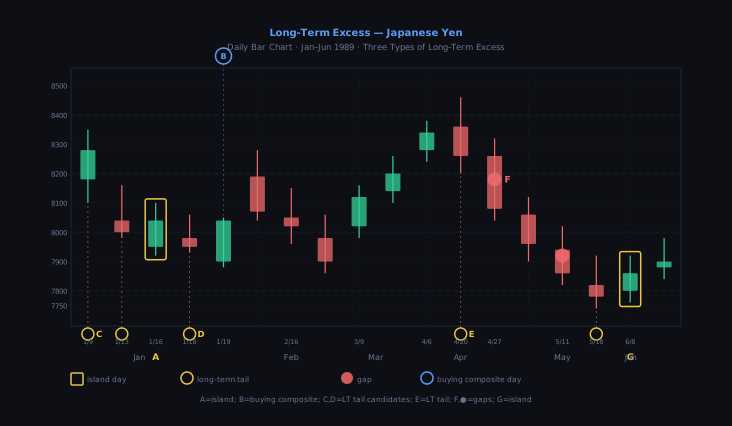
Fig 4.50 — Long-Term Excess in the Japanese Yen, January–June 1989. The daily bar chart shows all three types of long-term excess: A = island day (square) near the January high; B = buying composite day (open circle) at the January low — the market gapped lower and closed on its high; C, D = long-term tail candidates (open circles) — both days recorded new lows but closed near their lows (seller present). Point E = long-term tail at the secondary high; F and filled circles = gaps (price vacuums). G = island day at the subsequent low.
Identifying Long-Term Tails in Real Time
Because a long-term tail cannot be positively confirmed until the following day, the market provides early clues in real time. The key signals to monitor:
- Close relative to range extreme: A long-term tail requires that the day close near the opposite end from where it probed. A day that probes to a new low but closes near the low does NOT confirm a buying tail — it suggests continued seller presence (as with points C and D in Figure 4.50, where the yen made new lows and closed near those lows, indicating continual seller presence).
- Close on the opposite extreme: When the market probes to a new extreme but closes near the far end — the I period in gold probed to 3791, but the session closed near 3808 — this signals that the other timeframe has strongly rejected that level.
- Next day's open: Confirmation comes when the next day opens back within the prior day's range (away from the probed extreme). An open well inside the range or at the opposite extreme is strong confirmation of a long-term tail forming.
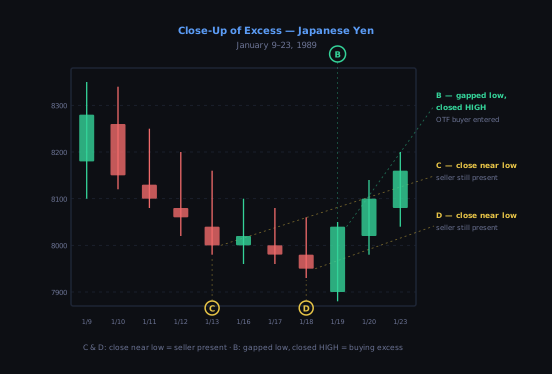
Fig 4.51 — Close-Up of Excess in the Japanese Yen, January 9–23, 1989. Points C (Jan 13) and D (Jan 18) both record new lows — but close near the lows, indicating continuing seller presence rather than buying excess. Point B (Jan 19) is the critical day: the yen gapped lower on the open, but closed on the upper extreme of the session. The market had overextended itself to the downside; the responsive other timeframe buyer entered aggressively and quickly auctioned price higher, establishing potential intermediate to long-term excess at the low.
The Segmented Profile as Real-Time Tool
The segmented profile — displaying each half-hour period as a separate column — is the analytical tool that makes long-term excess visible in real time, before the day ends. Rather than waiting to see the completed bar chart pattern, the segmented profile reveals the period-by-period structure of the developing tail.
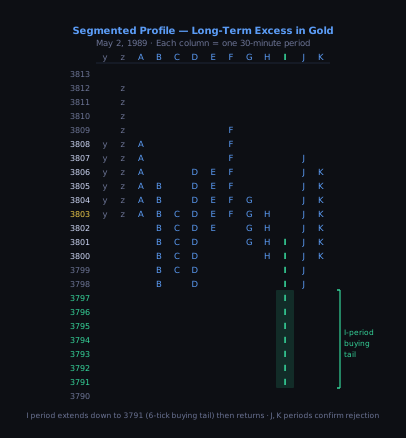
Fig 4.52 — Segmented Profile of Excess in Gold, May 2, 1989. Each column represents one 30-minute period. The I period is the key: it extends down to 3791 — six ticks below the session's other lows — then immediately returns. Periods J and K confirm the rejection; the distribution holds firmly above 3798. The segmented profile reveals the tail structure in real time, allowing the trader to identify the potential long-term excess reference before the session closes.
4.30 Composite Days
A composite day is defined by the relationship between the opening price and the day's closing location. The underlying logic is direct: if a market spends most of the day auctioning above the open, then the market is attempting to go higher — it is a buying composite. If the market spends most of the day auctioning below the open, then it is attempting to go lower — it is a selling composite. When the market opens near the middle of the day's range, neither side dominates — it is a non-composite day.

Fig 4.53 — Composite Days. The profile is divided into three zones by two horizontal lines. Top quarter: when the open falls here, the market opens high and auctions down most of the day — a Selling Composite (down arrow). Bottom quarter: when the open falls here, the market opens low and auctions up most of the day — a Buying Composite (up arrow). Middle half: Non-composite day. The composite type is determined by the open's location in the day's eventual range.
Reading Composite Structure
Open in Bottom Quarter
The market opens in the lower 25% of the day's range. The majority of trading occurs above the open. The day closes near the top.
Implication: Market is attempting to go higher. Consistent with OTF buying interest. Supports long positions or bullish context for next session.
Japanese Yen Example: Point B in Figure 4.50 — the yen gapped to the low of the day, then auctioned above the open for the remainder of the session, closing at the high.
Open in Top Quarter
The market opens in the upper 25% of the day's range. The majority of trading occurs below the open. The day closes near the bottom.
Implication: Market is attempting to go lower. Consistent with OTF selling interest. Supports short positions or bearish context for next session.
Context Requirement: A selling composite in an established up-trend may be a counter-trend day (one-day correction) rather than a trend reversal signal.
Composite Analysis — Important Limitations
Composite analysis identifies the direction the market is attempting to auction — it does not measure the effectiveness of that attempt. This is the same distinction as with the Rotation Factor: composite analysis answers Question 1 (which way is the market trying to go?) but not Question 2 (is it succeeding?).
Remember the illusion that can arise from a market that gaps higher and auctions down all day, but develops higher value than the prior session. Such a day would appear as a selling composite — yet value migrated upward, signaling OTF buyer activity despite the surface appearance of seller dominance. Like all other directional measures, composite analysis must be evaluated in conjunction with:
- Value area relationships — where did value form relative to the prior session?
- Trade facilitation — was the market able to generate substantial volume in the direction of the composite?
- Closing location — does the close confirm the composite direction?
- Context — is the composite type consistent with the current other timeframe trend?
★ Structured Study Notes
Chapter 4c — Range Extension, Long-Term Excess & Composite Days
- Range Extension (§4.28)
- Day timeframe: extension occurs when price auctions beyond A-B period initial balance range
- Direction of extension = which OTF side is facilitating: up = OTF buyer, down = OTF seller
- Multi-day extension: successive days each extend beyond prior day's extreme = confirmed one-TF market
- Swiss Franc Oct 22–28, 1987: Oct 22–23 tight balanced range → Oct 26 anchor day → Oct 27–28 successive extensions upward
- Never fade a confirmed multi-day one-timeframe extension; require closes near extremes + next day's open within/beyond prior extreme
- Extension vs. probe: single-day extension may reverse; multi-day with closes near extremes = genuine OTF conviction
- Long-Term Excess (§4.29)
- Same forces as day-TF excess (tails) but on longer timeframe; marks pivotal turning points
- Day-TF tail often acts as long-term pivot: Gold May 2, 1989 — I-period buying tail at 3791-3797 supported market in subsequent sessions
- Three types: (1) island day = isolated by gaps on both sides; (2) long-term tail = probes extreme, closes at opposite end; (3) gap = price vacuum, low-volume area between sessions
- Long-term tail NOT confirmed by day that probes new extreme and closes near that extreme (seller/buyer still present)
- Confirmation: probe to extreme + close at opposite end + next day opens away from extreme
- Japanese Yen: C (Jan 13) + D (Jan 18) = probed lows, closed near lows = seller still present; B (Jan 19) = gapped low, closed HIGH = buying excess confirmed
- Segmented Profile (§4.29b)
- Each 30-min period shown as separate column — reveals excess structure in real time
- Gold May 2: I-period column extends to 3791 alone; J and K return to distribution → tail visible before session ends
- Monitor next period after extreme probe: if it does not follow through, tail forming; tail confirmed when subsequent periods hold away from probed extreme
- Composite Days (§4.30)
- Buying composite: open in bottom quarter, majority of day auctioning above open → market attempting higher
- Selling composite: open in top quarter, majority of day auctioning below open → market attempting lower
- Non-composite: open in middle half, no clear directional bias from composite alone
- Composite answers Q1 (direction) only — NOT Q2 (effectiveness); must combine with value migration, volume, RF
- Illusion risk: market can gap up + auction down all day yet develop higher value = selling composite appearance, but OTF buyer active
- Japanese Yen point B = buying composite: open at low of day → spent all session above open → closed at high
4.31 Value-Area Relationships
Value-area placement from one day to the next provides critical context for reading directional conviction. Six distinct relationship types describe how today's value area sits relative to yesterday's:
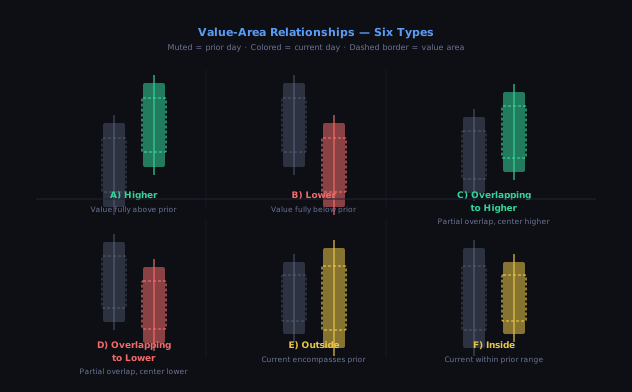
Fig 4.54 — Value-Area Relationships. A) Higher — today's value fully above yesterday's. B) Lower — today's value fully below yesterday's. C) Overlapping to Higher — overlap, but higher placement. D) Overlapping to Lower — overlap, but lower placement. E) Outside — today's range completely encompasses yesterday's. F) Inside — today's range entirely within yesterday's.
Full Migration Up
Today's entire value area sits above yesterday's. Strongest bullish signal — the other timeframe buyer has pushed value fully above prior reference. Confirms up-auction success.
Full Migration Down
Today's entire value area sits below yesterday's. Strongest bearish signal — the other timeframe seller has moved value fully below prior reference. Confirms down-auction success.
Gradual Migration Up
Partial overlap, but the center of gravity has migrated upward. Moderate bullish signal — buying is making progress but hasn't fully displaced yesterday's value.
Gradual Migration Down
Partial overlap, center of gravity migrated downward. Moderate bearish signal — selling making progress but not yet a full break.
Range Expansion
Today's range encompasses all of yesterday's. Value area may sit higher, lower, or centered. Directional signal depends on where value formed within the expanded range.
Range Contraction
Today's entire range falls within yesterday's. Market is accepting the prior session's reference — neither side successfully auctioning beyond prior range. Balanced, low-conviction context.
4.32 Evaluating Directional Performance through Combined Volume and Value-Area Placement
Arriving at a final evaluation of directional performance is like baking a cake — layer by layer. First, define attempted direction. Second, evaluate trade facilitation according to volume. Third, determine the relative success of that facilitation according to its impact on value-area placement.
- Attempted Direction — which way is the market trying to go? (Determined by composite structure, range extension, Rotation Factor)
- Volume — is the market generating above- or below-average volume in that direction? (Above average = trade facilitated; below average = trade discouraged)
- Value-Area Placement — did value migrate in the attempted direction? (Higher value in up-auction = success; lower value in up-auction despite buying = failure)
The Four Core Combinations
The interaction of volume and value placement against attempted direction produces four primary readings:
Strong Directional Performance (Buyer)
Attempted direction is up, volume is above average, and value migrated higher. Market is successfully facilitating trade at higher prices. Other timeframe buyer in full control.
Example: T-Bonds Sep 12, 1988 — gapped above prior day, initiative buying tail, buying composite, positive RF. Volume jumped to 189K while value moved substantially higher.
Poor Directional Performance (Buyer)
Attempted direction is up, but volume is below average — higher prices are cutting off activity. Even if value migrated slightly higher, the underlying buying auctions are discouraging trade. If value also goes lower, OTF seller still controls.
Key Insight: Lower volume on an up auction attempt is the clearest warning sign that the move lacks conviction and a reversal is likely.
Strong Directional Performance (Seller)
Attempted direction down, above-average volume, lower value. Seller is successfully facilitating trade at lower prices. OTF seller fully in control.
Example: Gold Sep 20, 1988 — attempted direction down, volume rose from 35K to 51K, value moved substantially lower. Seller's directional performance clearly strong.
Moderately Weak (Balancing)
Attempted direction down with basically unchanged or lower volume and value only overlapping to lower. Market is continuing in the attempted direction but slowing — coming into balance or in gradual transition. Monitor carefully for directional conviction signals.
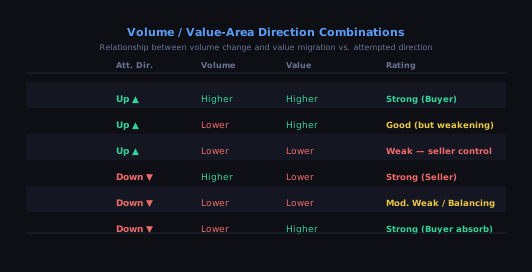
Fig 4.56 — Volume/Value-Area Relationships. Panel A: value migrated higher (higher bar) with above-average volume → Attempted Direction confirmed, Good for Buyer. Panel B: value migrated higher but with below-average volume → higher prices are cutting off activity, Poor for Buyer despite apparent up move.
Case Studies — Six Directional Performance Scenarios
Table 4.1 in the book catalogs 30 different volume/value/direction combinations. The following six cases from the figures illustrate the range of directional performance readings:
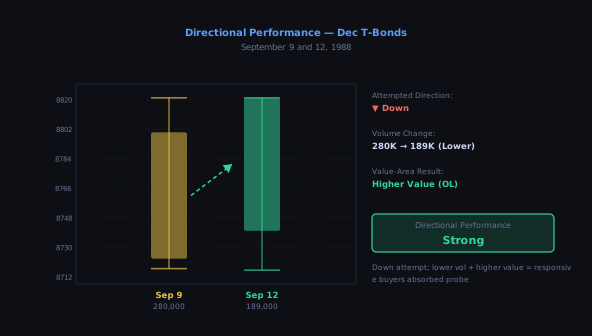
Fig 4.55 — Dec T-Bonds, Sep 9 and 12, 1988. Att. Direction: Down. Sep 9 volume: 280,000; Sep 12 volume: 189,000 (lower). Yet value on Sep 12 was substantially higher — the down auction actually built higher value. Result: Strong directional performance despite apparently paradoxical data. Lower volume on a down attempt that yields higher value = responsive buyers absorbing the probe effectively.
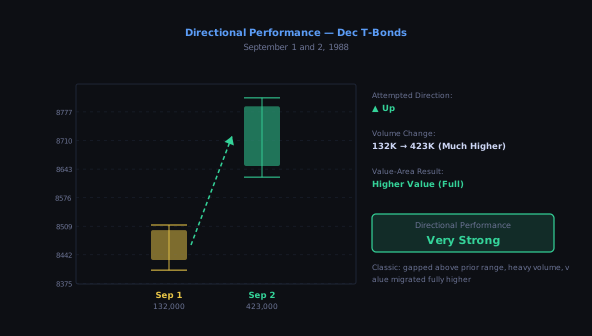
Fig 4.57 — Dec T-Bonds, Sep 1 and 2, 1988. Att. Direction: Up. Sep 1 volume: 132,000; Sep 2: 423,000 (much higher). Value migrated substantially higher. Result: Strong directional performance — the classic case. Higher volume + higher value on an up attempt = OTF buyer fully in command. T-Bonds gapped above the prior day's range and drove sharply higher all session.
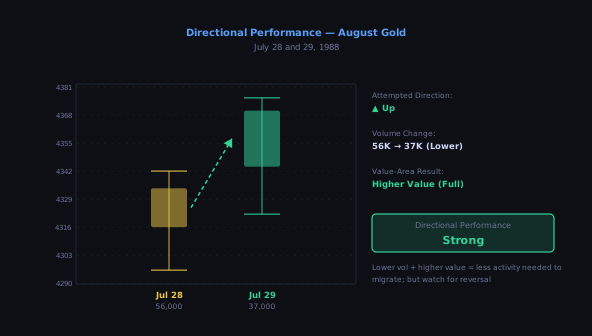
Fig 4.58 — August Gold, Jul 28 and 29, 1988. Att. Direction: Up. Jul 28 volume: 56,000; Jul 29: 37,000 (lower). Value moved higher. Result: Strong directional performance. Note: lower volume on an up attempt that does build higher value is still strong — lower volume here means the market did not need heavy participation to migrate value. The subsequent bar chart shows the market reversed — underlying conditions were weakening despite the volume/value reading.
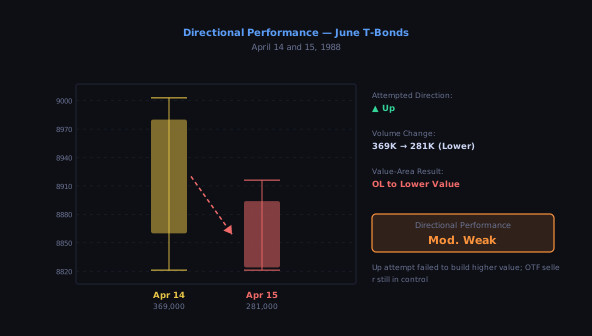
Fig 4.59 — June T-Bonds, Apr 14 and 15, 1988. Att. Direction: Up. Apr 14 volume: 369,000; Apr 15: 281,000 (lower). Value moved only overlapping to lower. Result: Moderately Weak — the upward attempt failed to build higher value. After a lower opening, bonds spent most of Apr 15 attempting higher. But buying auctions discouraged trade and could not return value to prior levels. OTF seller still in control.
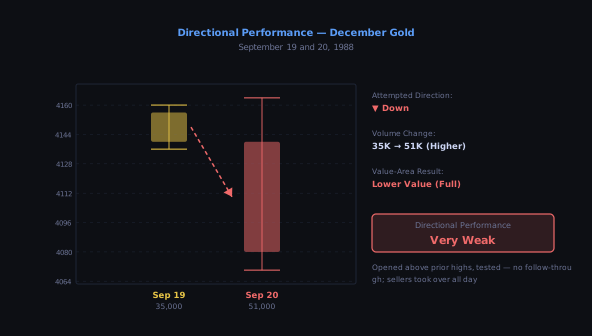
Fig 4.60 — Dec Gold, Sep 19 and 20, 1988. Att. Direction: Down. Sep 19 volume: 35,000; Sep 20: 51,000 (higher). Value moved substantially lower. Result: Very Weak (seller dominant). On Sep 20 gold opened and tested above prior highs — when no continuation developed, OTF sellers entered and auctioned price lower all day, building lower value on higher volume.
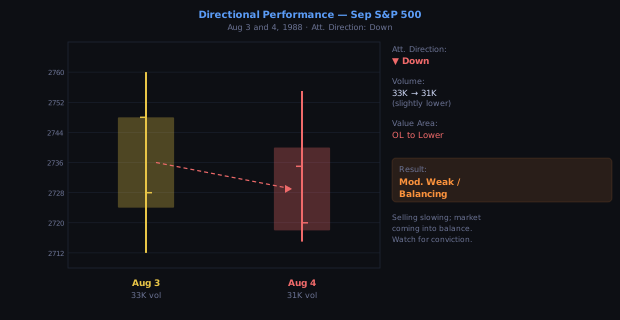
Fig 4.61 — Sep S&P 500, Aug 3 and 4, 1988. Att. Direction: Down. Aug 3 volume: 33,000; Aug 4: 31,000 (lower, basically unchanged). Value moved only overlapping to lower. Result: Moderately Weak, Balancing — the selling attempt managed only gradual lower movement with no volume conviction. Market slowing and coming into balance; subsequent sessions should be monitored carefully for directional commitment.
4.33 Value-Area Width
One practical limitation of volume analysis is that exact volume figures are typically not available until after the trading session ends. The value-area width provides a real-time proxy for volume during the day as it develops.
Market Balanced / Low Activity
A very narrow value area — just 2–4 ticks wide — signals low participation. The market has failed to generate significant trade facilitation in either direction. Often precedes a major move when participants have been holding back (e.g., awaiting an economic release).
T-Bonds Apr 17, 1989: Value area only 2 ticks wide (8825–8826). Volume at 120,250 — labelled "LOW VOLUME." Traders had balanced positions ahead of the Producer Price Index release the following day.
Active Facilitation
A wide value area signals heavy participation — the market is facilitating trade across a broad price range, and volume is above average. On Apr 27 (the next day after the PPI release), the value area widened dramatically as volume surged. High-volume days with wide VAs confirm directional conviction and active OTF participation.
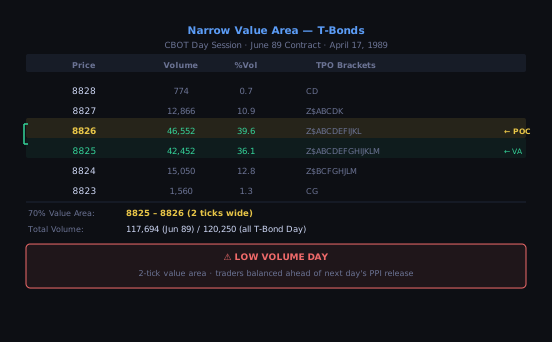
Fig 4.62 — Narrow Value Area. T-Bonds (CBOT) Day, June 89, April 17, 1989. The LDB shows the entire day's volume concentrated in just 5 price levels (8824–8828), with the value area spanning only 8825–8826 — two ticks. Total volume: 120,250 contracts (LOW VOLUME). The lack of facilitation reflected traders balancing positions ahead of the next day's Producer Price Index announcement.
Using Width in Real Time
As a practical monitor, track the developing profile's width against recent averages:
- Width narrowing vs. prior session: Volume likely declining; directional attempt losing facilitation. Treat current directional read with less confidence.
- Width expanding in direction of attempted move: Volume likely increasing; directional performance improving. Increases confidence in the directional bias.
- Extremely narrow width (2–4 ticks): Market in strong balance — participants withholding participation. Likely catalyst (news, data release) expected. Avoid initiating new positions; wait for the move to begin and confirm.
- Width explosion after narrow session: Volume surge incoming — the catalyst has arrived. Monitor the direction of the initial move and the resulting composite structure for directional bias.
★ Structured Study Notes — Added §4.31–4.33
- Value-Area Relationships (§4.31)
- Six types: A) Higher (fully above), B) Lower (fully below), C) OL Higher, D) OL Lower, E) Outside (encompasses prior), F) Inside (within prior)
- A and B = strongest directional signals (full value migration); C and D = moderate; E/F = neutral/need context
- Inside day = neither side auctioning beyond prior range = balanced, low-conviction context
- Directional Performance Framework (§4.32)
- Three layers: (1) Attempted Direction → (2) Volume → (3) Value-Area Placement
- Up + Above-avg Vol + Higher Value = Strong for Buyer (Sep 1/2 T-Bonds)
- Up + Below-avg Vol + Higher Value = Good but weakening (Gold Jul 28/29 — subsequent reversal)
- Up + Lower Vol + OL Lower Value = Moderately Weak (Apr 14/15 T-Bonds — OTF seller still in control)
- Down + Higher Vol + Lower Value = Strong for Seller (Gold Sep 19/20)
- Down + Lower Vol + OL Lower Value = Mod Weak, Balancing (S&P Aug 3/4)
- Down + Lower Vol + Higher Value = paradoxically Strong (T-Bonds Sep 9/12 — responsive buyers absorbed the probe)
- Key: volume comparisons are relative to the PREVIOUS day, not a pre-defined average
- Value-Area Width (§4.33)
- Width = real-time proxy for volume (no need to wait for end-of-day volume figures)
- Narrow VA (2–4 ticks) → low volume → balanced market, participants holding back
- Wide VA → higher volume → active facilitation, directional conviction present
- T-Bonds Apr 17, 1989: 2-tick VA, 120K volume (LOW) → traders balanced ahead of PPI release
- Use: if VA narrowing during day = volume declining = treat directional read with less confidence; if widening in attempted direction = volume rising = increasing confidence
4.33b Wide Value Area & Table 4.2
The contrast with April 17's two-tick value area is stark. On April 27, the PPI was released and the market moved decisively — the value area widened to a healthy 16 ticks with volume just under 600,000 contracts.
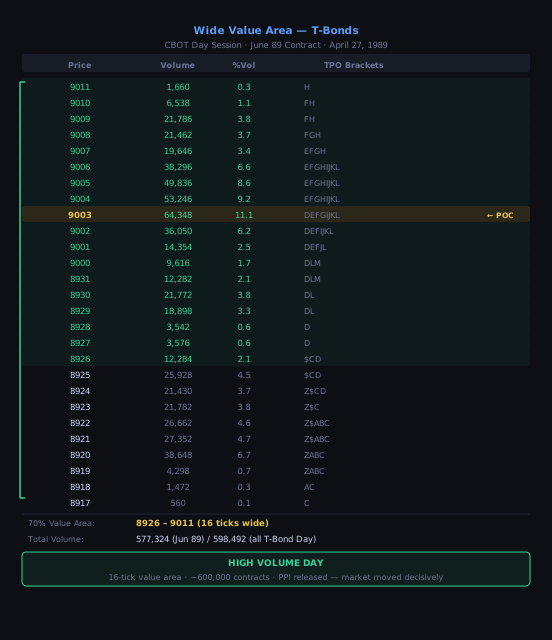
Fig 4.63 — Wide Value Area. T-Bonds (CBOT) Day, June 89, April 27, 1989. VA spans 8917–9011 (16 ticks). Volume: 577,324 (Jun 89) / 598,492 (all T-Bond Day). POC at 9003 with 64,348 contracts (11.1%). The wide, well-distributed profile confirms high participation and active OTF facilitation following the PPI release.
Figure 4.64 charts the empirical relationship between value-area width and average volume across T-Bond sessions from December 14, 1988 to June 22, 1989. The relationship is strongly positive and roughly exponential at the wide end.
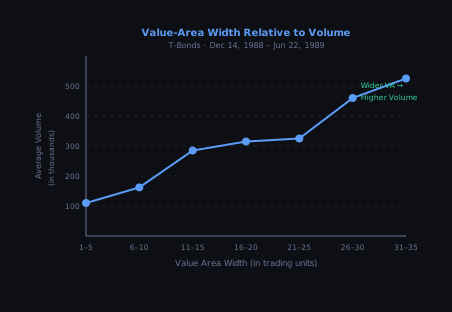
Fig 4.64 — Value Area Width Relative to Volume. T-Bonds, Dec 14, 1988 – Jun 22, 1989. Sessions with VA widths of 1–5 units averaged ~110K contracts; 11–15 units ~285K; 31–35 units ~525K. The wider the value area, the greater the range of prices at which trade is being conducted — Table 4.2 (in book) provides the full width-to-volume lookup for T-Bonds.
Because the width-to-volume relationship varies by instrument, each market has its own lookup table (Table 4.2 in the book covers T-Bonds). Build your own long-term activity record (LTAR) to establish a personal baseline for whichever instrument you trade. The LTAR is introduced in §4.34 below.
4.34 The Long-Term Activity Record (LTAR)
The Long-Term Activity Record (LTAR) is a structured daily log that forces you to synthesise all directional evidence and directional performance information into a single, disciplined read at the close of each session — and then to commit to an expected result for the next day.
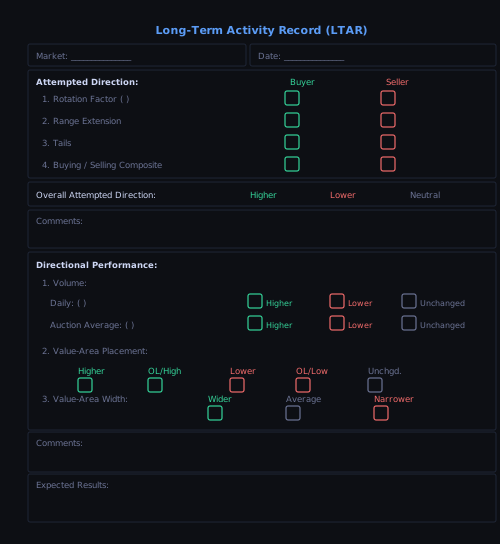
Fig 4.65 — Long-Term Activity Record (LTAR). The blank form. Completed daily, one record per session.
LTAR Structure — Two Halves
What was the market trying to do?
Score each of the four direction signals as Buyer or Seller:
- Rotation Factor — record the value (e.g. –11, +2). Negative = seller, positive = buyer.
- Range Extension — up (buyer) or down (seller)?
- Tails — buying tail = buyer; selling tail = seller. Last period tails don't count.
- Buying / Selling Composite — open in bottom quarter + close near high = buyer, etc.
→ Circle Overall Attempted Direction: Higher / Lower / Neutral.
How well did the market execute that attempt?
- Volume (Daily) — today's volume vs. yesterday's. Circle Higher / Lower / Unchanged.
- Volume (Auction Average) — vs. your personalised long-term baseline.
- Value-Area Placement — Higher / OL/High / Lower / OL/Low / Unchanged.
- Value-Area Width — Wider / Average / Narrower (proxy for volume in real time).
→ Write Expected Results: what are the likely scenarios for tomorrow?
4.35 LTAR Case Study — July Soybeans, May 16–20, 1989
Five consecutive days in July Soybeans illustrate how the LTAR builds a running narrative: a strong selling day, a balancing day, a failed up probe, continued buyer weakness, and then seller resumption. Together they show how each completed LTAR shapes the next day's expectations.
May 16 — Strong Selling Trend Day
Previous day's value area was 734.50–742.50. May 16 opened above that range and sold off sharply all day, closing near the lows at 708.50–733.50. A classic selling trend day: all four LTAR direction signals point to the seller.
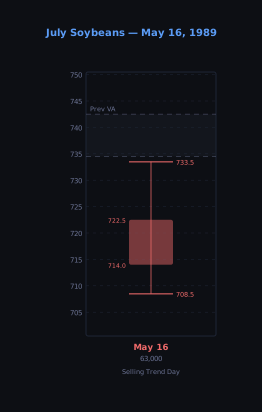
Fig 4.66 — July Soybeans, May 16, 1989. Selling trend day. Range 708.50–733.50; VA 714.00–722.50; volume 63,000. Note gap below previous day's VA (734.50–742.50).
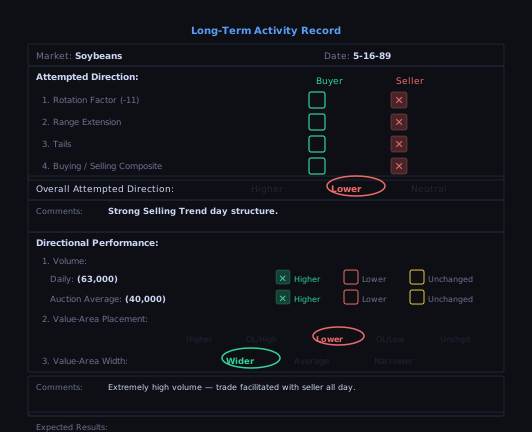
Fig 4.67 — LTAR for May 16. RF = –11 (seller), Range Ext = seller (trend day), Tails = seller, Composite = seller. Overall: Lower. Volume 63K vs avg 40K = Higher + Wider VA. Expected: market may balance; should develop lower value tomorrow.
May 17 — Balancing Day (Expected)
As predicted by the May 16 LTAR, May 17 balanced. It opened within May 16's range and never extended convincingly. The composite was selling (seller still present) but the RF was +2 (buyer showed some rotation). Mixed signals → Neutral overall attempted direction.
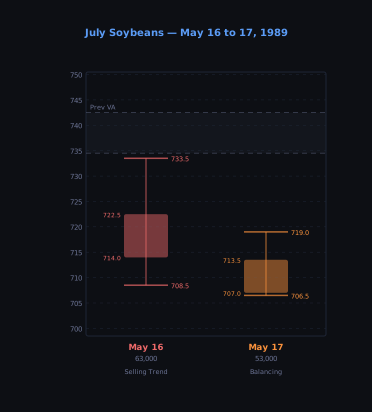
Fig 4.68 — July Soybeans, May 16–17. May 17 range 706.50–719.00 entirely within May 16's range — inside day. VA moved OL/Lower: 707.00–713.50.
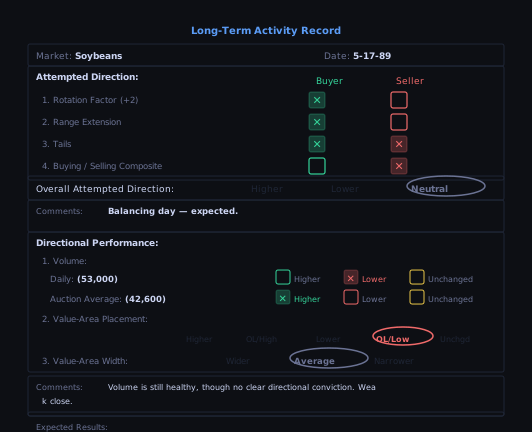
Fig 4.67 — LTAR for May 17. RF = +2 (buyer), RE = buyer, Tails = both, Composite = seller → Neutral. Volume 53K (lower) vs avg 42.6K (higher). VA: OL/Low. Width: Average. Expected: monitor for conviction tomorrow.
May 18 — Failed Up Probe (Underlying Weakness)
May 18 attempted higher — RF +1, upside range extension, buying composite. But volume collapsed to 24,000 (vs avg 43,100) and the VA was only OL/High with a narrower profile. The "p"-shaped profile (short covering, not genuine OTF buying) warned that the attempt was suspect. K-period's buying tail was the final period, so it doesn't count.
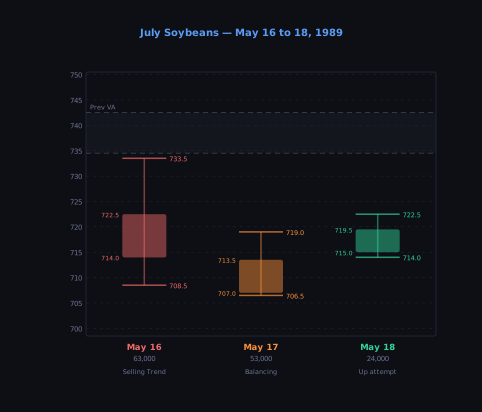
Fig 4.70 — July Soybeans, May 16–18. May 18 attempts higher off May 17's lows. Range 714.00–722.50; VA 715.00–719.50 (narrow). Volume 24,000 — drastically lower.
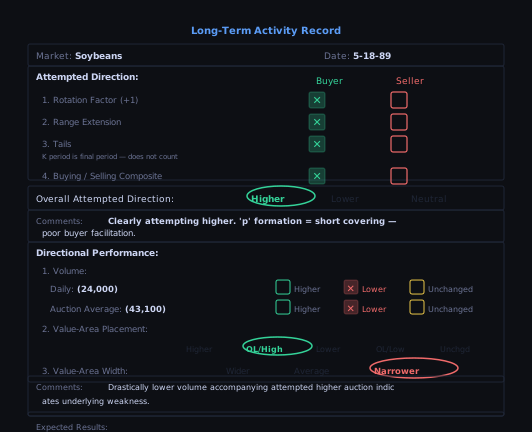
Fig 4.71 — LTAR for May 18. Overall: Higher. Volume 24K vs avg 43.1K = Lower + Narrower. VA: OL/High. Comment: drastically lower volume on higher attempt = underlying weakness. Expected: seller should resume control; K-period probe suspect.
May 19 — Higher Value, But Buyer Still Weak
May 19 again attempted higher (RF +3, upside RE, buying tails) and did develop higher value — but volume was essentially unchanged at 27,000 (avg 41,400) and the VA was narrower still. Higher prices continue to cut off activity. The buyer is technically succeeding on value migration, but failing to attract participation.
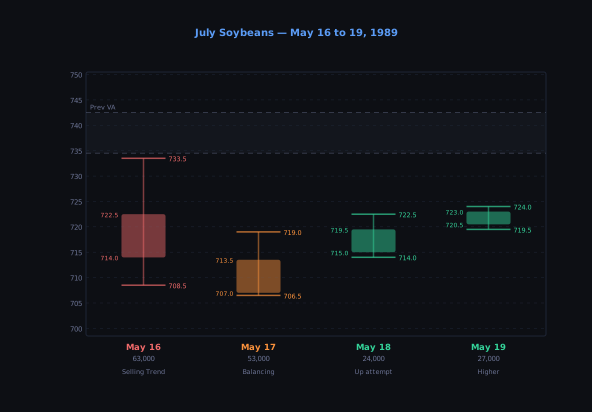
Fig 4.72 — July Soybeans, May 16–19. May 19 range 719.50–724.00; VA 720.50–723.00. Value moved higher but profile is very narrow — participation absent.
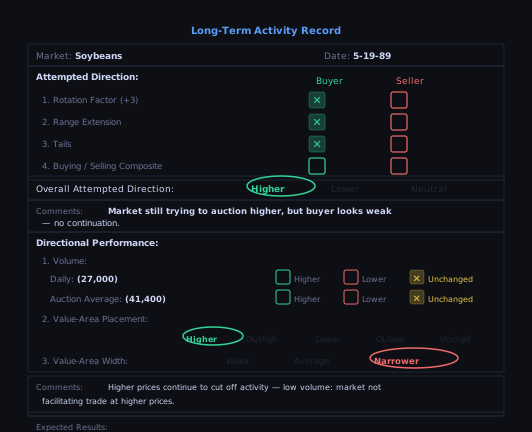
Fig 4.73 — LTAR for May 19. Overall: Higher. Volume 27K / avg 41.4K = Unchanged + Narrower. VA: Higher. Comment: higher prices continue to cut off activity — market not facilitating trade at higher prices. Expected: market needs to go lower to facilitate trade; look to short while monitoring seller entry.
May 20 — Seller Resumes; LTAR Narrative Confirmed
May 20 validates three days of LTAR warnings. The market gapped below May 19's range and sold off sharply, extending down to 691.00 — well below May 16's lows. Volume surged to 44,000 (nearly double May 19) with a dramatically wider and lower value area. The seller predicted by the May 16 LTAR had been preparing throughout the short-covering probe and finally re-asserted full control.
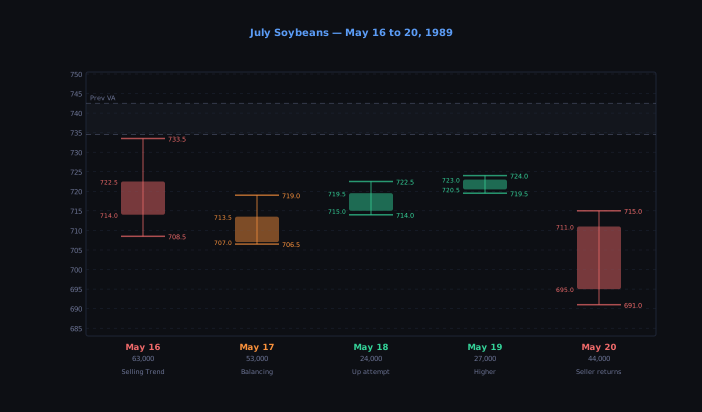
Fig 4.74 — July Soybeans, May 16–20, 1989. The full five-day sequence. May 20: range 691.00–715.00; VA 695.00–711.00; volume 44,000 — more than 60% above May 19's volume on a decisive move lower. The LTAR narrative from May 16 played out exactly as anticipated.
- May 16: Conviction sell. LTAR says: balance likely tomorrow, lower value expected, hold short.
- May 17: Balance confirms. LTAR says: mixed signals, monitor for conviction.
- May 18: Up probe on collapsing volume = suspect. LTAR says: seller should resume, K-period tail doesn't count.
- May 19: Higher value but no participation. LTAR says: market needs to go lower; look to short.
- May 20: Seller fully in control. Three consecutive LTAR warnings validated in one session.
The LTAR transforms isolated daily reads into a connected narrative — each day's record contextualises the next and builds conviction over time.
★ Structured Study Notes — Added §4.33b–4.35
- Wide Value Area (§4.33b)
- Apr 27, 1989 T-Bonds: 16-tick VA, ~600K contracts (HIGH VOLUME) — PPI released, market moved decisively
- Fig 4.64: empirical proof — wider VA = higher average volume, near-exponential relationship at upper end
- Table 4.2 in book gives width-to-volume lookup for T-Bonds; build your own LTAR for other instruments
- Long-Term Activity Record — LTAR (§4.34)
- Completed after each session: two halves — Attempted Direction + Directional Performance
- Att. Direction: score RF value, Range Extension, Tails, Composite → circle Higher/Lower/Neutral
- Dir. Performance: Volume (daily vs prior + vs auction avg), VA Placement, VA Width → write Expected Results
- Key rule: final-period tails do NOT count (e.g. K period on May 18)
- Value: forces daily synthesis; accumulates narrative; surprise vs. expectation = high-conviction trade signal
- Soybean Case Study May 16–20, 1989 (§4.35)
- May 16: Selling Trend Day — RF –11, all signals seller, 63K vol (higher), wider VA → lower value tomorrow expected
- May 17: Balancing day as expected — neutral direction, OL/Low VA, average width; monitor for conviction
- May 18: Up probe on 24K volume (vs 43.1K avg) — "p" formation = short covering, not OTF buyer; K-period tail discounted; seller should resume
- May 19: +3 RF, higher VA but 27K volume (unchanged/below avg), narrower — higher prices cutting off activity; look to short
- May 20: Seller resumes — range 691–715, VA 695–711, 44K volume; full confirmation of 3-day warning from LTAR
4.36 Volatility — Bracket vs Trend
Markets oscillate between two fundamental states: trending and bracketing. These states exhibit distinctly different volatility characteristics.
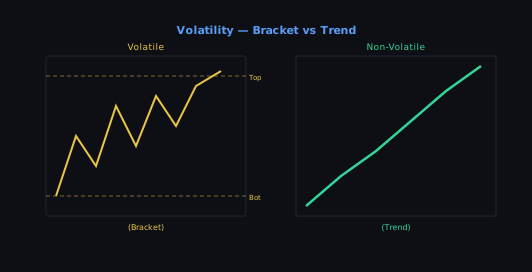
Fig 4.75 — Volatility. Left: a bracketed (balanced) market is volatile — price swings sharply up and down within a defined range, oscillating between two extremes. Right: a trending market is non-volatile — price moves in a sustained, relatively smooth direction with less back-and-forth.
Oscillating, high-swings
Price auctions aggressively between bracket top and bottom. Responsive buying at the bottom and responsive selling at the top create large swings. The range of prices is wide relative to net directional movement — high volatility.
Directional, low-swings
One timeframe participant dominates. Price advances (or declines) in a relatively smooth staircase with shallow pullbacks. Daily ranges are narrower relative to net movement — low volatility from day-to-day.
4.37 Identifying and Defining Brackets
A bracket is a balanced region where neither buyer nor seller can gain sustained control. The market oscillates between two extremes, with responsive participants active at both ends. Brackets exist at every timeframe simultaneously — brackets within brackets within brackets — and your bracket definition depends entirely on your trading timeframe.
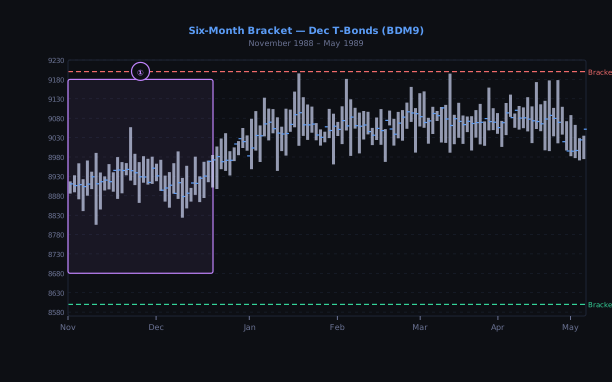
Fig 4.76 — A Six-Month Bracket in T-Bonds (BDM9), November 1988 – May 1989. Bracket ①: the full six-month range spans roughly 8600–9200. A swing trader would attempt longs around 8800 and shorts above 9000. This large bracket encompasses the entire displayed period.
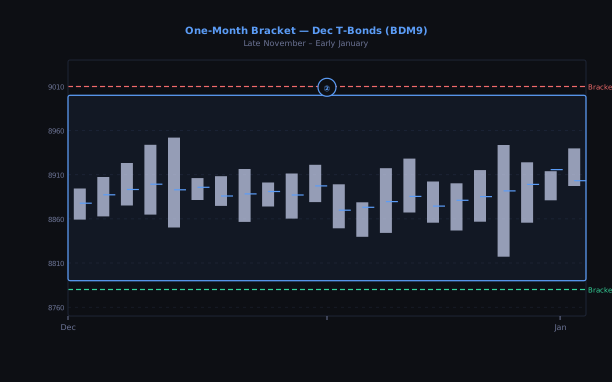
Fig 4.77 — A One-Month Bracket in T-Bonds. Bracket ②: a shorter-term trader sees a tighter balanced region within the larger bracket spanning roughly December into early January — about 8780–9010. Same market, different timeframe, different bracket.
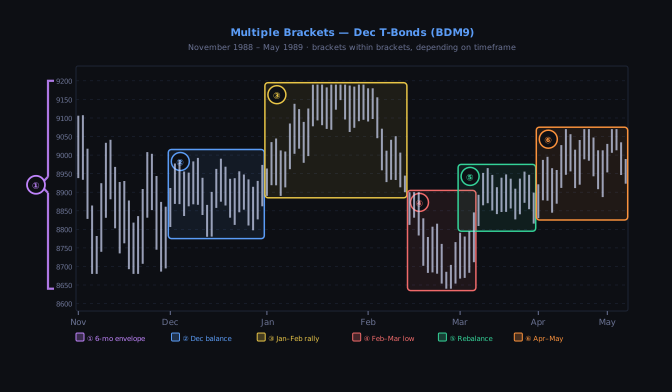
Fig 4.78 — Multiple Brackets in T-Bonds. Six brackets (①–⑥) are visible simultaneously at different scales. Point ⑤ illustrates a key insight: a short-term trader might consider six days of overlapping value (a tight cluster) to be its own bracket; a long-term trader sees that same region as part of the larger bracket ④. There is no perfect bracket — definition is a product of your trading timeframe.
Defining Bracket Extremes — Two Methods
Even traders who agree on a balance area may define its extremes differently. Two valid approaches:
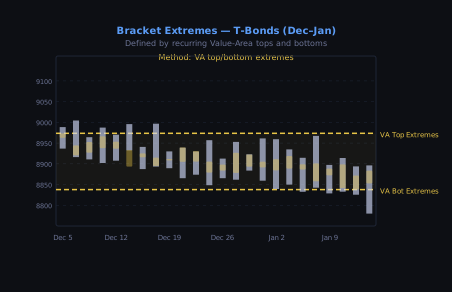
Fig 4.79 — Bracket extremes defined by recurring value-area tops and bottoms. The bracket boundary is set at the level where value areas repeatedly top out (upper) or bottom out (lower). More conservative — excludes price extremes that represent short-lived excess.
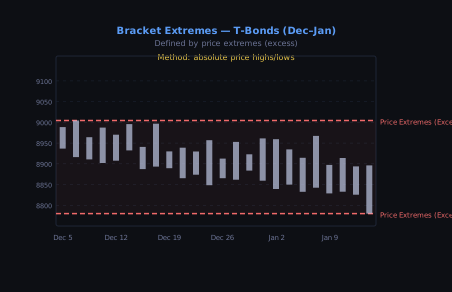
Fig 4.80 — Bracket extremes defined by absolute price extremes (excess). Uses the highest high and lowest low (including tails). More aggressive — defines the true outer boundary of the auction, including probe extremes.
4.38 Trade Location in a Bracketed Market
Once you have identified a bracket and defined its extremes, four rules govern trade location.
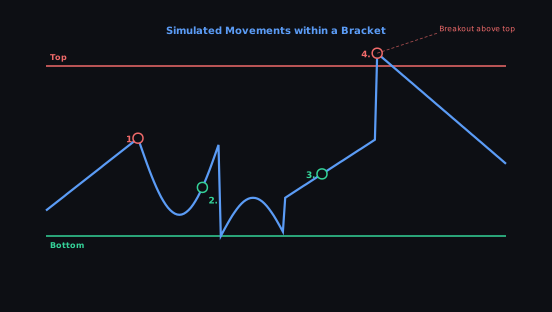
Fig 4.81 — Simulated Movements within a Bracket. Points 1–3 illustrate normal auction rotations between top and bottom. Point 4 shows a breakout above the bracket top — the signal to abandon responsive trading and shift to initiative/trend mode.
Trade Responsively
All trades in a bracketed market should be placed responsively. The distance from the top of the bracket represents the degree of risk for a long entry; the distance from the bottom represents the risk for a short. The closer to the extreme, the better the trade location and the less risk assumed.
Near the bottom: responsive buyers enter longs. Near the top: responsive sellers enter shorts. Avoid initiating in the middle of the bracket — poor location, maximum risk.
Avoid the Centre
The middle of the bracket is the most dangerous area for trade initiation. Both buyers and sellers are active; there is no clear edge. Trades initiated in the middle carry maximum risk with minimum directional conviction. Wait for price to reach a bracket extreme before entering.
Wait for Confirmation
At a bracket extreme, wait for confirmation that the extreme is holding before entering. A single bar touching the top or bottom is not sufficient — look for rejection (tail formation, excess, lack of follow-through). A bracket extreme that absorbs an initiative probe and then rotates back into range is the highest-confidence responsive entry.
Always Watch for Transition
The bracketed market can transition to a trend at any time. Monitor for: (1) a close outside the bracket, (2) next day's open outside the bracket, (3) subsequent sessions failing to return to the bracket range. When a breakout is confirmed, immediately shift from responsive to initiative trading — the old bracket top becomes support; the old bottom becomes resistance.
4.39 Transitions: Bracket ↔ Trend
Bracket to Trend
When one timeframe participant gains sufficient conviction to consistently overcome responsive opposition, the bracket breaks. In Crude Oil (Fig 4.82), the market tested bracket lows four times (points 1–4) in the Nov–Dec period. With each successive test failing to generate new lows, responsive buyers grew bolder. Eventually the initiative buyer overwhelmed the sellers and the market transitioned into a sustained uptrend through May 1989.
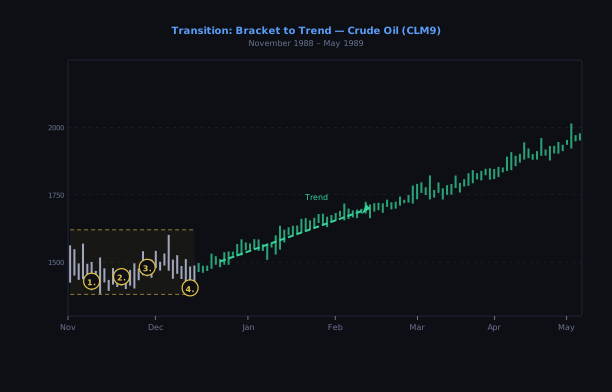
Fig 4.82 — Transition from Bracket to Trend — Crude Oil (CLM9), November 1988 – May 1989. Points 1–4 label successive tests of the bracket bottom in November–December. After the fourth test, initiative buying carried the market from ~$15 to above $20 — a clean bracket-to-trend transition. The breakout demanded an immediate shift from responsive to initiative trading.
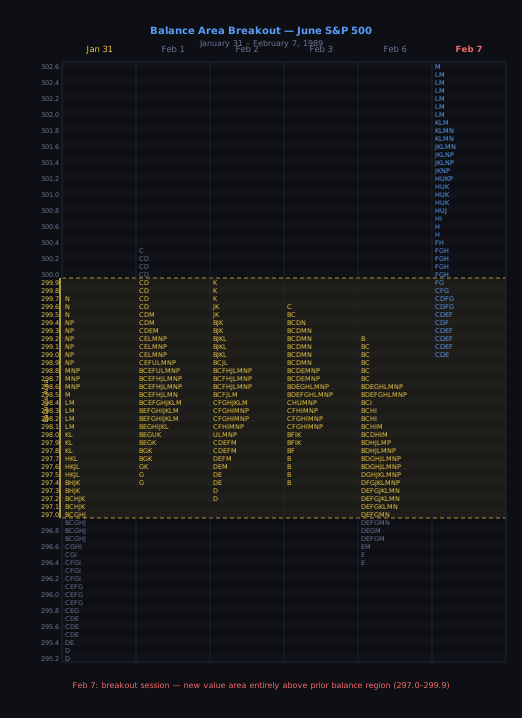
Fig 4.83 — Balance Area Breakout, June S&P 500, January 31 – February 7, 1989. Jan 31 – Feb 6 show overlapping value between roughly 296.60–300.30 — a balance area. February 7 breaks explosively higher to 302.60, opening above the entire prior balance region and building new value entirely above it. The breakout session shows wide, upside-extended TPO columns.
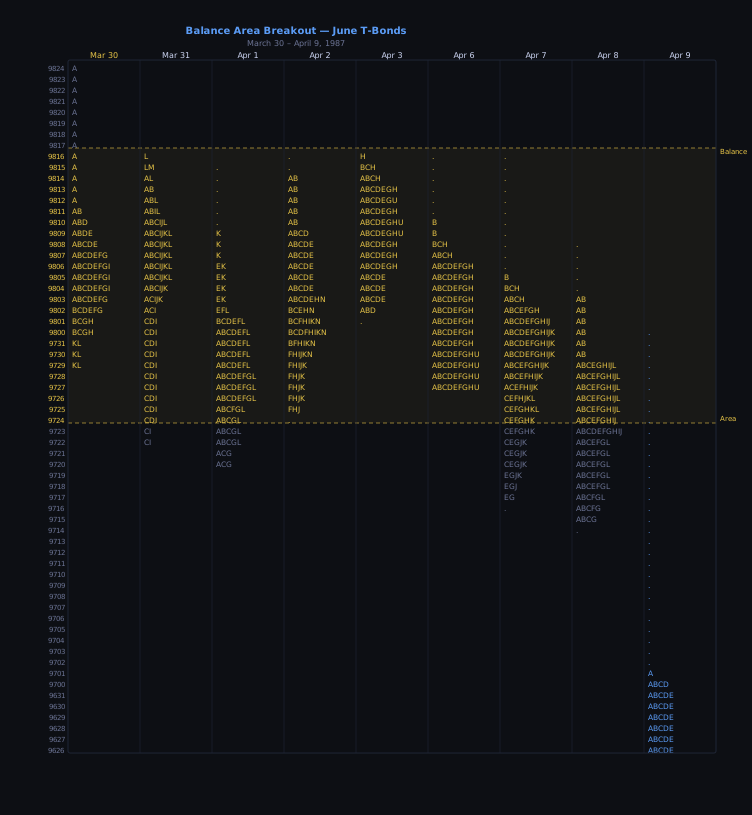
Fig 4.84 — Balance Area Breakout, June T-Bonds, March 30 – April 9, 1987. Mar 30 – Apr 8 build a balance area in the 9724–9816 range with overlapping daily profiles. April 9 breaks decisively lower — opening below the balance area and extending down into the 9626–9701 range, well below any prior session. Classic downside bracket breakout.
Trend to Bracket
A trend ends when the responsive participant can exert as much influence on price as the initiator. In an up-trend, this occurs when the responsive other-timeframe seller creates significant excess at the top. Once the trend ends, the market begins to balance — as bracketing begins, revert to responsive mode: sell the top of the emerging bracket, buy the bottom.
Monitoring Trends for Continuation
To monitor whether a trend is still healthy, compare volume on up days versus down days within the trend. In a strong uptrend, up days should generate higher volume than down days — the market facilitates more trade in the direction of the trend. When volume begins to increase on days against the trend, the trend is aging and may soon enter a bracket. This is the clearest early warning sign that the trend is losing momentum.
★ Structured Study Notes — Added §4.36–4.39
- Volatility: Bracket vs Trend (§4.36)
- Bracketed market = VOLATILE (large oscillations within range); Trending market = NON-VOLATILE (smooth directional movement)
- Counter-intuitive: bracket creates more price uncertainty than a clean trend
- Identifying & Defining Brackets (§4.37)
- Brackets exist at every timeframe simultaneously — brackets within brackets; your bracket = your timeframe
- Six-month bracket (Fig 4.76): 8600–9200; one-month sub-bracket (Fig 4.77): 8780–9010; multiple nested brackets (Fig 4.78)
- Two methods for extremes: (A) recurring VA tops/bottoms = conservative; (B) absolute price extremes/excess = aggressive
- Key rule: draw your bracket extremes explicitly; there is no perfect bracket; definition is timeframe-dependent
- Point ⑤ in Fig 4.78: 6 days of overlapping value = short-term bracket; long-term trader sees it as part of bracket ④
- Trade Location in Bracket (§4.38)
- Rule 1: All trades placed RESPONSIVELY. Near bottom = long; near top = short. Distance from extreme = degree of risk
- Rule 2: Middle of bracket = treacherous. Maximum risk, no edge. Avoid initiating in the middle
- Rule 3: Wait for confirmation at extremes — tail formation, rejection, lack of follow-through before entry
- Rule 4: Always monitor for breakout — close outside bracket → next day opens outside → subsequent sessions fail to return = confirmed breakout
- Transitions (§4.39)
- Bracket → Trend: initiative participant overwhelms responsive; successive failed probes of an extreme = warning; close + open outside bracket = confirmed
- Crude Oil: 4 tests of bracket bottom (Fig 4.82) → uptrend to $20; must shift immediately from responsive to initiative after breakout
- Balance area breakouts: fast and difficult to anticipate; S&P Feb 7 1989 (Fig 4.83): explodes above balance; T-Bonds Apr 9 1987 (Fig 4.84): breaks below
- Trend → Bracket: responsive participant creates excess at trend extreme; market begins to balance; revert to responsive mode
- Monitoring trend health: up days should have higher volume than down days in uptrend; rising volume on counter-trend days = trend aging
- Cardinal rule: NEVER trade against the trend. In mature trend, trade responsively (buy pullbacks/sell rallies)
4.40 Transition: Trend to Bracket
A trend is officially over when the responsive participant is able to exert as much influence on price as the initiator. In an uptrend, this occurs when the responsive other-timeframe seller is able to create significant excess at the top of the trend. Once the trend ends, the market begins to balance — as soon as a market begins the bracketing process, traders should revert to a responsive mode, seeking to sell the top of the emerging bracket and buy the bottom.
Crude Oil — Trend Begins to Balance (Fig 4.85)
The long-term uptrend in Crude Oil that began in late November 1988 transitioned into balance when the responsive seller was strong enough to induce a gap lower opening on March 28, 1989. Although the resulting excess did not last long, it indicated that the initiative buyer was weakening and a trading range was developing. The gap lower is the clearest signal that responsive sellers have arrived in force — and that the initiating buyers who drove the trend can no longer sustain the move.
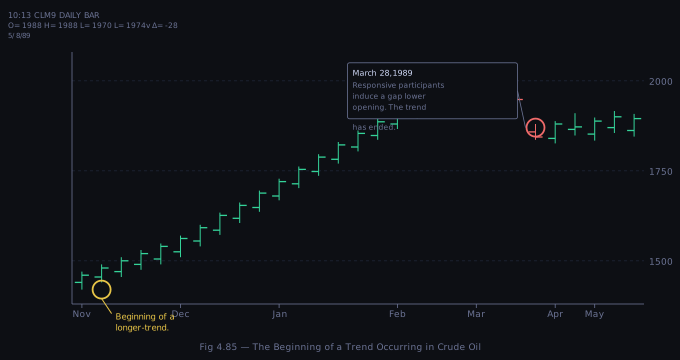
Fig 4.85 — The Beginning of a Trend Occurring in Crude Oil (CLM9). The uptrend from late November 1988 reaches approximately $20.00 before a gap lower opening on March 28, 1989 marks the transition. Responsive participants induced the gap, signalling the trend had ended. A trading range then began to develop.
Japanese Yen — Coming into Balance (Fig 4.86)
Figure 4.86 provides a second example of a transition from trend to bracket, over a much shorter period of time. After two strong buying days on January 19 and 20, the Japanese Yen began to balance. The inability of the buyer to establish continually higher value indicated the presence of the responsive seller. The Yen had entered a short-term bracketing period, as evidenced by responsive activity at both extremes of the bracket (see circled areas).
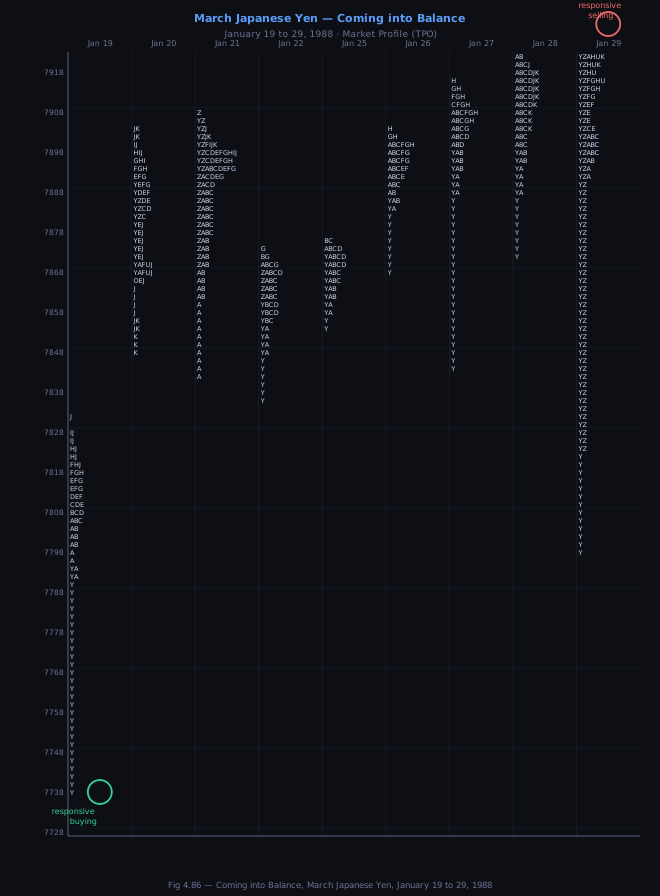
Fig 4.86 — Coming into Balance, March Japanese Yen, January 19–29, 1988. After the strong buying on Jan 19–20, the buyer fails to build higher value. Responsive sellers appear at the top extreme and responsive buyers support the bottom extreme — classic bracket formation. The buying tail on Jan 19 (circled) and the selling excess on Jan 29 (circled) mark the bracket boundaries.
Signals the Trend Has Ended
Responsive participant creates excess at trend extreme. Gap opening against the trend. Volume rising on counter-trend days. Value area stops migrating in trend direction.
Shift to Responsive Mode
Stop trading with the initiative. Begin selling near emerging bracket top, buying near bracket bottom. Wait for bracket to define itself before committing size.
4.41 Monitoring Trends — T-Bond Case Study (Regions A–D)
To illustrate how a competent trader monitors a developing market, consider a detailed analysis of June Treasury Bonds from November 1988 through May 1989. The market is divided into four regions (A–D), each revealing a different stage of the auction process. The key discipline throughout is patience: wait for balance areas to form, then monitor for confirmation of follow-through or rejection before acting.
Region A — Initial Sell-Off and First Balance (Fig 4.87)
Starting November 1, 1988 (point 1), a major selling trend develops, driving prices from the high 91s down toward 89. At point 2 the market comes into short-term balance, as evidenced by two days of overlapping value. On the third day (point 3), a probe above the balance area fails to attract buying — the market is swiftly rejected. Armed with the knowledge that there is no interest in buying, the bond market then breaks below the balance area, starting a new selling auction. The result at point 4 is a dynamic outside day — a powerful session that breaks cleanly below balance and closes on its lows. Point 5 marks the continuation of the new selling auction.
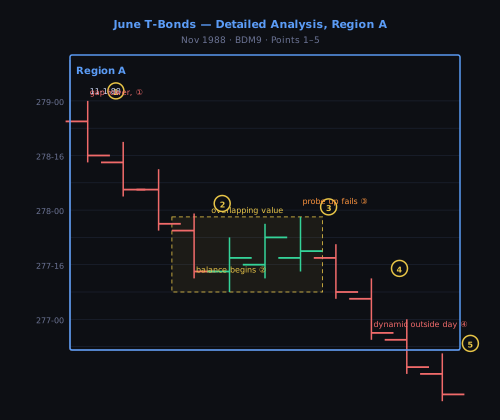
Fig 4.87 — Detailed Analysis of a Developing Market, June Treasury Bonds — Region A. Starting from 11-1-88: point ① gap down begins the selling trend; point ② marks the first short-term balance (overlapping value); point ③ is the failed probe above balance; point ④ is the dynamic outside day breakout to the downside; point ⑤ confirms continuation of the new selling auction.
Region B — Bounce, New Balance, Second Failure (Fig 4.88)
At point 6, the market begins a counter-trend bounce attempt. At point 8, bonds open higher and begin to auction into the selling gap established at point 1. However, buyers fail to auction completely through the gap — and the market closes near its lows. The resistance provided by the gap created more than a month earlier is still intact. After establishing potential buying excess at point 8, the market quickly comes into balance again (overlapping value on the following two days — points 9–10). On the third day (point 11), a test of the excess at point 8 fails (bonds close on the low), which fuels an intermediate bracketing period. Point 12 marks the break below the balance area to resume the downtrend.
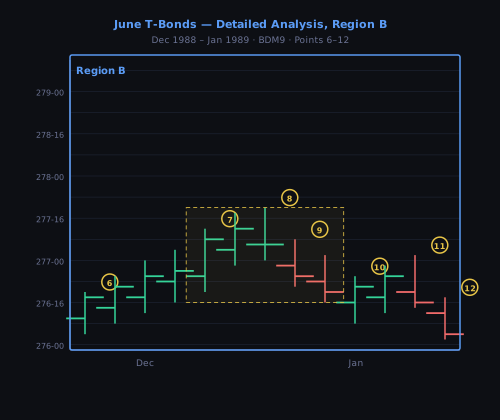
Fig 4.88 — Detailed Analysis, June T-Bonds — Region B (Dec 1988 – Jan 1989). Point ⑥ begins the counter-trend bounce; point ⑧ opens into the selling gap but closes at the lows (failed upside auction); points ⑨–⑩ form a new short-term balance; point ⑪ is the test of ⑧'s excess that fails; point ⑫ breaks below balance, resuming the selling trend.
Region C — Long-Term Low and New Uptrend (Fig 4.89)
By point 16, the market comes into balance just above the long-term lows created at point 5. Sellers are unable to generate continuation below the 89-06 low — this attracts the responsive buyer. Bonds close in the upper half of the range on this day, signaling the potential formation of long-term selling excess. Note once again: the dynamic outside day was sparked by a failed auction. Point 17 marks the resumption of downward pressure, but the failure to hold below the prior lows ultimately invites strong responsive buying in Region C, which transitions the market back into an uptrend.
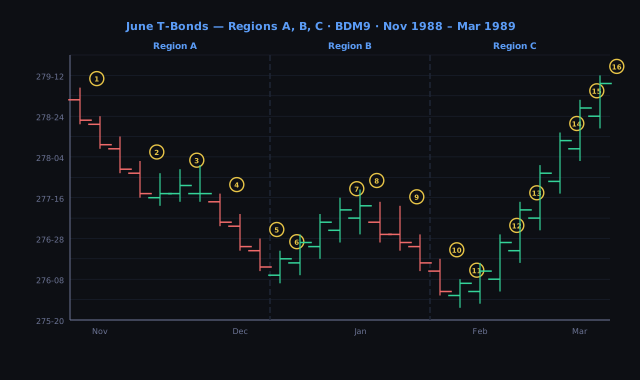
Fig 4.89 — Detailed Analysis, June T-Bonds — Regions A, B & C (Nov 1988 – Mar 1989). The full sweep from the initial selling (Region A), through the failed bounce and intermediate bracketing (Region B), into the final low at point ⑤ and the new uptrend building through Region C (points 13–17). Each circled number marks a key auction decision point.
Region D — Full Overview and Bracket Re-Entry (Fig 4.90)
Region D provides additional examples of why selectivity is essential during bracketed conditions. Points 18, 19, 20, and 21 show dynamic outside days — two buying and two selling. These powerful sessions are all generated by failed auctions: a probe to one extreme that attracts responsive activity and reverses sharply. The full chart (Fig 4.90), spanning November 1988 to May 1989, shows the entire cycle: trend → bracket → new trend → bracket re-entry, with 21 numbered points marking every key auction decision moment across all four regions.
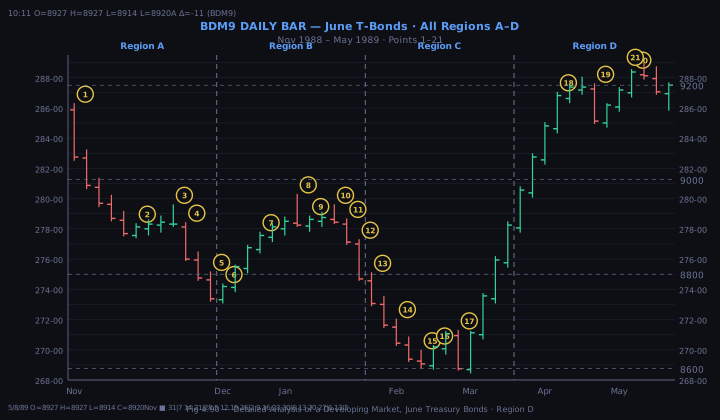
Fig 4.90 — Detailed Analysis, June T-Bonds — All Regions A–D (BDM9, Nov 1988 – May 1989). The complete picture showing all 21 numbered points and four distinct market phases. Price range spans approximately 86-00 to 92-00. Vertical dashed lines separate the four regions. Each region illustrates a different stage of the auction process: initial trend (A), failed bounce and re-test (B), exhaustion and reversal (C), and new bracketing (D).
- The pattern that repeats across all regions:
- Balance area forms (overlapping value on 2+ days)
- A probe is made beyond the balance in one direction
- If the probe fails to attract continuation → it's rejected
- Market breaks in the opposite direction → dynamic outside day
- The failed auction generates the clearest directional signal
- Trading rule — be selective:
- Do not trade the balance area itself — wait for the breakout or rejection
- The highest-confidence trade is after a confirmed failed auction at an extreme
- Old references (the selling gap from point 1) remain relevant for weeks
4.42 Auction Failure
An auction failure occurs when a market attempts to break out of a balance area or test a prior extreme — but fails to attract the participation necessary to sustain the move. The market quickly reverses, often violently. Auction failures are among the most reliable and tradeable events in market profile analysis because they provide both a directional signal and a clear reference point for risk management.
Auction Failure in Treasury Bonds (Fig 4.91)
Figure 4.91 shows the June T-Bond daily bar chart from November 1988 through May 1989. Box 1 highlights the critical failure zone in February 1989: the market attempts to auction above the prior highs (the selling gap created at point 1 in Region A), but buyers cannot sustain the move above the gap. The market closes near its lows — a failed upside auction. The 86-09 area marked at the bottom represents a long-term support reference that the market tested twice (November 25, 1988 and March 21, 1989), creating significant long-term buying excess. When sellers fail to break through long-term support, the responsive buyer is activated.
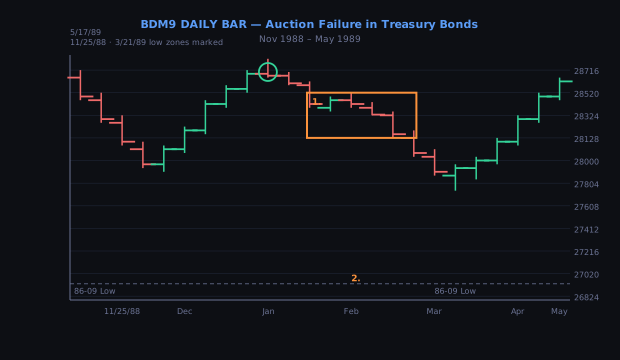
Fig 4.91 — Auction Failure Occurring in Treasury Bonds (BDM9), Nov 1988 – May 1989. Box 1 identifies the failed upside auction in February, where the market attempted to close the selling gap but failed and closed near its lows. The dotted line at 86-09 marks a long-term low (tested Nov 25, 1988 and Mar 21, 1989), where sellers twice failed to generate continuation — attracting powerful responsive buyers each time.
Auction Failure in Detail — March Bonds (Fig 4.92)
Figure 4.92 shows the Market Profile view of the auction failure in March T-Bonds across February 9–22, 1989. On February 9, the session creates a wide profile extending from the high 90s down to the high 88s — a one-timeframe selling day. The subsequent sessions show a narrowing balance area. The market attempts to probe higher on February 13 but gaps lower instead, confirming the rejection of the upside auction. This TPO view makes the failure unmistakable: value is not accepted at the higher prices, and the subsequent sessions show value migrating lower.
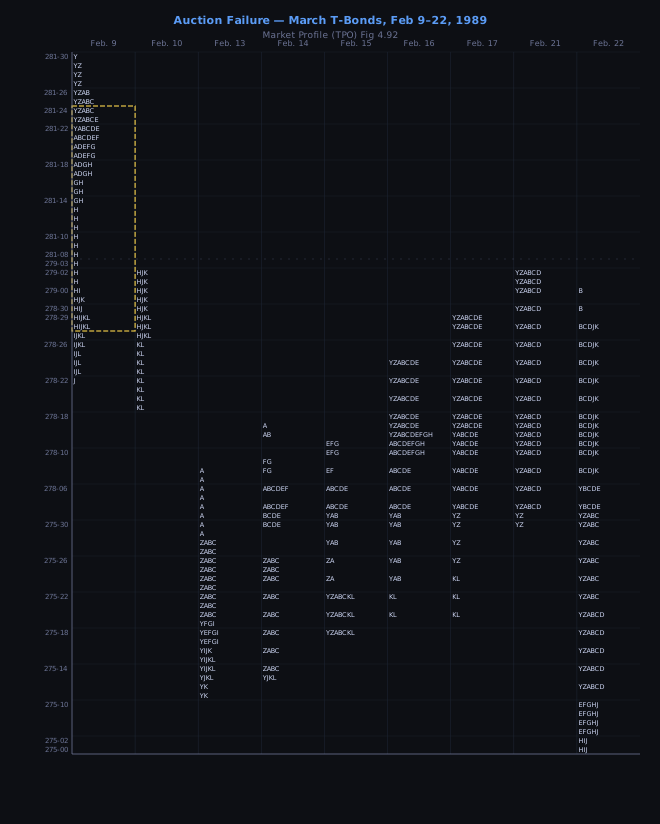
Fig 4.92 — Auction Failure in March Treasury Bonds, February 9–22, 1989. Market Profile (TPO) view. Feb 9 creates a wide, one-sided selling profile. The subsequent balance area (dashed gold rectangle marks approximate value area) fails to hold when the market gaps lower on Feb 13, confirming the auction failure. Value migrates lower across the following sessions.
Balance Area Forms
2+ days of overlapping value. The market is in equilibrium — both buyers and sellers present. Wait; do not trade the middle.
Directional Attempt
Market probes beyond the balance boundary. Watch for: Does it attract follow-through? Or is it quickly rejected and closed back inside?
Auction Fails → Trade
Probe rejected. Market closes back inside or beyond the opposite extreme. This is the dynamic outside day. Enter in the direction of the failure.
- Anatomy of an Auction Failure (§4.42)
- Occurs when a breakout attempt fails to attract continuation buying/selling
- Market quickly reverses — often generating a dynamic outside day
- Provides both signal and risk reference: stop goes just beyond the failed probe extreme
- Old references (selling gaps, prior highs/lows, 86-09 lows) remain active for months
- TPO view confirms failure: value area fails to migrate in the probed direction
- Summary — Transitions §4.40–4.42
- Trend→Bracket: gap opening against trend; responsive excess at trend extreme; revert to responsive trading mode immediately
- Monitoring trends (§4.41): read balance areas and failed probes; the four-region T-Bond case study illustrates the pattern repeating at multiple scales
- Auction failure (§4.42): the highest-confidence setup; enter after confirmed rejection, stop beyond probe extreme
4.43 Long-Term Short Covering
Long-term participants enter and exit markets based on reference points that may be weeks or months old. When price approaches such a reference level — a prior high, a long-term bracket extreme, a significant structural low — the response of those participants can generate a powerful, rapid move against the prevailing trend.
The soybean market in January–February 1989 provides a textbook example. A multi-month downtrend had carried prices from near 900¢ in August 1988 to the 740¢ area by late January 1989. Sellers at every timeframe had accumulated short positions. The key moment came on January 26, 1989 — when sellers attempted to push price below the long-term reference level of 740¢ and failed.
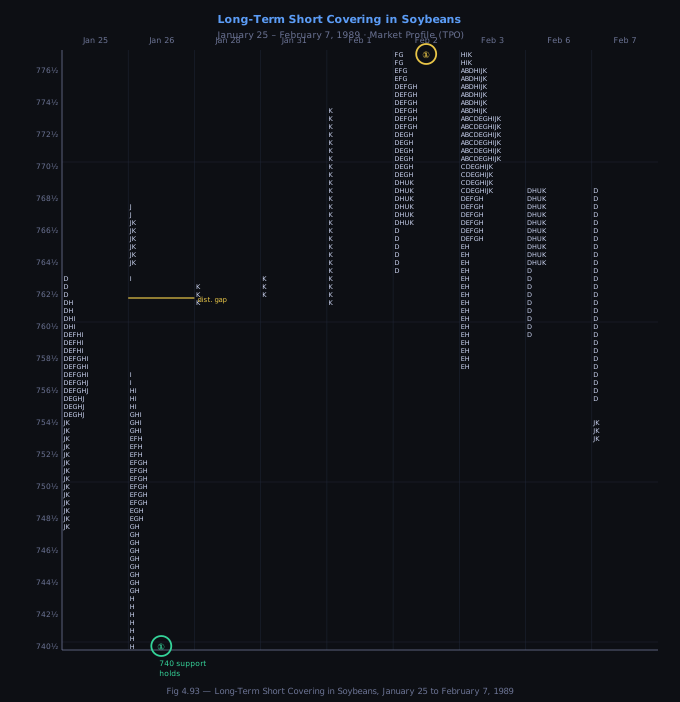
Fig 4.93 — Long-Term Short Covering in Soybeans, January 25 to February 7, 1989. Jan 26 is a Double Distribution Buying Trend day: the lower distribution (D/H letters, down to 740½¢) represents initial one-timeframe selling, while the upper distribution (J/JK letters at 762–768¢) is the explosive short-covering rally that took over in the afternoon. Circle ① marks the 740¢ support that held; circle ① (Feb 2 top) marks where responsive sellers briefly contained the rally at 777½¢.
The broader context is visible on the daily bar chart. The entire Aug–Jan downtrend compressed more than 150¢ in price. The circle on January 9 marks the actual low — the point where sellers exhausted themselves — with the Jan 26 session completing the reversal structure.
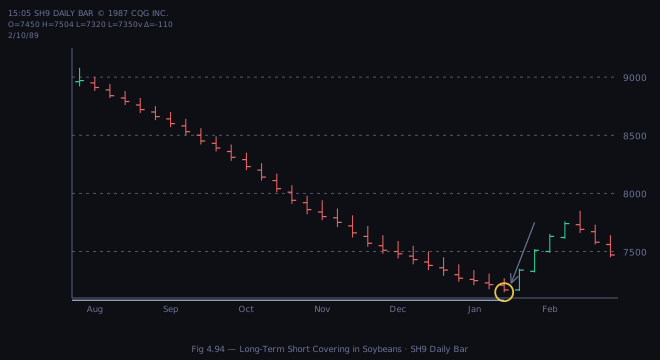
Fig 4.94 — SH9 Daily Bar, Aug 8, 1988 to Feb 10, 1989. The support bracket at the bottom of the chart shows the long-term reference level (~735–735¢ area) that sellers failed to penetrate. The circle marks the Jan 9 low — the point of maximum responsive buying — with the short-covering rally following in late January and early February.
The progressive volume profile (Fig 4.95) reveals how the Double Distribution structure built up over nine trading days, Jan 26 through Feb 9. Each stage adds volume, and the separator line at 768½¢ becomes increasingly visible as the two distributions develop distinct shapes.
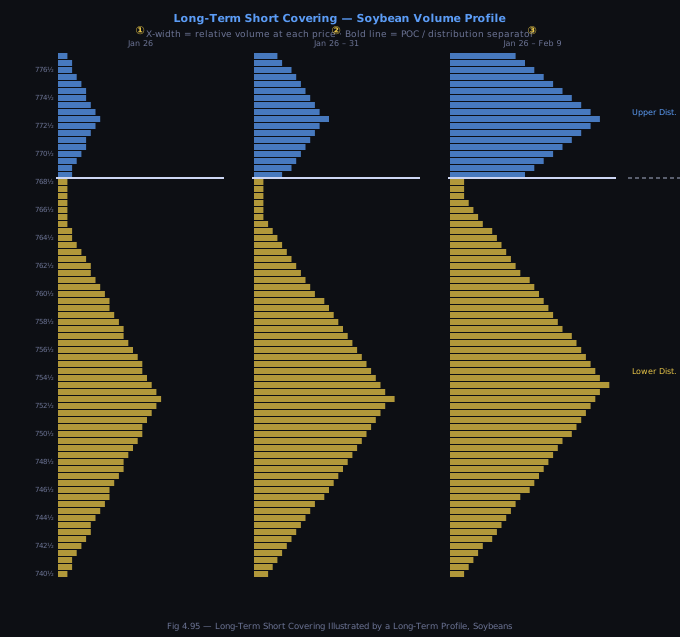
Fig 4.95 — Long-Term Short Covering Illustrated by a Long-Term Profile. The X-width at each price represents relative volume. Panel ① (Jan 26 alone) shows the initial day's shape — lower distribution slightly heavier. Panel ② (Jan 26–31) shows both distributions filling in. Panel ③ (Jan 26–Feb 9, full composite) shows a clear Double Distribution with the POC separator line at 768½¢.
- Reading long-term short covering
- Occurs when price reaches a well-known long-term support or resistance — a level where participants who have been positioned for weeks or months will act simultaneously
- Characterised by a "knee-jerk" response: price initially moves through (or to) the reference level, then reverses sharply as short-covering buying overwhelms new sellers
- The Jan 26 Double Distribution Buying Trend day is the signature profile: lower distribution = initial one-timeframe sell attempt; upper distribution = short-covering surge; gap between = thin area (distribution separator)
- Implications for traders
- Sellers who built positions over months suffered rapid, substantial losses — those who held through the 20¢ Jan 26 rally watched profits evaporate in hours
- The long-term profile (Fig 4.95) confirms the structural shift: lower distribution = where the old sellers dominated; upper distribution = where new buyers found value
- After a short-covering event, the prior trend should be considered over until price re-establishes below the distribution separator
4.44 Corrective Action
A corrective action is a temporary, responsive move against the primary trend. Unlike a trend reversal, it does not represent a true change in market direction — it is the market's mechanism for eliminating weak participants, resetting prices to a more attractive level for continuation buyers, and testing whether the trend is still supported.
Corrective moves are identifiable in the Market Profile because they leave a distinctive structural signature: a one-timeframe move in the corrective direction, followed by a rapid return to (or beyond) the prior value area. Old buyers have time to add to or protect positions; new buyers enter with favourable location.
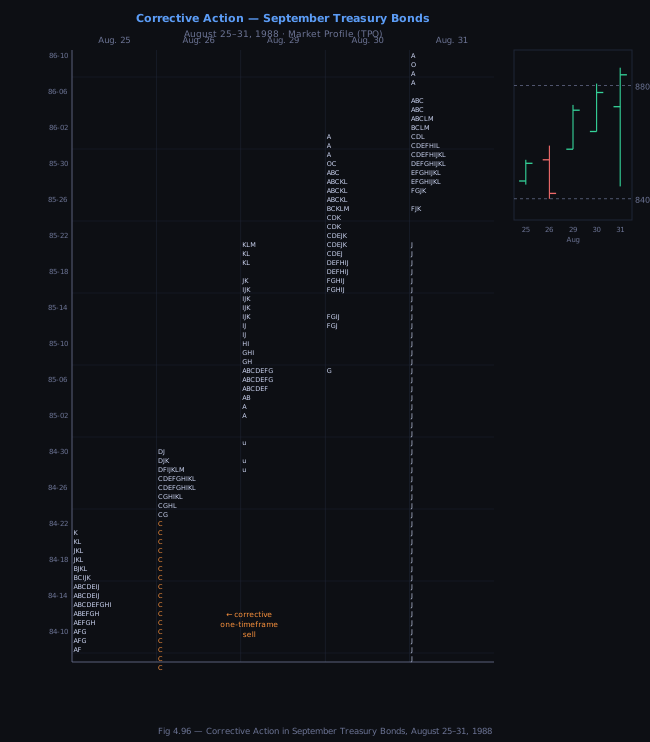
Fig 4.96 — Corrective Action in September Treasury Bonds, August 25–31, 1988. Aug 26 (orange column) is the corrective sell: letter C runs uninterrupted from 84-30 all the way to 84-00 — a pure one-timeframe downward move. This washed out weak longs. The market then recovered strongly over Aug 29–31, with Aug 31 posting a wide buying range from 84-07 to 86-10. The inset bar chart (top right) shows the same five days in OHLC form.
- Identifying corrective vs. reversal
- Corrective: one-timeframe structure in counter-trend direction; price returns to value quickly; old buyers had time to liquidate at acceptable prices (no panic)
- Reversal: price stays outside value; new value area builds in new direction; prior trend participants are trapped and unable to exit at acceptable prices
- The Aug 26 correction passed all three corrective tests — buyers who held through Aug 26 were rewarded by Aug 31
- Trading corrective action
- Do not sell into a one-timeframe correction if the broader trend is up — this is the classic "sold the dip" mistake that traps late sellers
- Old buyers should use the correction to add at better prices, not exit — only exit if price fails to recover the corrective extreme within 1–2 sessions
- New buyers get the best entry: correction provides value-area location in the direction of the primary trend
- Conventional price-only traders may misread the Aug 26 sell as a trend change; Market Profile traders recognise the one-timeframe single-print structure as corrective
4.45 Profiles across Timeframes
The Market Profile is fractal: the same bell-curve structure that describes a single day's auction appears again when you composite a week's worth of days, and again across a month. Each successive timeframe captures more information — a wider price range, a denser value area, and clearer excess at the extremes.
Figure 4.97 makes this explicit. The three profiles — One Day, Ten Days, One Month — share the same general shape, but they grow progressively taller and wider. The one-day profile is narrow; the long-term composite is broad and full, revealing structure that is invisible in a single session.
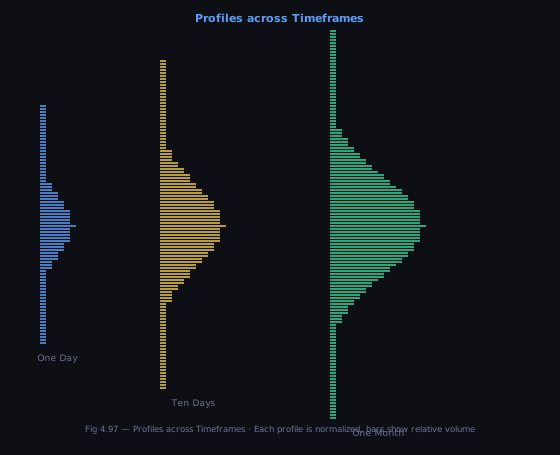
Fig 4.97 — Profiles across Timeframes. Left: one-day profile — narrow, moderate range. Centre: ten-day composite — wider bars, fuller shape. Right: one-month composite — broadest, most developed bell curve. X-width at each price = relative volume.
- Key relationships across timeframes
- Each timeframe nests inside a larger one: day timeframe activity builds the weekly profile; weekly profiles build the monthly
- A day-timeframe trader who ignores the long-term profile is trading without context — value may be at the top of a 30-day range while appearing to be in the middle of a single session
- Long-term excess (tails and single-print areas) in the composite marks the highest-confidence reference points for responsive trading
- Reading composite profiles
- High-volume nodes = long-term value area — price repeatedly returned here and accepted
- Low-volume gaps = price moved through quickly; market did not accept these prices — often the location of future bracket breakouts
- The point of control (POC) of the composite shifts over time; a falling POC = other-timeframe sellers in control; a rising POC = other-timeframe buyers in control
4.46 Japanese Yen — Region A
The Japanese Yen futures case study (JYM9, June 1989 contract) demonstrates how long-term structure analysis guides trade decisions across a multi-month period. The market is divided into two "regions" of activity, each characterised by its own long-term profile.
Region A covers February 15 through April 25, 1989 — a period in which other-timeframe sellers established lower value incrementally. The daily bar chart (Fig 4.98) reveals the structure: a high-volume balance area at ① (8050–8100), a selling gap at ②, a series of lower lows marked by ③ and ④, and a final bracketing phase at ⑤ (7750 area) before Region A's close.
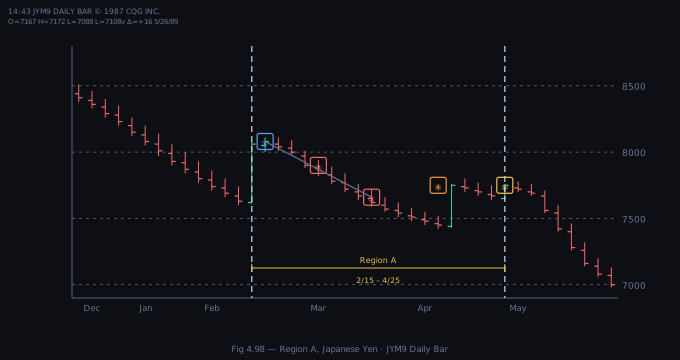
Fig 4.98 — Region A, Japanese Yen. JYM9 Daily Bar, December 1988 to May 1989. The Region A bracket (dashed vertical lines) spans February 15 to April 25. Points ① (balance top ~8100), ② (selling gap ~7980), ③ (trend low ~7700), ④ (bounce), and ⑤ (bracket bottom ~7750) mark the key structural events of the region.
The Long-Term Profile for Region A (Fig 4.99) translates these events into volume structure. The combined TPO plot (normalised to 50) shows two distinct high-volume brackets separated by a selling gap. The upper bracket ① (roughly 7992–8116) represents the initial balance area where the market spent considerable time; the lower bracket ⑤ (roughly 7584–7760) is where value was re-established after the trend move. Between them, at point ②, is a thin low-volume selling gap — the price range through which sellers moved aggressively and buyers did not participate.
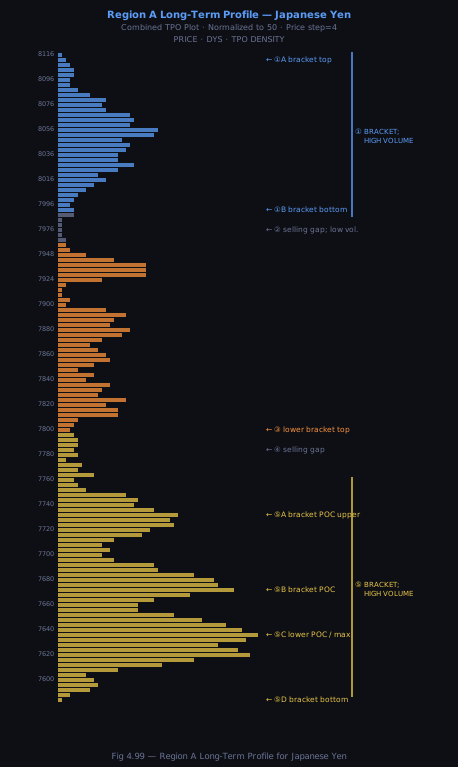
Fig 4.99 — Region A Long-Term Profile for Japanese Yen. Combined TPO plot, price step=4, normalised to 50. Upper bracket ① (blue, ~7992–8116): the initial high-volume balance area. Selling gap ② (~7976): thin low-volume area — sellers were in full control here. Lower bracket ⑤ (gold, ~7584–7760): the destination value area. Sub-markers ①A/①B, ⑤A–⑤D locate specific structural details within each bracket.
- Identifying control in the long-term profile
- A falling long-term POC = other-timeframe sellers in control; rising POC = other-timeframe buyers in control
- Selling gaps (low-volume thin areas between brackets) confirm aggressive seller control — the market did not pause at those price levels
- High-volume brackets represent accepted value — the market balanced at those levels long enough to build full, rounded profile shapes
- Using Region A as a trading reference
- The upper bracket ① is now overhead resistance — any rally back into 7992–8116 is a responsive selling opportunity for other-timeframe participants
- The selling gap ② is a key reference: if price re-enters the gap, it signals potential structural shift; if sellers defend the gap, the trend remains intact
- The lower bracket ⑤ without a strong tail means the low is not confirmed — further selling pressure is consistent with the profile's shape
4.47 Japanese Yen — Region B
Region B begins at point 6 — where the yen gapped below the bracket established at point ⑤ in Region A. This gap below the established lower bracket is the defining event: it confirmed that other-timeframe sellers had rejected the balance area and were driving price significantly lower. The long-term selling trend resumed with force.
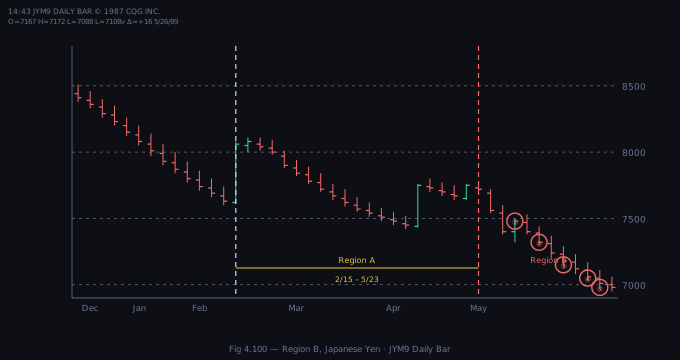
Fig 4.100 — Region B, Japanese Yen. JYM9 Daily Bar, December 1988 to May 26, 1989. The dashed vertical line at April 24 marks the start of Region B. Points ①–⑤ (red circles) track the successive lower-low structure of the Region B selling trend, from ~7480 down to ~6980. Region A is shown to the left for context.
The Region B Long-Term Profile (Fig 4.101) covers the full period February 15 to May 23, and uses price intervals of ten units (rather than four) to fit the extended range on one page. The composite reveals the complete selling auction: the Region A value area is visible as a high-volume zone in the upper portion, while the Region B selling has driven price down to new lows in the 7050–7370 area.
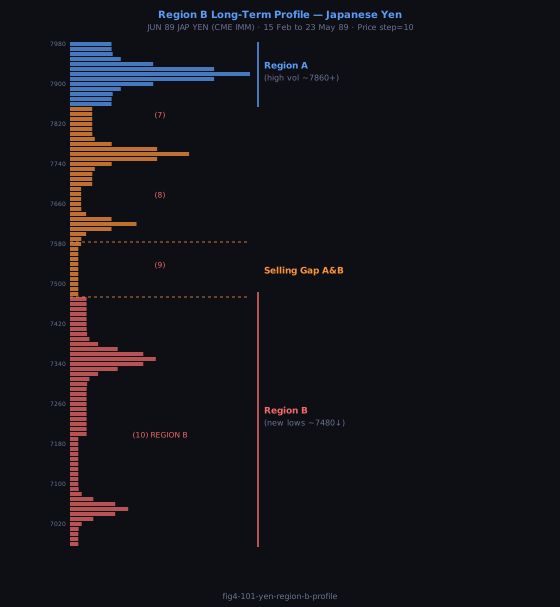
Fig 4.101 — Region B Long-Term Profile for Japanese Yen. JUN 89 JAP YEN (CME IMM), February 15 to May 23, 1989. Price step=10. Blue zone: Region A value (high volume, ~7860+). Gold zone: combined bracket area. Orange: selling transition zone. Red: Region B new lows. The selling gap "A & B" (~7540) marks where both regions accelerated selling. Points (7)–(10) track the progressive structure of the Region B decline.
- Bracket break as the trigger
- Point 6 (the gap below bracket ⑤) is the highest-confidence sell signal of the entire sequence — it confirmed both that the bracket was rejected and that other-timeframe sellers were aggressively in control
- A gap below a well-defined long-term bracket is the long-term equivalent of a selling Trend day opening beyond the prior value area
- Reading Region B's profile structure
- The "selling gap A & B" in the composite (~7540) marks where sellers from both regions were active — it is the most significant thin-volume reference point in the entire chart
- Points 7 and 8 mark short-term balance periods within the trend — analogous to corrective action at the day timeframe, they did not change control; they merely paused the trend
- The thin, elongated lower portion of the Region B profile (points 9 and 10) is consistent with continued other-timeframe selling pressure — no strong long-term tail had formed as of May 23
4.48 The 3-to-1 Day
The 3-to-1 day (also written "3-to-I day") occurs when a market opens in three-timeframe trading and then transitions to one-timeframe trading in a single direction. It is one of the most powerful day-timeframe structures because the transition itself — from two-sided responsive activity to one-sided initiative activity — signals a change in who is in control of the auction.
The soybeans example (Fig 4.102, May 5, 1989) illustrates the sequence perfectly. The day opened with D-letter single prints extending down to 750¢ — a long initiative buying tail. This initial three-timeframe period was followed by a full reversal: price moved to 760.50¢ in a clean one-timeframe upward move, with every subsequent TPO period posting a higher high. The May 5 column went from a three-timeframe opening (broad, uncertain) to a one-timeframe closing drive.
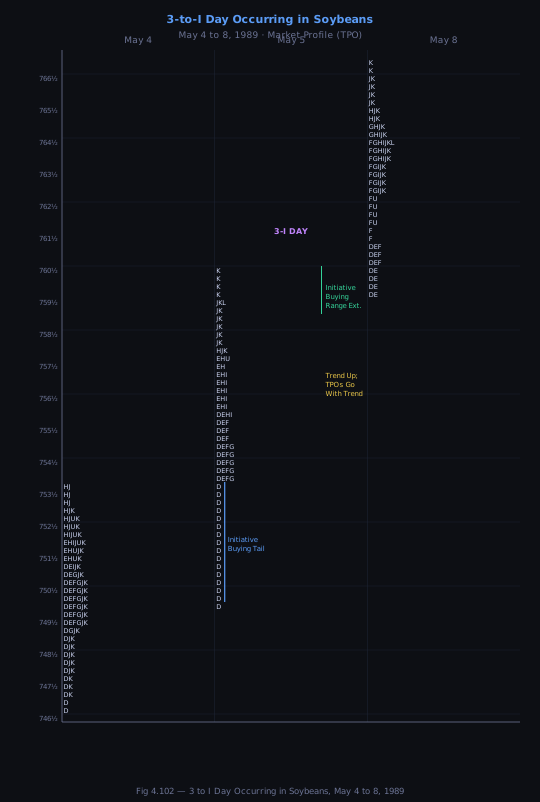
Fig 4.102 — 3-to-I Day Occurring in Soybeans, May 4 to 8, 1989. May 5 (centre column) is the 3-to-I day. The D-letter tail from 750.00 to 753.75¢ is the initiative buying tail — single prints showing aggressive buyers entered below value. Above the tail, TPOs climb in one-timeframe fashion through 758–760¢. The initiative buying range extension (K, JKL) at the top confirms other-timeframe buying. May 8 (right) follows through with a wide range up day from ~759 to 767¢.
- Anatomy of the 3-to-1 day
- Phase 1 — three-timeframe opening: market tests both directions; responsive activity is visible; wide initial balance; profile appears normal
- Phase 2 — initiative tail forms: price is driven aggressively in one direction with single prints; other-timeframe participants have entered; no responsive opposition at the extreme
- Phase 3 — one-timeframe trend: each TPO period extends in the direction of the tail; no two-timeframe trading; profile builds an elongated column on one side
- Phase 4 — range extension: final period(s) push beyond the developing value area; confirms other-timeframe control
- Trading the 3-to-1 day
- Entry: once the one-timeframe structure is confirmed (2–3 periods of consistent higher highs), enter in the direction of the trend with a stop beyond the initiative tail
- Target: the day's range extension — in a buying 3-to-1, the close typically occurs near or above the range extension high
- Context: the 3-to-1 day is most significant when it occurs at a long-term reference level (e.g., the bottom of a multi-week bracket), because it signals that other-timeframe participants have rejected that level
- The May 4–5 context: May 4 was a narrow, indecisive session — a classic setup day before the 3-to-1 day's resolution
- Summary — Transitions §4.45–4.48
- Profiles across timeframes (§4.45): each timeframe nests in a larger one; the long-term composite reveals structure invisible in single sessions
- Japanese Yen Region A (§4.46): falling long-term POC + selling gap = other-timeframe seller control; bracket ⑤ without tail = low not confirmed
- Japanese Yen Region B (§4.47): bracket break (gap below ⑤) = highest-confidence sell; one-timeframe Region B profile = uncontested selling auction
- 3-to-1 day (§4.48): initiative tail + one-timeframe follow-through = other-timeframe participant entry; most significant at long-term reference levels
4.49 The 2I-1R Day
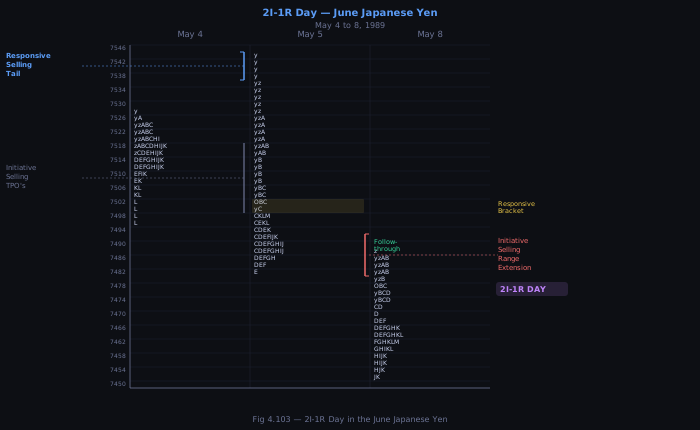
Fig 4.103 — 2I-1R Day in the June Japanese Yen, May 4 to 8, 1989.
- Anatomy (May 5): (1) Responsive selling tail at the open (7544–7538) — sellers reject the overnight high; (2) one-timeframe selling from 7536 down through 7500; (3) a brief responsive bracket (OBC at 7502–7504, yC at 7500) confirms two-timeframe activity; (4) a second initiative selling wave drives a range extension down to 7482 (E-period low) — the 2I-1R signature.
- Setup day (May 4): A normal-to-narrow day clustered near 7500–7528. Its tightly overlapping value warns that the market is coiling. The lack of a buying tail means longs have no protected reference — a precondition for the sell-off.
- Follow-through (May 8): Price gaps far below May 5's range extension, opening at 7488 and descending to 7450. The entire range of May 8 sits below the May 5 range extension low — unambiguous other-timeframe seller control.
- Trading implication: The responsive buying tail at the top of a 2I-1R day is the highest-confidence entry for shorts. Each initiative selling wave thereafter is a re-entry signal. Longs should stand aside until a tail forms at a known long-term support.
- Contrast with 3-to-1: The 3-to-1 day (§4.48, May 5 soybeans) had an initiative buying tail followed by uncontested upside. The 2I-1R day has a responsive selling tail (sellers answer the open drive) followed by two separate selling auctions. The presence of a brief two-timeframe pause between initiative waves is what distinguishes 2I-1R from a pure trend day.
4.50 The Value-Area Rule
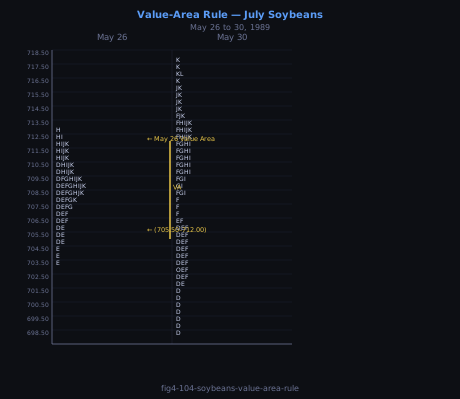
Fig 4.104 — The Value-Area Rule in July Soybeans, May 26 to 30, 1989.
- May 26 value area: Approximately 705.50–712.00¢ (the 70% volume zone). The POC is near 709–710. The profile is single-distribution, symmetric — well-defined value.
- May 30 setup: Price opens at 703.00¢, below the May 26 value area low of 705.50¢. This is the trigger condition. Once D-period trades back up through 705.50, the value-area rule is activated — expect a probe to 712.00¢ (the upper bound) to follow.
- May 30 resolution: Price rallies all the way to 718.00¢ by K-period, penetrating the value area completely and extending well above its high. The rule not only predicted the traverse but the breakout magnitude itself — once accepted above the VA high, price auctions freely upward.
- Why it works: Value areas are built by two-timeframe activity. When price re-enters value, the locals and short-term traders who defended the earlier bracket are now covering shorts and adding longs, providing fuel to drive through the area. Other-timeframe buyers who missed the original range see re-entry opportunity and add conviction.
- Practical application: Enter long when price first re-enters the VA from below (or short when re-entering from above). Initial stop just outside the VA entry point. Target the opposing VA extreme. Risk-reward is excellent because the stop is tight and the target is the full VA width.
- Important caveat: The rule requires acceptance inside the value area — at minimum, two TPO prints at the entry price. A single tick probe that immediately reverses is not acceptance. Always wait for the market to confirm entry before committing.
4.51 Opening within a Spike
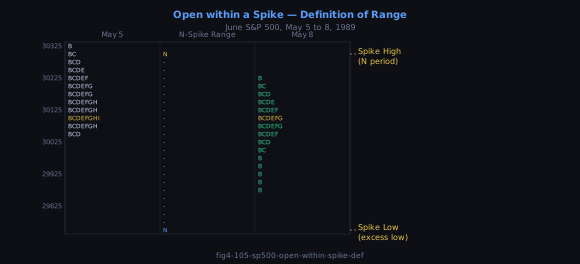
Fig 4.105 — Open within a Spike — Definition of Range, June S&P 500, May 5 to 8, 1989.
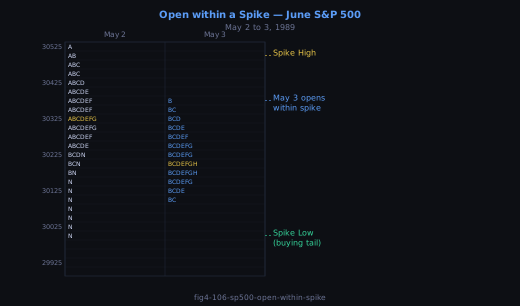
Fig 4.106 — Open within a Spike, June S&P 500, May 2 to 3, 1989.
- Spike definition (Fig 4.105): On May 5, the N-period alone prints from 311.00 down to 309.00 in the S&P — a spike down. The spike range is that single-period column. May 8 opens at 308.60 — within the spike range (between spike top 311.00 and spike bottom 308.60).
- Open-within dynamics: Expected activity is Normal or Neutral. The day-timeframe uses the spike bottom as support and the spike top as resistance. These levels hold for an initial probe outside the spike region only — if double TPO prints appear above or below the spike, the support/resistance is cancelled and the market has made a new directional statement.
- May 2–3 example (Fig 4.106): On May 2, the N-period spike sweeps through 311.70–311.30, creating the spike. On May 3, the open is within the spike range. Price subsequently builds a Normal day that uses both the spike bottom (≈309.50) as support and the spike top (≈311.40) as resistance before breaking below on high volume.
- Spike top and bottom as reference: The spike top is day-timeframe resistance; the spike bottom is day-timeframe support. A trade initiated at the spike top (short) or spike bottom (long) has the entire spike range as its target with a very tight stop just beyond the spike extreme.
- Double-TPO cancellation: If the market prints two TPOs above the spike top, the resistance is cancelled — longs are now favored with the spike bottom as the new support. Conversely, two TPOs below the spike bottom cancel support and signal a trend continuation to the downside.
4.52 Opening outside a Spike
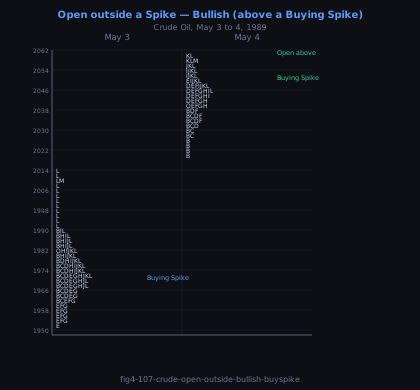
Fig 4.107 — Open outside a Spike — Bullish (above a Buying Spike), Crude Oil, May 3 to 4, 1989.
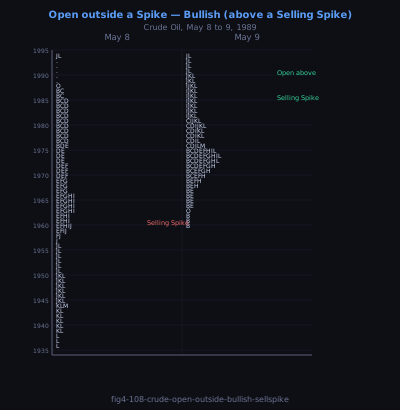
Fig 4.108 — Open outside a Spike — Bullish (above a Selling Spike), Crude Oil, May 8 to 9, 1989.
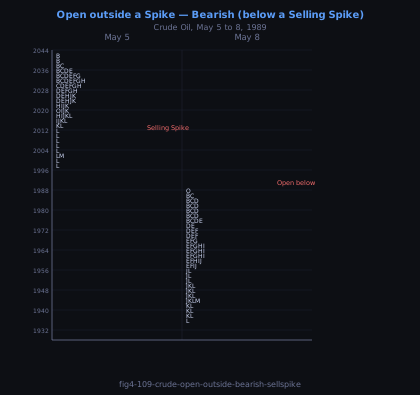
Fig 4.109 — Open outside a Spike — Bearish (below a Selling Spike), Crude Oil, May 5 to 8, 1989.
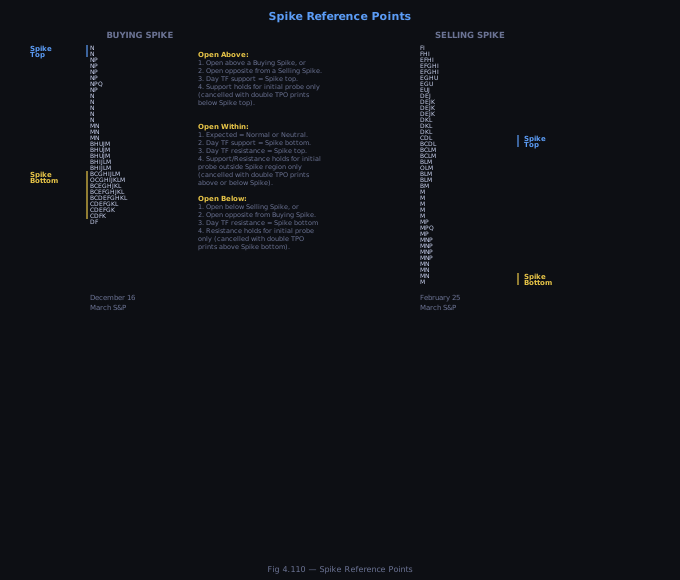
Fig 4.110 — Spike Reference Points: summary schematic for Buying and Selling Spikes.
- Open above a Buying Spike (Fig 4.107, May 3–4): On May 3, a buying spike (L-period) runs from ≈1982 up to ≈2014. May 4 opens at 2020 — above the spike top. The spike top (≈2014) now becomes day-timeframe support. As long as price stays above the spike top, buyers are in control. The May 4 profile builds entirely above the spike, with a strong range from 2020 to 2060 — a classic Trend day above support.
- Open above a Selling Spike (Fig 4.108, May 8–9): On May 8, a selling spike (J-period) runs down from ≈1988 to ≈1938. May 9 opens at 1963 — above the spike top (≈1988). This is the "open opposite from a Selling Spike" scenario: the market has rejected the sell-spike entirely. The spike top becomes support; day-timeframe resistance is the spike top. May 9 builds above 1960, confirming bullish sentiment.
- Open below a Selling Spike (Fig 4.109, May 5–8): On May 5, a selling spike (L-period) runs from ≈2014 down to ≈1998. May 8 opens at 1988 — below the spike bottom (≈1998). This is strongly bearish. The spike bottom (≈1998) becomes day-timeframe resistance. May 8 builds an entire profile below 1990, trending down to 1936 — resistance was never challenged.
- Reference diagram (Fig 4.110): The schematic summarizes all three open-relative-to-spike scenarios for both Buying Spikes (Dec 16 March S&P) and Selling Spikes (Feb 25 March S&P). Key rules: (1) Open Above → spike top = support, holds for initial probe only; (2) Open Within → spike = normal range boundary; (3) Open Below → spike bottom = resistance, holds for initial probe only. Double-TPO prints cancel these reference levels.
- Trading implication: An open outside the spike is among the most actionable setups in the profile. The trade is with the open — if above the spike, buy any retest of the spike top; if below, sell any rally to the spike bottom. Risk is defined as a close back inside the spike range (which signals rejection and requires a stop-out).
4.53 Balance Area Breakout
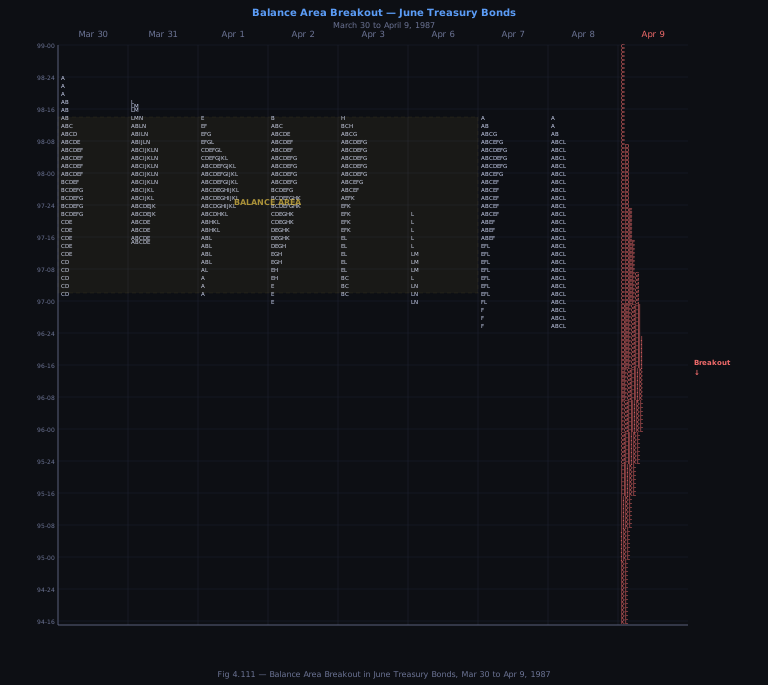
Fig 4.111 — Balance Area Breakout in June Treasury Bonds, March 30 to April 9, 1987.
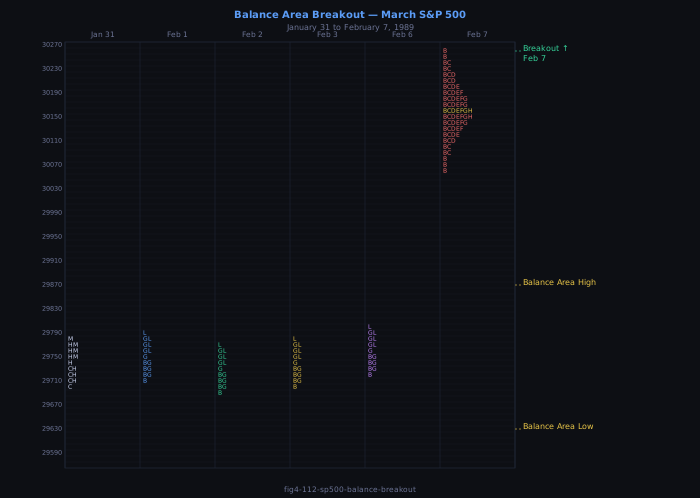
Fig 4.112 — Balance Area Breakout in the March S&P 500, January 31 to February 7, 1989.
- Definition of balance area: For a day trader, balance may be two or three days of overlapping value. For a swing trader, five days. For a long-term trader, a major bracket period. The definition scales with timeframe — the important signal is multiple sessions of congestion followed by a decisive break.
- T-Bond example (Fig 4.111, Mar 30–Apr 9): Eight sessions of overlapping value from 97-03 to 98-16 — a very tight 1¼-point band. On April 9, C-period breaks below the balance-area low (97-03) established on April 3. This is the trigger. Traders should enter short when C-period prints below 97-03. Stop: a few ticks above the breakout point, because a return into the balance area signals rejection by responsive buyers. The April 9 profile then extends all the way to 94-21 — nearly three full points from the entry.
- S&P 500 example (Fig 4.112, Jan 31–Feb 7): Three days of overlapping value (Feb 1–3) at approximately 297.20–299.70 constitute the balance area. Feb 6 probes below (near 296.40) but generates no follow-through — a false break. Traders go short on the probe but exit quickly when price returns into the balance area. Crucially, this failed downside probe prepares traders to be aggressive on an upside breakout. Feb 7 opens above 300.40 and runs to 302.60 — a clean 2-point breakout rally.
- False breakout handling: The Feb 6 down probe that fails is a key lesson. When a breakout has no follow-through and price returns inside the balance area, exit promptly at minimal loss. The failed break is itself information — it tells you the market tested the lows and found no new selling interest. This prepares you for the opposite direction.
- Why breakout trades feel late: After watching price oscillate sideways for several days, it feels as if the best entry was earlier. In reality, a breakout from a balance area is usually the start of a much larger move. Trades placed with the initiator are ultimately early relative to the full move. Risk is minimal (stop just inside the balance area) and profit potential is very high.
- Balance area vs. bracket: Balance areas are short-term (days); brackets are longer-term (weeks to months). The same logic applies to both — price stored in a range is energy waiting to be released. But balance-area breakouts are tactical, day-to-swing trades; bracket breakouts carry longer-term trend implications.
4.54 Selling Gaps
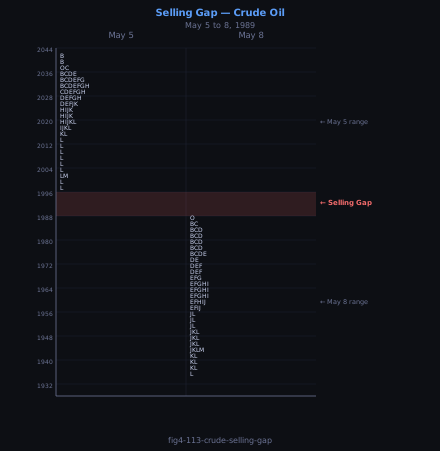
Fig 4.113 — A Selling Gap Occurring in Crude Oil, May 5 to 8, 1989.
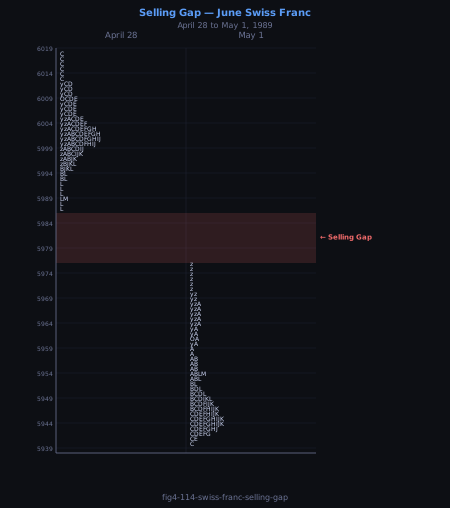
Fig 4.114 — A Selling Gap Occurring in the June Swiss Franc, April 28 to May 1, 1989.
- Crude Oil (Fig 4.113): May 5 built a range from 1998 to 2042. May 8 opens at 1988 — entirely below May 5's range. The gap (1990–1998) is a no-man's land; no TPO letter prints there. The gap top (1998) becomes the highest-conviction short-sale reference for the day. Any rally into the gap should be sold.
- Swiss Franc (Fig 4.114): April 28 ranged from 5987 to 6018. May 1 opens at 5976 — again a clean gap below. The gap zone (5977–5986) is the key reference. The z-period tail on May 1 confirms other-timeframe sellers driving price lower from the open. The gap is not filled — the selling conviction is sustained all session.
- Why gaps matter: Under normal two-timeframe conditions, responsive buyers would enter near the prior day's low to defend value. A gap means those buyers never showed up — other-timeframe selling overwhelmed any responsive interest. This is directional certainty of the highest order.
- Gap as reference: The gap top is day-timeframe resistance. If price probes into the gap and two TPOs print there, the gap is beginning to fill — the short trade should be exited. If price immediately turns back below the gap entry, the resistance is confirmed and the short can be re-added.
- Trading implication: Enter short on the open or the first rally toward the gap top. Stop above the gap top (double-TPO close inside the gap cancels the signal). Target is the prior day's value area low or beyond.
4.55 Filled Gaps
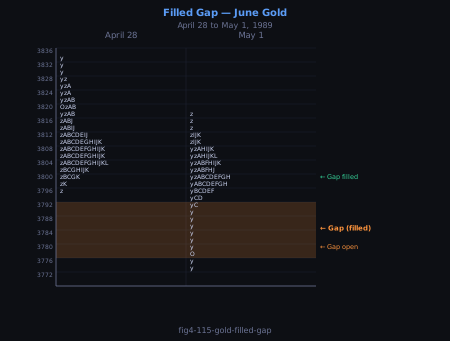
Fig 4.115 — A Filled Gap Occurring in June Gold, April 28 to May 1, 1989.
- April 28–May 1 Gold (Fig 4.115): April 28 ranged from 3796 to 3834. May 1 opens at 3778 — below April 28's low of 3796, creating a selling gap. However, after a quick test of 3778 (the O-period), responsive buyers enter. The y-period rallies back above 3796, and by mid-session the profile is trading fully within April 28's range. By the end of the session, May 1 has traded above 3812 — well inside April 28's value area. The gap is filled.
- Signs the gap will fill: The key signal is a tail forming at or near the gap opening price. A long tail at the gap low (for a selling gap) means only one TPO period found sellers at those prices — responsive buyers quickly arrived. When the tail is clear and price immediately begins to recover, exit any short positions from the gap.
- Cancelled signal: Once the gap is filled (price accepted back inside the prior day's range), the bullish/bearish premise of the gap is negated. The trader should reverse position if the gap fills convincingly (two TPOs inside the prior range), because the failed auction implies the opposite direction is now preferred.
- Contrast with selling gaps (§4.54): In the Crude and Swiss Franc examples, price never returned to the gap zone — the gap held all day. In Gold, the gap was rejected immediately, confirming that the selling auction was a failed attempt. The market's speed of rejection is the key differentiator: the faster and more decisive the fill, the more convinced you can be that the gap was a false directional signal.
4.56 Nontrend Days
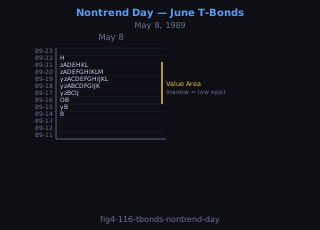
Fig 4.116 — A Nontrend Day Occurring in June Treasury Bonds, May 8, 1989.
- Structure (Fig 4.116): The May 8 T-Bond Nontrend day spans only 89-14/32 to 89-22/32 — a mere 8/32 range. Every period from B through M prints in nearly the same narrow band. There is no tail, no range extension, no clear initiative activity. The y and z periods (opening rotations) are the widest part of the day.
- Identification: A Nontrend day is characterized by: (1) very narrow initial balance that barely widens all day; (2) TPOs stacked on top of each other with no directional separation; (3) no clear open type — the open is inside the prior day's value area with no follow-through; (4) low volume and tight bid-ask spread activity.
- What to do: The answer is simple — do nothing. There is no edge in a Nontrend day. Any position taken will be based on random price rotation, not market structure. The opportunity cost of sitting out is zero compared to the real cost of taking forced trades that produce small losses with no upside.
- Context clue: A Nontrend day often precedes a significant directional move. The market is coiling, building latent energy before the next auction. Note that May 8 (this Nontrend day) came after the employment report news event (see §4.58), and the market was digesting that information. The following days (May 9 onward) produced a major directional move — precisely because of this period of compression.
4.57 Nonconviction Days
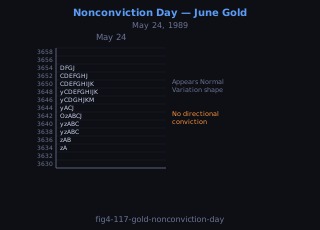
Fig 4.117 — A Nonconviction Day Occurring in June Gold, May 24, 1989.
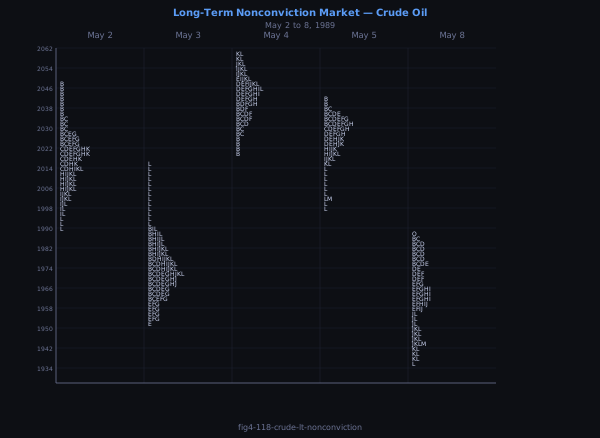
Fig 4.118 — A Long-Term Nonconviction Market. Crude Oil, May 2 to 8, 1989.
- Gold (Fig 4.117): May 24 has a 22-point range (3634–3654) that looks respectable. The y, z, and A periods build a lower bracket; then periods C through M work the upper portion. In hindsight it resembles a Normal Variation day. But no period established clear support or resistance, and the Open-Auction at 3642 (OzABCJ) never triggered a directional auction. A trader entering on any breakout would have been immediately faded.
- Key distinction from Normal days: On a genuine Normal or Trend day, each successive period either holds or extends the prior period's reference point. On a Nonconviction day, each period's direction is random relative to the prior — there is no accumulation of directional evidence. The result is a profile that looks complete but carries no predictive information.
- Long-term version (Fig 4.118): Crude oil May 2–8 shows five days of overlapping, directionless profiles. Each day's range partially overlaps the prior, but no day breaks away with conviction. May 4 probes up to 2060 but immediately falls back. May 5 falls to 1998 but doesn't trend lower. May 8 gaps down but from a position already below May 3's range. The entire five-day period conveys no long-term directional signal — long-term traders should have no position.
- Practical recognition: During the session, a Nonconviction day reveals itself through: (1) the open is within prior value with no follow-through; (2) each new period probes a new direction but doesn't attract follow-on activity; (3) no reference point from earlier in the day holds for more than one or two periods. When you notice this pattern developing, reduce position size or stand aside entirely.
4.58 News-Influenced Markets
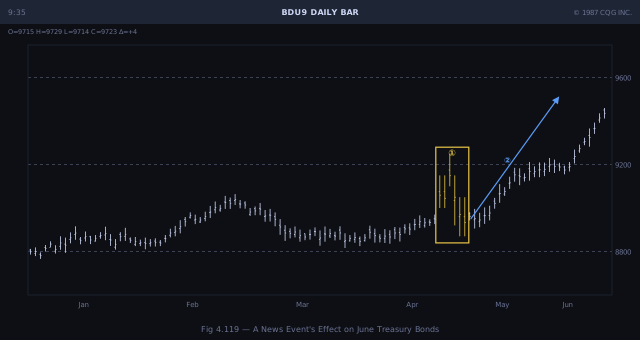
Fig 4.119 — A News Event's Effect on June Treasury Bonds (daily bar, Jan–Jun 1989). ① marks the news-event spike zone; ② marks the subsequent acceptance and rally.
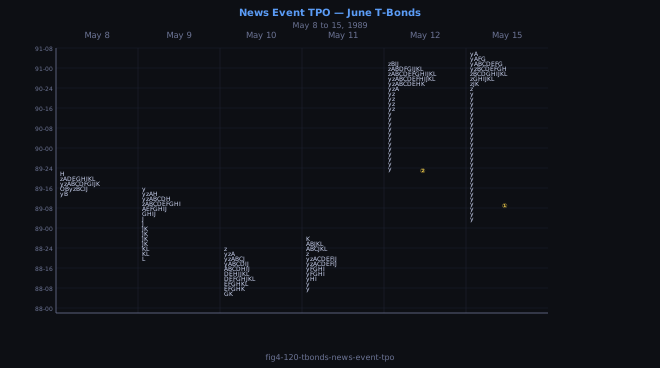
Fig 4.120 — A News Event's Effect on June Treasury Bonds, May 8 to 15, 1989. ① = spike-bottom reference (May 15 tail support); ② = May 12 spike reversal level.
- The news event (Fig 4.119): The employment report on approximately May 1 caused T-Bond prices to spike sharply in zone ①. This is marked on the daily bar chart as a cluster of high-volatility bars near 9200. The subsequent activity (②) shows the market accepting higher prices and beginning the sustained rally to 9700 by June. The key: the news moved price, and the market accepted the new level, validating the move.
- May 8 Nontrend day (Fig 4.120, col 1): The day of the news itself produced the narrowest possible range (89-14 to 89-22) — the market was paralyzed. This is the Nontrend day described in §4.56. Participants were waiting to see how prices would be accepted at the new levels before committing.
- The sell-off (May 9–11): After the news-induced move, the market sold off sharply (May 9: 89-16 down to 88-20; May 10: continued lower to 88-06; May 11: sideways 88-08–88-28). These were the responsive sellers testing whether new lower prices would attract buyers. The POC and value area were migrating rapidly downward.
- May 12 reversal (② reference): On May 12, price gapped up on a y-period tail that reached from 89-26 all the way down to 88-16 (the ② level), and then the body of the day built at 90-24–91-02. This was the other-timeframe buyers' answer — they absorbed all the selling of May 9–11 and drove price back above the news-event zone. The May 12 spike bottom (② near 89-18–89-22) is the most important long-term reference point created by this news event.
- May 15 follow-through (① reference): May 15 opened with a y-tail extending all the way down to 89-06 (① level) before the body built at 90-24–91-06. The fact that the ① tail found support at the same level as May 9's first sell-off low confirms that the market has accepted prices above 90-00. Long trades initiated at ① (the tail extreme) had the ② level as an intermediate target and the 91-06 body top as a further target.
- Framework for news events: (1) Identify the news-driven spike. (2) Wait for acceptance or rejection. (3) If accepted (two TPOs at new prices with no reversal), trade with the new direction. (4) If rejected (tail forms at the spike extreme with immediate reversion), fade the move. (5) The spike extremes become the most significant reference points for subsequent days, regardless of whether the move was accepted or rejected.
5.1 Introduction — The Results Equation
- Beyond competency: A futures trader who has progressed beyond competency begins to intuitively feel when conditions are right for a successful trade. This intuitive ability is not purely academic — it is the synthesis of derivative knowledge and empirical market experience.
- Three pillars: The Results Equation identifies three interdependent components. Market understanding (the bulk of Chapters 1–4) provides the structural framework. Strategy channels that understanding into actionable plans. Self-understanding bridges the two — without it, even perfect market analysis will not produce consistent results.
- The learning arc: Like a musician who eventually stops thinking about fingering and simply plays, a proficient trader reaches a point where structural recognition is automatic. The challenge then shifts inward: learning to trust your intuition and manage the psychological forces that distort decision-making.
- David's piano: The book uses a college student named David who learned piano as its central metaphor throughout all five skill levels. At the Proficient stage, David transcended derivative knowledge — fingering was committed to muscle memory, theory was fully assimilated. He could finally express himself through the instrument. Proficient trading is analogous: the market structure becomes the instrument; self-understanding enables expression.
5.2 Self-Understanding
- The real job description: A hypothetical honest advertisement for trading would describe: rigorous intellectual schooling, intensive introspection to identify invisible inner blocks to success, a long behavior-modification process, and daily on-the-job training — all with no guarantee of outcome. Most people entering the field would not apply to such a position.
- Innate skills matter: Just as a surgeon needs precision hand-eye coordination and a physicist needs a mathematical mind, a trader needs specific innate skills: the ability to process uncertainty, manage risk emotionally, tolerate loss, and maintain objectivity under pressure. These seeds must already be planted; they can be cultivated, but not conjured from nothing.
- The emotional reward: Successful futures traders often describe their motivation in terms of the intellectual and emotional challenge of mastering a complex, dynamic system — not the money per se. Traders who enter the field primarily for the money are analogous to Olympic athletes who compete only for sponsorship: they never develop the intrinsic motivation that drives true excellence.
- Common entry mistake: Traders who begin their careers by seeking "the system" — a black-box algorithm or a guru's rules — are outsourcing their self-development. When the system fails (and all systems do under certain conditions), they have no internal framework to fall back on. Self-understanding cannot be purchased; it must be earned through experience and honest reflection.
5.3 Self-Observation
- What to record: A useful trading journal captures thoughts, feelings, and surrounding circumstances before, during, and after each trade — not just outcomes. Note the market conditions, your emotional state, your reasoning, the open type, whether you followed your plan, and how you felt about the result. Over time, behavioral patterns will emerge.
- Patterns to look for: Common self-undermining patterns include: (1) exiting profitable trades too early due to anxiety; (2) holding losing trades too long due to ego; (3) over-trading on boring (Nonconviction) days; (4) paralysis on high-conviction days due to conflicting outside opinions; (5) size expansion after a string of wins (overconfidence); (6) size reduction after losses at exactly the wrong moment.
- External influences: Note whenever a trade decision was influenced by a news story, analyst opinion, or chat room commentary. If you find that external opinions consistently degrade your performance, eliminate those sources. Streamlining information to purely market-generated data is a structural discipline that reduces noise.
- The feedback loop: Self-observation creates a feedback loop: identify a behavior → trace its origin → modify the behavior → observe the new outcome. This is the mechanism by which experience converts into self-understanding. Without the journal, behavioral patterns repeat invisibly. The journal makes them visible and therefore addressable.
5.4 The Whole-Brained Trader
- The left hemisphere in trading: The left brain is essential for preparation: setting up watchlists, calculating stop levels, reviewing structural history on bar charts, categorizing yesterday's profile, and designing your trade plan. This pre-market work is inherently sequential and analytical. During this phase, the left brain should dominate.
- The right hemisphere in trading: Once the market opens, the volume of simultaneous, conflicting signals far exceeds what the left brain can process sequentially. The right brain — pattern recognition, holistic assessment, gut reactions — becomes the primary tool. The feeling that "this market isn't acting right today" is the right brain communicating what the left brain cannot yet articulate.
- The Mike Singletary model: Between games, linebacker Mike Singletary used left-brain analytical skills to study the opposing offense and design a game plan. During the game, he operated right-brain dominated — reacting instinctively to an overwhelming stream of stimuli. The preparation enables the intuition; neither works alone.
- Developing balance: The first step is knowing which hemisphere dominates you. A highly left-brained trader may rigidly follow a rule system and miss the feel of the market; a highly right-brained trader may trade on pure emotion with no structural discipline. Identifying your default mode is the starting point for developing the complementary skill. The whole-brained trader switches hemispheres fluidly as the situation demands.
- Practical implication: If you find yourself murmuring "I cannot believe what is happening in the market today" — that is your left brain whispering that its model has been invalidated. The correct response is to defer to what the market is actually doing (right brain) rather than what your analysis predicted it should do (left brain). The market is always right.
5.5 Strategy: Trading as a Business
- Capital: Rule 1 — be adequately capitalized from the start. An undercapitalized trader is forced into suboptimal decisions (holding losing positions too long because they cannot afford the loss; avoiding winning trades that require more margin). The book's example guidelines: initial account $100,000; if capital grows to 125%, withdraw 25%; if capital shrinks to 50%, cease trading. The withdrawal rule banks profits; the stop-trading rule preserves capital for a fresh start.
- Trade location: Where you enter determines your risk/reward ratio more than almost any other factor. Just as a gas station on a four-way corner off an interstate is better located than one on a median-divided road, a trade entered at a long-term excess or balance-area extreme has a better structural cost/revenue profile than a trade entered in the middle of the range. Planning trade location in advance — placing orders before the session — prevents emotional paralysis at the moment of opportunity.
- Timing: Enter orders ahead of time at known reference levels. Use the open type (drive, test-drive, rejection, open-auction) to calibrate same-day entry conviction. In a one-timeframe trending market, place the trade early and monitor for improvement. In a two-timeframe balanced market, wait for a probe to the bracket extreme before entering.
- Information: Use only market-generated information: structure, time, and volume. Use daily bar charts for structural history across sessions. Eliminate opinionated outside sources (news commentary, analyst recommendations, social media). The best trades are made before the information becomes obvious to everyone — acting on early structural signals rather than waiting for confirmation.
- Know your competition: Understand who the other participants are and how they behave. At long-term lows, the entire market is selling — it is the least popular moment to buy. That is precisely when other-timeframe buyers are accumulating. At long-term highs, everyone is buying — that is when the smart money is distributing. Recognizing the behavior of the other timeframe is the competitive edge of Market Profile analysis.
- Consistency: A proficient trader aims to generate revenue virtually every day — not through large speculative wins, but through consistent small wins that cover overhead. The old adage "successful trading is a lot of small losses and a few big winners" is false for proficient traders. Small losses are overhead costs, not a strategy. Consistency breeds objectivity and cash flow; it keeps you in the game.
- Inventory: Your open positions are your inventory. Day traders should end the day flat (zero inventory) except for "free exposure" situations where a winning trade has been partially locked in. Long-term traders should never carry more than 50% of capital in open positions. The parallel: a jeweler holds diamonds patiently; a grocery store turns inventory rapidly. Know your trading timeframe and manage inventory accordingly.
- Risk: Never commit more than 50% of capital to margin, or more than 50% of usable margin in any one direction. Trade no more than three related markets simultaneously. Use structural stops (at minimum) at all times. Add to a trade only when the added position still results in a profitable overall position. These rules are not suggestions — they are the conditions for staying in business.
- Record keeping: Categorize every trade by profitability (gain/loss), market, day type, timeframe (day/swing/long-term), trade location, and position size. Review records weekly to identify trends — both positive patterns to reinforce and negative patterns to eliminate. Records make invisible patterns visible, which is the same function that the journal serves for emotional patterns.
- Dedication: Arrive at least 30 minutes before the market opens to review overnight activity. Keep charts by hand — the physical act of drawing the profile develops a kinesthetic "feel" for the market's auctions that cannot be replicated by a software chart. Perform a daily evaluation of each market traded. Review the day's activity after market close. Dedication is not optional; it is the compound interest of skill development.
5.6 The Trading Strategy Flow Chart
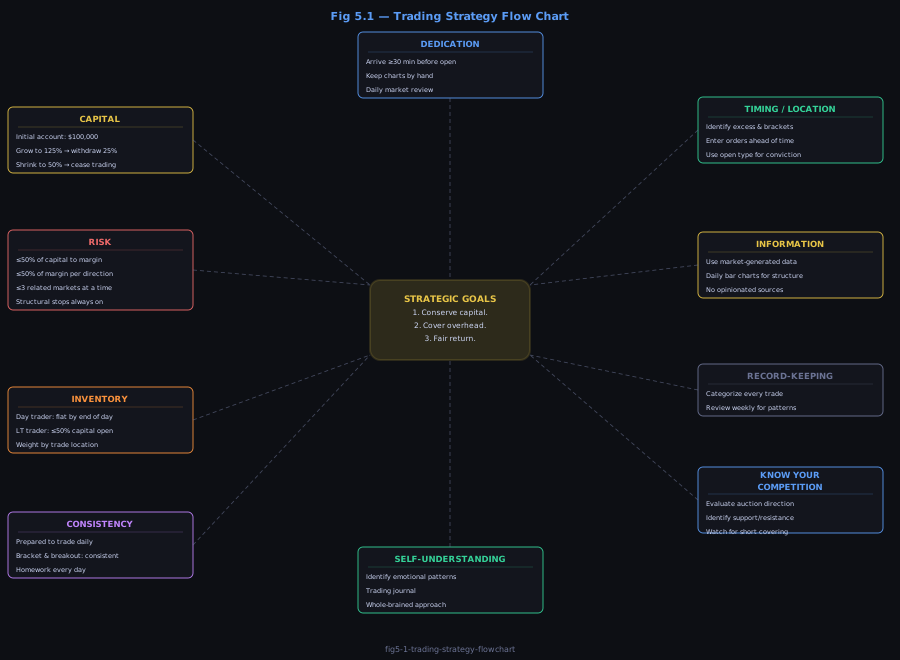
Fig 5.1 — Trading Strategy Flow Chart. The hub (Strategic Goals) and eight satellites define the complete infrastructure of a trading business.
- Three steps to build your strategy: Step 1 — accept and begin to view trading as a business. Step 2 — develop a comprehensive strategy based on the twelve business concepts shown in Fig 5.1 (Capital, Timing, Location, Knowing Your Competition, Knowing Yourself, Consistency, Information, Inventory, Risk, Goals, Record Keeping, Dedication). Step 3 — formulate specific rules and mini-strategies to guide individual trades within the framework of Step 2.
- The goals are modest — on purpose: The strategic goals are deliberately conservative. "Conserve capital" comes first because a trader who loses their capital cannot trade. "Pay the overhead" comes second — daily revenue consistency keeps the operation running. "A fair return" is third, not first. This hierarchy forces risk management to precede profit-seeking, which is the opposite of how most new traders think.
- The chart as a diagnostic: Use Fig 5.1 as a weekly diagnostic tool. For each satellite, ask: am I actively applying this principle? Where is my strategy weakest? A trader who has excellent market analysis (left side: Timing/Location, Information) but poor self-management (right side: Risk, Capital, Consistency) will have inconsistent results. The weakest link determines overall performance.
5.7 Summary
— Bennett W. Goodspeed, The Tao Jones Averages
- The synthesis: Successful futures trading is the result of a delicate balance between derivative learning and experience, between analytical thinking and intuition. A proficient trader forms a strategy built upon three pillars: market understanding, self-understanding, and structural guidelines.
- Whole-brained balance: The proficient trader switches fluidly between left-brain discipline (planning, rules, structural analysis) and right-brain creativity (pattern recognition, intuition, holistic market feel). Neither dominates permanently. The goal is a central, integrated mode of processing that draws on both hemispheres as required.
- Self-understanding as a lifelong process: Unlike market structure, which can be learned from a derivative source (such as this book), self-understanding must be developed entirely through personal experience and introspection. A trading journal, honest performance review, and willingness to confront uncomfortable behavioral patterns are the tools. There is no shortcut.
- Trading is a business: The transition from competent to proficient requires viewing trading not as speculation or gambling but as an entrepreneurial endeavor. A proficient trader is an entrepreneur — managing capital, information, risk, inventory, and relationships within a comprehensive, personally tailored strategy. The market provides endless opportunities; the limiting factor is almost always the trader themselves.
6.1 The Expert Trader
— Benjamin Hoff, The Tao of Pooh
- Beyond derivative knowledge: Everything covered in this book — from the market's smallest structural unit to the nuances of self-understanding — is only the beginning. A derivative source can impart all the learning in the world, but much learning does not teach understanding. Expert trading begins within yourself.
- Belief as prerequisite: An athlete of average ability will defeat a more skilled opponent if he truly believes he can win. The same principle applies to trading. Without belief in your own potential, no amount of structural knowledge will produce consistent excellence. The inner conviction to succeed is a prerequisite, not a consequence, of expertise.
- The price of excellence: Achieving the level of expert in any pursuit requires complete dedication and determination — a desire to succeed that transcends personal sacrifice. Olympic swimmers train four to six hours daily. Great composers practice most of their waking hours. Top professionals in every field go beyond rules and calculative rationality to the higher ground of innovation and excellence. The question is not whether you understand the theory; it is whether you are willing to pay the price.
- The lifelong process: Expertise is not a destination; it is an ongoing process. Mistakes and frustration are not failures — they are the material from which understanding is built. With the inner strength that comes from believing in your potential, you can strive beyond the average and feel the exhilaration of completing what you set out to accomplish. Your newly acquired skill is just the start of a journey that will continue for a lifetime.
7.1 Perspective — Reading Multiple Timeframes
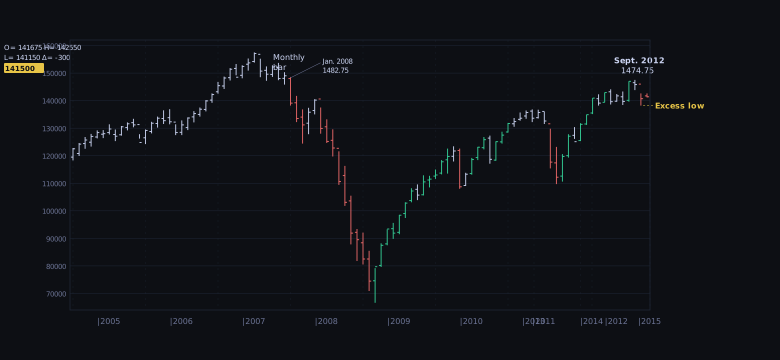
Fig 7.1 — S&P Indices Monthly Bar Taken December 2012. The monthly bar shows the S&P just below the multiyear high set in September 2012 (1474.75). An excess low was established in November. Current bar: O=1416.75, H=1425.50, L=1411.50, Δ=−3.00. The long-term trend remains up.
- Two core concepts: The most important concepts the experienced trader deals with at the monthly timeframe are excess and balance. Excess marks the end of one auction and the beginning of a new one. When a market comes out of balance it also represents the beginning of a new auction.
- Excess asymmetry: The excess on the September high is far less than the excess on the November low — an important structural asymmetry. Smaller selling excess at the top versus larger buying excess at the bottom favours the existing uptrend.
- Top-down order: Monthly bar establishes the macro context. Weekly bar will show change before the monthly bar does. Daily bar will show change before the weekly bar does. Profile provides the finest structural detail. Always read in this order.
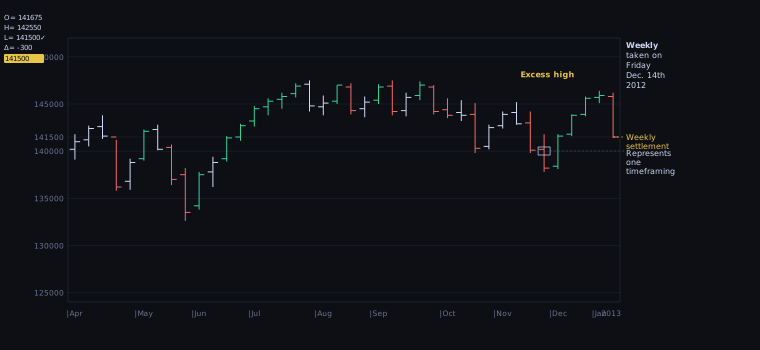
Fig 7.2 — S&P Weekly Bar. Taken Friday, December 14, 2012. The chart shows an excess low followed by four consecutive weeks of one-timeframing higher (each week's low does not take out the prior week's low). The most recent weekly settlement is close to the low of the week — a potential signal that the one-timeframing higher mode is ending.
- One-timeframing higher defined: One-timeframing higher occurs when the low of the next week does not exceed (take out) the low of the preceding week. Four consecutive weeks of this pattern constitutes a strong directional conviction from the other-timeframe buyer.
- Weekly settlement significance: The latest weekly settlement is close to the low for the week. Imagine what the weekly bar will look like if, during the early part of the next week, the prior week's low is taken out — the market will have stopped one-timeframing higher, and an excess high will be confirmed.
- Two scenarios to prepare: (1) The one-timeframing higher mode remains intact — the weekly low holds and the market continues upward. (2) The prior week's low is taken out early next week — an excess high is confirmed and the one-timeframing mode reverses. Preparing for both scenarios before the session opens prevents price blindness.
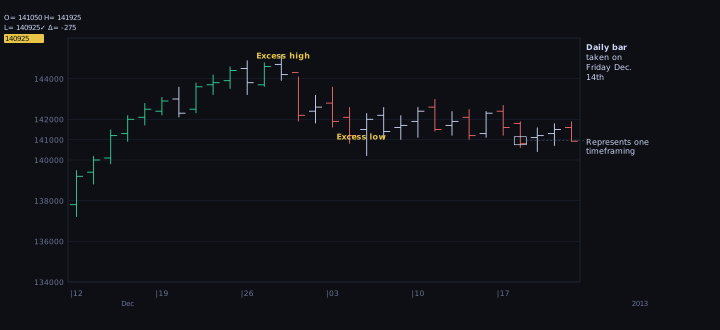
Fig 7.3 — S&P Daily Bar. Taken Friday, December 14, 2012. The daily bar shows an excess high, followed by a downward one-timeframing mode. This contrasts with the upward one-timeframing shown on the weekly bar — the ambiguity between timeframes is itself informative. Change is very likely to occur early in the next week.
- Timeframe ambiguity is opportunity: The upward one-timeframing mode on the weekly bar versus the downward one-timeframing mode on the daily bar presents an ambiguous picture. People abhor ambiguity — but real trading opportunities develop from ambiguous situations. If the situation were not ambiguous, everyone would be sharing the same position.
- Trading is about change: "Trading is about dealing with change. People generally don't like change, but change is at the heart of opportunity, in any endeavor." The cessation of a one-timeframing mode represents change. The daily chart shows the downward mode; the weekly shows the upward mode still barely intact. Early next week will resolve the ambiguity.
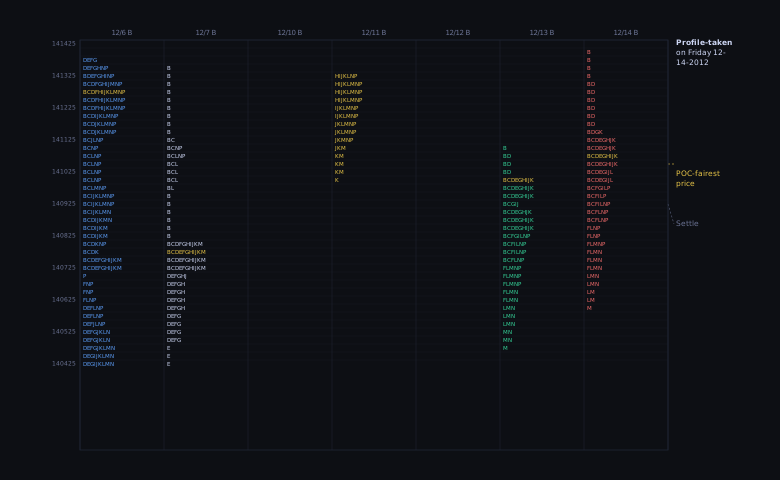
Fig 7.4 — S&P Daily Profile. Taken Friday, December 14, 2012. The December 14 profile (rightmost column) depicts an almost perfectly balanced day — the Point of Control is just a single tick above the center of the range. The settlement is close to the low. The POC represents the fairest price at which business is being conducted in the day timeframe.
- POC as fairest price: Think of the POC as the fairest price at which business is being conducted in the day timeframe. This conceptual approach makes it easier to understand what is actually occurring in the market. The question: are traders selling S&P futures at prices below the fairest price and becoming short-in-the-hole? Or are they buying futures above the fairest price?
- Balanced day implications: A balanced day means neither buyers nor sellers were able to move price meaningfully away from fair value. Any meaningful change to the weekly bar will require activity outside of Friday's daily balanced range. The weekly bar settled at a level where the market could continue to one-timeframe higher (status quo) or cease one-timeframing higher (change).
- Downward OTF within the week: The seven-day profile shows a progressive downward one-timeframing pattern from Dec 6 onward — each day's low is lower than the prior day's low. Dec 14's balance day is a pause within that structure, not necessarily a reversal. Context from the weekly bar is essential.
7.2 Overnight Inventory

Fig 7.5 — Overnight Inventory Example. Four columns: November 30 day session (11/30 B), November 30 overnight/Globex session (11/30 Q), December 2 electronic session (12/2 T), and December 3 pit opening (12/3 B). The overnight session builds a net long inventory well above the November 30 settlement. On December 3, the pit opens near the overnight high — and immediately sells off as long inventory is liquidated to bring the market into balance.
- The adjustment mechanism: The December 3 opening occurs near the high of the overnight trade and begins to sell off immediately. Long overnight inventory is immediately liquidated to bring the market into balance. This selling is not necessarily bearish — it is simply inventory adjustment.
- Why this matters for day traders: A shorter-timeframe trader who is unaware of the overnight inventory context might interpret the early selling as the beginning of a sustained downmove and enter short. In reality, the market is simply correcting an overnight imbalance. Misreading this early action can set up a losing bias for the entire session.
- Net long inventory = early selling risk: If overnight inventory is long and the market does not adjust (does not sell off), that is an indication of a strong market — at least in the short term. Quite often you will see an early adjustment when there is a significant degree of long or short overnight inventory. The best way to internalize overnight trading is to monitor it each day, always forming your own opinion.
- Preparation requirement: Your final morning analysis should assess overnight inventory and alert you to the potential adjustment. Traders who don't prepare — or don't know how to prepare — are at a serious disadvantage. Being prepared includes writing down at least three possible market scenarios: What will I do if the auction moves up, down, or remains in balance? How will I assess the conviction of those moves?
7.3 Gaps Can Be Gold
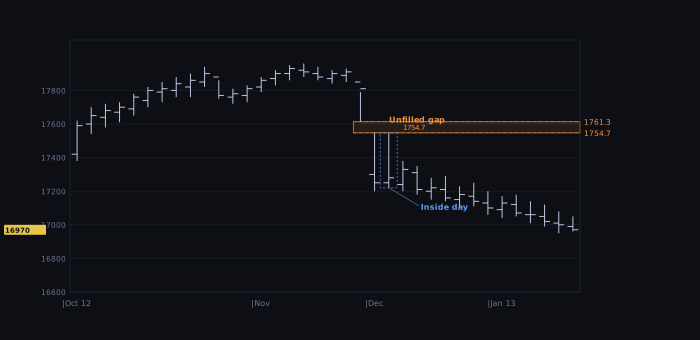
Fig 7.6 — Gold Daily Bar, Taken December 14, 2012. Leading up to November 23, 2012, financial news stations were interviewing traders and analysts who were bullish on gold based on price — price had been rising. The daily bar shows an unfilled gap between 1754.7 and 1761.3, followed by an inside day at the lower edge of the gap (1754.7). The gap remains unfilled and acts as overhead resistance.
- Gap structure: The unfilled gap between 1754.7 and 1761.3 represents a price vacuum — a zone where no transactions occurred during regular trading. Any subsequent rally that reaches this zone will face a structural test: does the market accept prices within the gap, or does it reject them?
- Inside day significance: The inside day that forms at 1754.7 — just below the gap's lower boundary — tells a story. The market is unable to enter the gap. Buyers at the lower gap boundary are being absorbed by sellers who are using the gap reference to execute short entries. Until the market closes above 1761.3, the gap remains an overhead reference that caps upside.
- Price-based bullishness vs. structure-based analysis: The media narrative at the time was based purely on rising price. Market Profile analysis — focused on the gap structure, the inside day, and the structural rejection — told a different story. Structure-based analysis identified a potential inflection point that price-based analysis missed entirely.
- Three-scenario framework applied to gaps: (1) Market fills the gap and accepts higher prices — structure has shifted bullish; trade long. (2) Market tests the gap boundary and reverses — gap confirmed as resistance; trade short. (3) Market consolidates near the gap without a directional test — maintain neutrality and monitor for conviction entry.
7.4 The Fairest Price Revealed
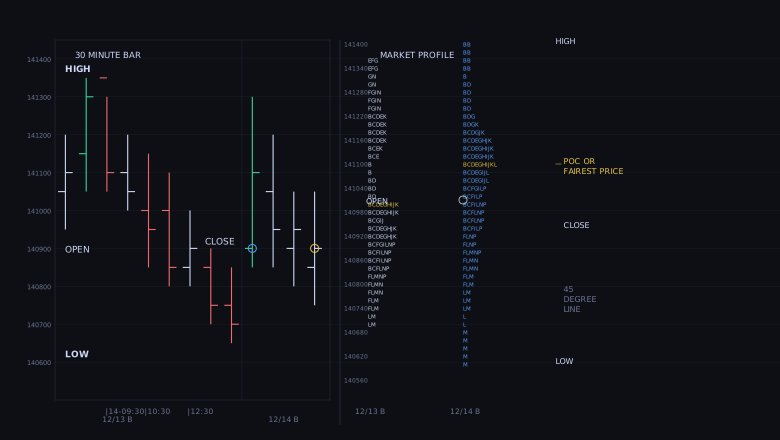
Fig 7.7 — Conventional Bar Chart versus the Market Profile Graphic, S&P 500, December 14, 2012. The 30-minute bar chart (left) and the Market Profile (right) display the same session. The Profile immediately reveals the structural inequality between different prices — the POC is clearly identified as the fairest price, and the 45-degree line shows the market's directional lean. This information is invisible in the bar chart.
- Bar chart vs Profile: We are not technically "Profile traders" in the narrow sense — we employ a range of tools and interwoven analysis. But we value the Market Profile for its ability to reveal the inherent inequality in different prices — information you can leverage to trade more competitively. The multidimensional Profile gives structure to the market's continuous two-way auction process.
- Short-in-the-hole mechanics: Selling that takes place below the fairest price is an indication of traders' willingness to sell futures below the current day's fairest price. Traders refer to this as selling "short-in-the-hole" — selling short at poor prices. There isn't always a short-covering rally following this pattern. However, the odds of profiting from remaining short have decreased, and the odds of a rally to adjust short-term inventory have increased.
- Structure vs. prediction: The study and interpretation of structure is a lifelong endeavor, as no two days are ever the same. Learning to read and interpret that structure can provide a serious edge, because it helps you avoid the perils of price blindness. Structure does not tell you what will happen — it tells you what is probable and helps you frame risk.
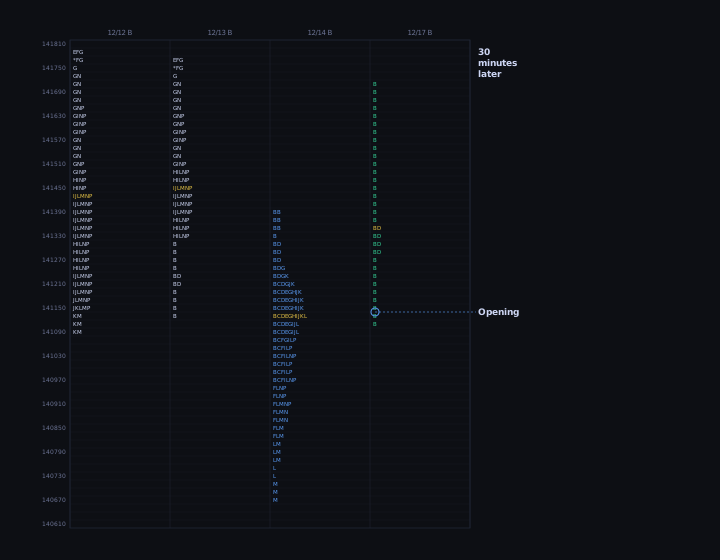
Fig 7.8 — December 17th after Opening. The capture was taken on Monday morning, December 17, 33 minutes after the opening, showing the early short-covering rally predicted by the Dec 14 structure. The market opened and immediately rallied sharply. You can never prove it was a short-covering rally — but from experience, the structural conditions were consistent with one: a balanced day with settlement near the low, POC well above the close.
- The prediction and the outcome: The Friday December 14 analysis concluded with the expectation of a balanced Monday opening. Any meaningful change to the weekly bar would occur outside of Friday's daily balanced range. December 17 opened and immediately auctioned higher — consistent with short-covering by traders who had been short-in-the-hole.
- Thinking in odds, not certainties: Thinking in terms of odds helps keep you from becoming too focused on price, which will help keep you out of bad trades. You may not have wanted to go home long on the December 14th close — but taking home a short was against the odds. Market structure, not price, contained the information necessary to read Friday's market.
- POC evolution: Prior to the second edition of Mind Over Markets, the Point of Control (POC) evolved into the more conceptual descriptor fairest price — the fairest price at which business is being conducted. This framing makes it easier to understand market behavior: sellers below the fairest price are in a poor structural position; buyers above it are in a poor structural position.
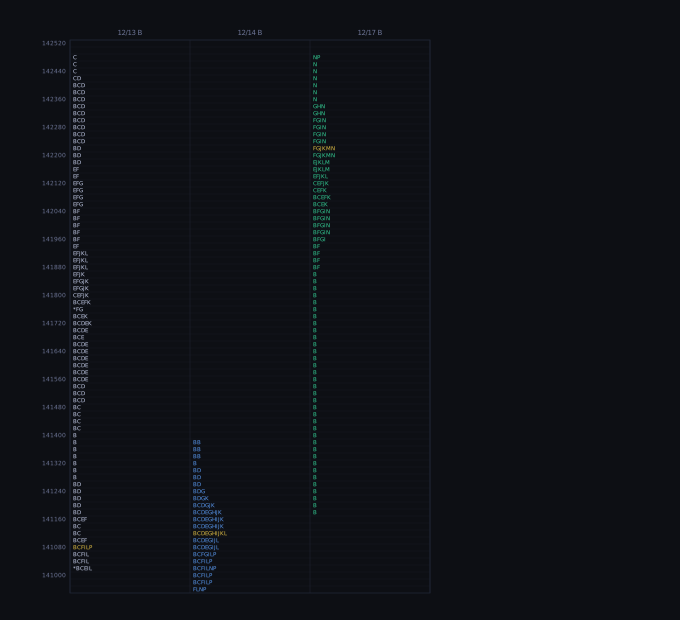
Fig 7.9 — S&P 500, December 13–17, 2012. The three-day composite shows December 13 (balanced with wide range), December 14 (balanced, POC above close), and December 17 (short-covering rally early in the session, one-timeframing higher). The structural sequence — excess high followed by downward OTF, then balanced close near the low — set up the conditions for the short-covering rally.
- Reading the sequence: December 13 showed a wide, balanced profile — both timeframes present, no clear directional conviction. December 14 confirmed the balance with a symmetric profile and a close near the low — building the short-in-the-hole condition. December 17 immediately resolved the imbalance with an upward move that exceeded the prior two days' highs.
- Experience as the teacher: This example was written about on Saturday December 15th and the follow-through was captured Monday December 17th. The structural analysis was completed before the outcome was known. Experience allows the trader to recognise these patterns in real time — but only by continually monitoring markets and building a library of structural situations.
7.5 A Landscape View of the Market
- Why simple systems fail: It is highly unlikely that simple systems will win over any reasonable length of time. That's why serious professional traders begin with a landscape view of the markets — no single market exists in isolation. The interconnections shift constantly, requiring an adaptive, holistic awareness that no mechanical system can replicate.
- Key inter-market relationships: Three foundational examples:
- Rising bond prices can be positive or negative for stocks depending on the environment — in some regimes, lower rates support equities; in others, a flight to bonds signals risk-off.
- A rising Dollar can be positive or negative for stocks depending on the circumstance — it may signal economic strength or compress earnings for multinationals.
- Crude oil is influenced by its own fundamentals, the Dollar, and the broader economy — it rarely moves in isolation.
- Sentiment shifts: The landscape view is not about continuously monitoring correlations — it is about detecting sudden shifts in sentiment across markets. A sudden break in bond prices while stocks are rallying, or an unexpected surge in the Dollar when commodity markets are extended, can precede a major move in the market you are trading. These signals appear first on the landscape.
- Landscape vs. price blindness: Price blindness affects traders who are too narrowly focused on a single instrument or timeframe. The landscape view is the structural antidote — it provides context that prevents you from being surprised by moves driven by factors outside your primary market.
7.6 Trends

Fig 7.10 — U.S. Dollar Index Weekly Bar, as of December 21, 2012. Settle: O=79.375, H=79.735, L=79.340, C=79.712 (+0.402). Six numbered structural points: ① Trading range formed after the September 2012 nonlinear break; ② Excess low at 78.945 (lower extreme test); ③ Excess high ~82.100; ④ Short-term trend downward; ⑤ Destination trade ~79.500; ⑥ Current settle 12-21-2012.
- The six-point structural narrative: (1) The current trading range evolved from the nonlinear break in early September 2012. Nonlinear breaks define the extremes of the brackets that develop thereafter — the range is validated between Excess Low 2 and Excess High 3. (2) The excess low at 78.945 occurred when price explored below the prior four weekly lows and found aggressive opportunistic buyers — a downside breakout failure. (3) Excess high at ~82.100 marks the top of the subsequent rally. (4) The short-term trend is now downward from the excess high. (5) The structural destination for the downside move is the prior balance area (~79.500). (6) The current settle at 79.712 confirms progress toward the destination.
- Downside breakout failure: When price tests below the lower extreme of a trading range and finds aggressive buyers (excess low), this is called a downside breakout failure. The rejection is powerful because it traps short sellers who entered below the range's lower extreme — their subsequent covering adds fuel to the upside move.
- Trading against the trend: If you are trading against the short-term downtrend (i.e., looking for longs), you must have excellent trade location — specifically at a long-term structural reference like the excess low or the prior balance area's lower boundary. You also want the trade to work quickly; if it doesn't, exit. Poor location plus a slow trade is the formula for large losses.
7.7 Daily Perspective & Cognitive Dissonance
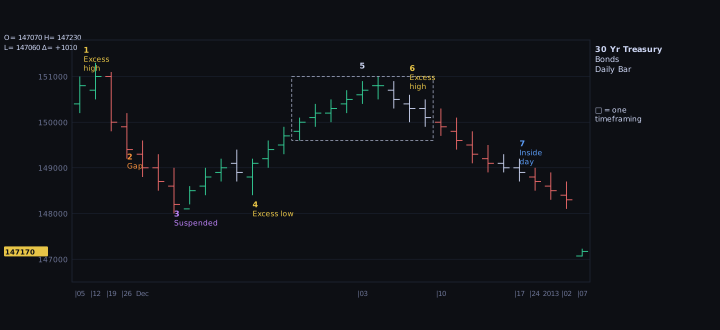
Fig 7.11 — 30-Year Treasury Bonds Daily Bar. O=147.070, H=147.230, L=147.060, C=147.170 (+1.010). Seven annotated structural points: ① Excess high; ② Gap downward; ③ Suspended auction (poor low, no excess); ④ Excess low; ⑤ One-timeframing higher (boxed); ⑥ Second excess high; ⑦ Inside day.
- Cognitive dissonance as opportunity: All humans feel acute discomfort when holding two opposing thoughts. But cognitive dissonance can be positive for traders willing to think through its source. For example: a market is rising, but the higher it goes without confirming structure and volume, the better the downside opportunity to follow. The trend may be your friend, but recognising when it is ending gives you the best trade location.
- The T-Bond structural sequence: The excess high ① marked the peak of the initial rally. The gap ② that followed confirmed aggressive selling by other-timeframe participants. The suspended auction ③ is the key structural warning — a poor low formed with no excess buying. This means the downward auction was paused, not reversed; it suggested the lows would be revisited. The excess low ④ then formed — aggressive buyers finally entered and established a structural base. One-timeframing higher ⑤ followed, then a second excess high ⑥ confirmed the upper boundary. The inside day ⑦ at the end sets up the ambiguous next session.
- Suspended auction: A suspended auction occurs when the market forms a poor low (no tail, no structural excess) after a downward move. Unlike an excess low (which features a sharp single-print probe that is immediately rejected), a suspended low is simply where selling stopped temporarily. The book's key insight: the poor low suggests the market will return to repair that low at some point in the future.
- Two causes identified: The subsequent auction higher in T-Bonds was driven by: (1) the market having gotten extremely short following the excess high — short covering fuelled the rally; and (2) the Federal Reserve reaffirming its decision to support the bond market by keeping rates low. Market logic superseded all analysis.
7.8 Excess High & The Y Period
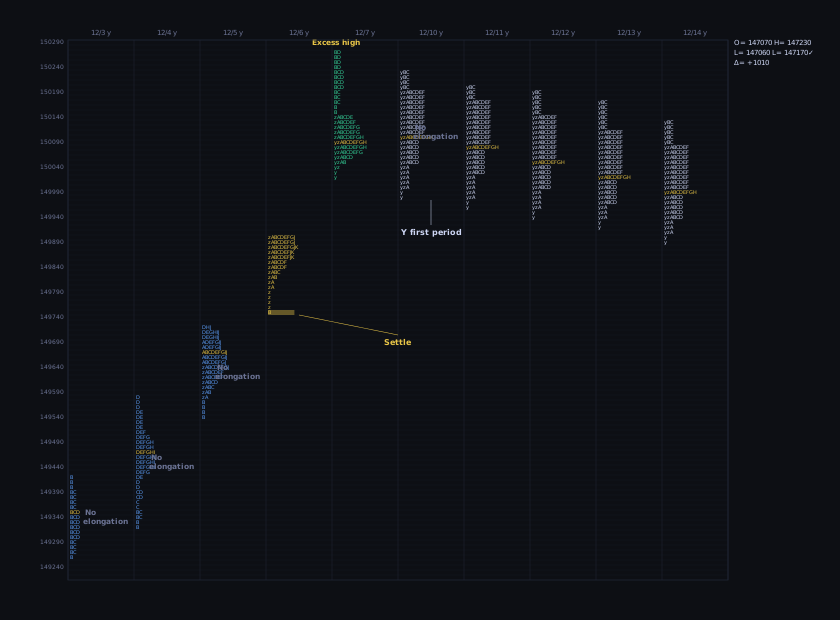
Fig 7.12 — Excess High Marked on the Previous Daily Bar Chart. S&P 500 daily TPO profiles, December 3–14, 2012. Each column's label includes "y" (pit session only). The Y period establishes the daily low in each column. Several columns show "No elongation" — price didn't extend significantly beyond initial balance. The excess high is visible on the 12/7 y column (~150.270).
- Y period as directional indicator: The Y period is the first 30-minute period of the pit session. When the Y period consistently forms the day's low (rather than probing higher then reversing), the market is demonstrating upward intent by the day timeframe. This is a simple but powerful structural diagnostic available in real time at the start of each session.
- No elongation: Several columns in the figure show "No elongation" — meaning neither buyers nor sellers generated significant range extension beyond the initial balance range. No elongation signals that other-timeframe participants are not active or are indifferent at those price levels. These are relatively low-risk, low-reward sessions.
- The excess high context: The excess high on the 12/7 column represents the point at which the market reached a price extreme that attracted responsive sellers. The market spent several subsequent sessions unable to return to or exceed that high — confirming the excess. The subsequent sessions' poor lows (no aggressive buying tails) indicate that short-term, weaker-hands traders were dominating, setting up the structural deterioration visible in Figure 7.13.
- Settle as reference: The settlement price from each session becomes the most important reference for the following day's opening analysis. A settle near the high favours continuation; a settle near the low raises caution. The settle on 12/6 (marked in Fig 7.12) becomes a key reference for structural continuity.
7.9 Poor Lows & Price Anomalies
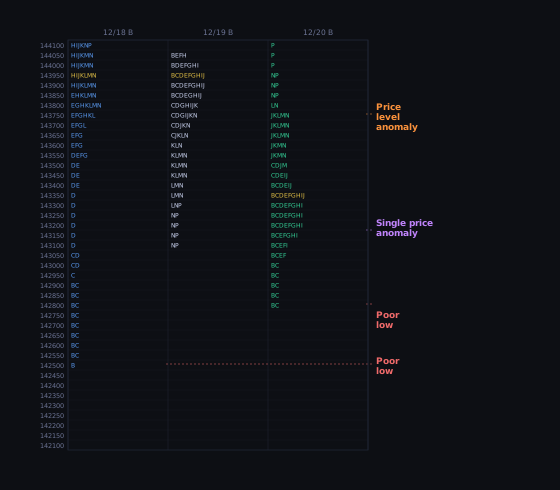
Fig 7.13 — Market Profile, Thursday December 20, 2012. Three daily profiles: 12/18 B, 12/19 B, 12/20 B. Two poor lows are annotated — one at the bottom of 12/18 B (~142.500) and one at the bottom of 12/20 B (~142.800). A "price level anomaly" is noted in the upper portion of 12/20 B, and a "single price anomaly" near the POC.
- Poor low mechanics: Other-timeframe participants express their interest on the highs and lows of profiles through single-print buying and selling tails. When tails are nonexistent, the higher and lower structural portions of the Profile lack excess. Three successive days of no buying tails (12/18, 12/19, 12/20) is an indication that the market is being dominated by short-term, weaker-hands traders who impulsively liquidate and reverse at the first sign of a problem.
- Price level anomaly: A price level anomaly occurs when price prints at a level where no prior sessions had established value — an unusual isolated distribution that doesn't connect smoothly to the surrounding price action. In Fig 7.13 (12/20 B), the upper portion of the profile shows letters printing at levels (near 143.750-143.800) that sit above a structural gap, creating an anomalous "island" in the distribution.
- Single price anomaly: A single price anomaly occurs when only one or two periods traded at a specific price level, creating a structural single-print within the body of the profile (not at the extreme). This differs from a tail: a tail at the extreme signals excess; a single print within the body signals weak acceptance at that level and potential rapid movement through it in either direction.
- The cognitive dissonance setup: This is precisely the type of ambiguous situation that produces the best trading opportunities. Short-term traders, excited about a potential fiscal cliff resolution, were buying aggressively — but the structural evidence (poor lows, price anomalies, no tail excess) was painting a very different picture. Being prepared to recognise and act on that structural deterioration is the application of accumulated experience.
7.10 Market Logic & Exponential Risk
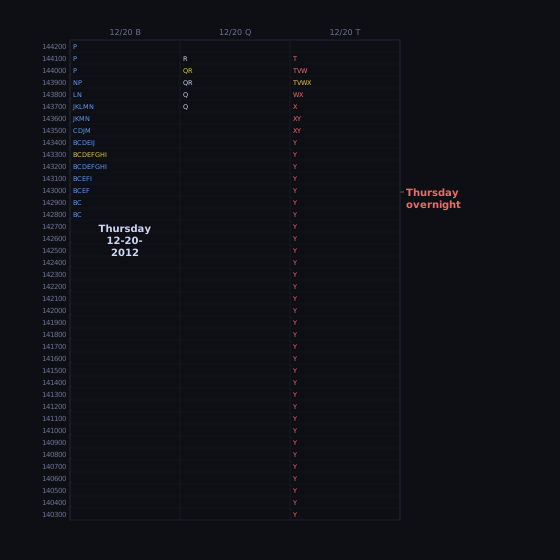
Fig 7.14 — Exponential Risk as Market Traded Limit Down. Three columns: 12/20 B (Thursday day session), 12/20 Q (Globex overnight, limited activity 143.700–144.100), 12/20 T (Thursday overnight electronic session — limit-down move from ~144.100 to ~140.300). The Y letters extending from 143.400 down to 140.300 represent the uninterrupted overnight decline.
- Market logic defined: It is not unusual for market logic to supersede all other analysis and understanding. Market logic is the accumulated force of participant behaviour in aggregate — when the majority are positioned the same way for the same reason (anticipating a rally on fiscal cliff resolution), the market has maximum potential energy to move violently in the opposite direction when that narrative is challenged.
- The limit-down anatomy: The 12/20 Q column (Globex overnight) shows limited activity between 143.700–144.100, with very few transactions. The 12/20 T column (Thursday overnight) shows the violent resolution: from ~144.100, the Y period alone drives price down to 140.300 — a move of nearly 400 ticks in a single session. The "Thursday overnight" label captures this dramatic structural event.
- Exponential risk from multiple poor lows: A single poor low is one data point; limited attention is warranted. But the three successive days of poor lows in Figures 7.12–7.13 represented exponential risk to longs: each subsequent poor low meant the prior lows had not attracted structural buyers, and the inventory of weak-handed longs was growing. When market logic eventually overrode the fiscal cliff optimism, there were no structural buyers to stop the decline.
- The whipsaw trap: Many traders reversed to short after the initial limit-down move — only to experience another whipsaw when the market partially recovered. This is the psychological damage of being caught on the wrong side of a structural move: first the loss, then the second loss from the reactive reversal. Structural awareness of the poor lows would have kept experienced traders on the sidelines or modestly short with defined risk, avoiding both traps.
- Chapter summary: Experience in the market is the synthesis of all prior learning. The examples in Chapter 7 — S&P timeframe analysis, overnight inventory, gaps, the fairest price, trends, cognitive dissonance, and the limit-down — all demonstrate the same principle: market-generated information, read through the lens of structure, provides a reliable edge over price-based analysis alone. The study and interpretation of structure is a lifelong endeavor.
S.1 The Dreyfus Model — Five Stages of Trading Mastery
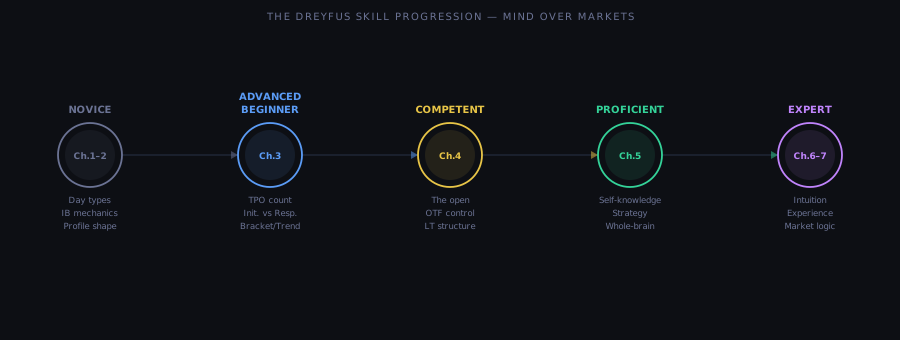
Fig S.1 — The Dreyfus Skill Progression. Five stages mapped to book chapters with key conceptual unlocks at each level.
- Novice (Ch. 1–2): Derivative learning. Absorb the six day types, IB mechanics, and profile structure as rules — without needing to understand the underlying why. The architecture must be built before intuition can inhabit it.
- Advanced Beginner (Ch. 3): Rules become contextual. TPO count identifies real-time control. Initiative vs. Responsive classifies every significant price move. The macro divide — Bracket vs. Trend — governs which strategy applies.
- Competent (Ch. 4): The book's largest stage. Real-time decision making at the open, OTF control monitoring, structural tools (tails, singles, volume, gaps, spikes), and long-term auction monitoring. You trade with contextual rules, not mechanical ones.
- Proficient (Ch. 5): The pivot point. Market understanding is largely complete — the bottleneck is internal. Self-observation through the journal, whole-brained balance (analytical preparation + intuitive execution), and comprehensive business strategy become the focus.
- Expert (Ch. 6–7): Rules are invisible — assimilated into intuition. The expert perceives holistically, adapts without deliberation, and draws on an accumulated structural library built through years of daily observation. Chapter 7's real-world case studies show what this looks like in practice.
S.2 The Auction Principle — Foundation of Everything
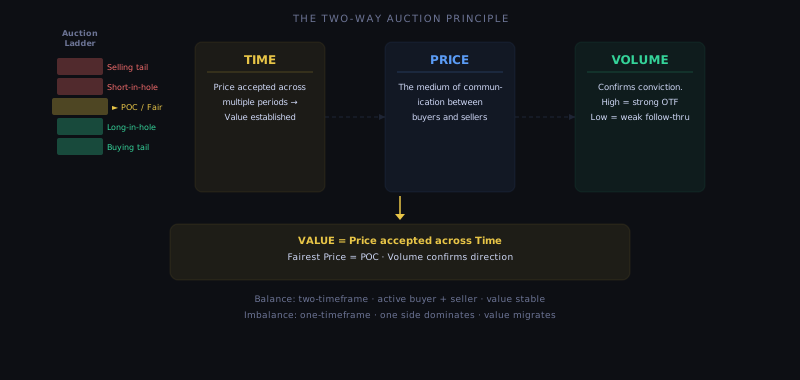
Fig S.2 — The Auction Principle. Three pillars — Time, Price, Volume — synthesise into Value and the Fairest Price.
- Price is communication, not destination: Most traders ask "Where is price going?" Market Profile traders ask "Is price being accepted or rejected here?" This reframe — from prediction to observation — is the book's most important conceptual shift.
- Value vs Price: Value is where most trading occurs (the value area, centred on the POC). Price can trade far from value, but the gap between price and value is where opportunity lives — either as a return to value trade or as evidence of a structural shift.
- Two-way auction states: At any moment the market is either in balance (two-timeframe, value stable) or out of balance (one-timeframe, value migrating). The transition between these states produces the best trades.
S.3 Anatomy of a Market Profile
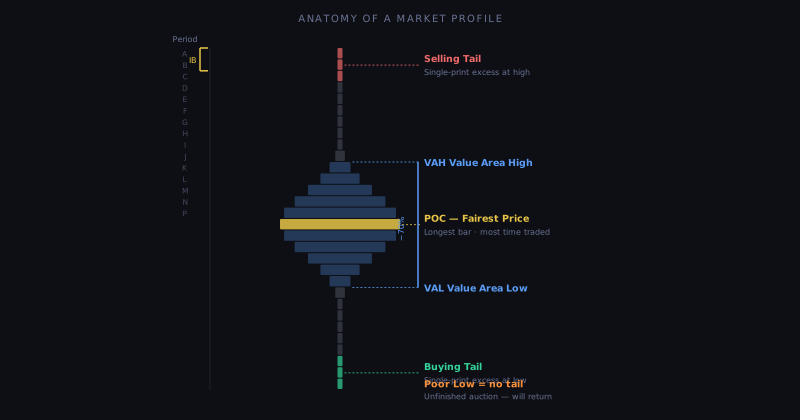
Fig S.3 — Profile Anatomy. POC (gold), Value Area (blue, ~70% of volume), tails (excess at extremes), and Initial Balance bracket annotated.
- POC — Fairest Price: The price level with the most TPO letters. Where buyers and sellers most agreed on fair value. A close near the POC signals balance; a close far from it signals directional conviction or imbalance.
- Value Area (VA): ~70% of the day's TPO count. The VAH and VAL are the most important reference levels for the following session's opening analysis. An open inside the VA continues prior context; an open outside provides directional information.
- Tails (Excess): Single-print letters at the extremes, formed in one period and never revisited. Mark where aggressive OTF participants entered and drove price away. Longer tails = stronger excess = more reliable future reference.
- Poor low / Poor high: A profile extreme with no tail. The auction paused without conviction from the opposing side. Unlike a tail (which signals reversal), a poor extreme signals an unfinished auction — the market will return to repair it.
- Initial Balance (IB): First-hour range (periods A–B). The day's anchor. Day types are defined in part by how price behaves relative to the IB throughout the session.
S.4 Reading the Open
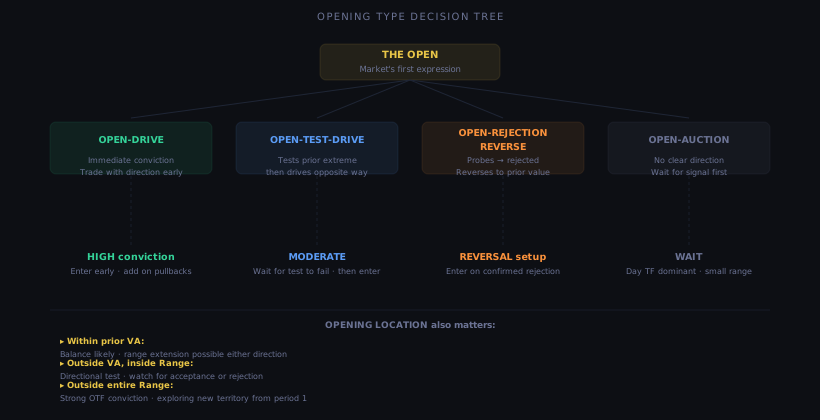
Fig S.4 — Opening Type Decision Tree. Four open types and their trading implications, from high-conviction (Open-Drive) to ambiguous (Open-Auction).
- Open-Drive: Immediate directional move, opening price rarely revisited. Strong OTF conviction. Trade with the drive early — before the move becomes obvious.
- Open-Test-Drive: Opens, probes one direction, fails to attract continuation, then drives strongly in the opposite direction. The failed probe creates a structural reference (potential tail). High-probability directional signal once confirmed.
- Open-Rejection-Reverse: Opens outside value or range, attracts responsive participants who reject the extreme, reverses back toward prior value. The "bouncing ball" analogy: released from the same height, it bounces to roughly the same level.
- Open-Auction: Back-and-forth rotations, no directional conviction. Indicates day-timeframe dominance. Wait for a clear signal — premature entry is the primary risk.
- Location matters as much as type: Open within VA → balance continuation likely. Open outside VA but within range → directional test. Open outside entire prior range → strong OTF conviction, exploring new territory from period one.
S.5 Bracket vs Trend — Macro Context for Every Trade
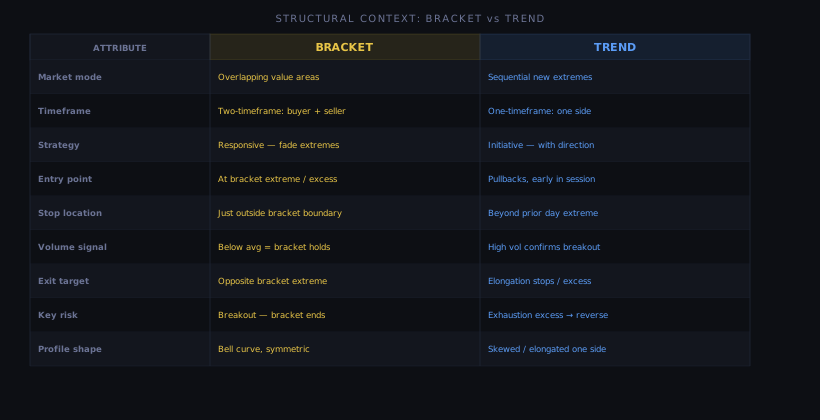
Fig S.5 — Bracket vs Trend Decision Matrix. Nine structural attributes compared across the two market regimes.
- Bracket identification: Three or more days of overlapping value areas, oscillating between two extremes. Boundaries defined by recurring VAH/VAL levels (conservative) or absolute extremes including tails (aggressive).
- Trend identification: Successive days where each high exceeds the prior high (or each low undercuts the prior low). Value migrates directionally. Range extensions in the same direction. Elevated volume confirms participation.
- The breakout transition: When price trades outside the bracket boundary with acceptance — closes beyond it, builds value there — the bracket has ended and a trend has begun. The boundary flips: prior resistance becomes support, prior support becomes resistance. Continuing to trade responsively after a confirmed breakout is a structural error.
- Volatility paradox: Brackets are more volatile day-to-day (sharp swings between extremes). Trends are less volatile intra-day (steady directional movement). Most traders' intuition is reversed on this — they over-trade brackets and under-trade trends as a result.
S.6 The Pre-Session Analysis Framework
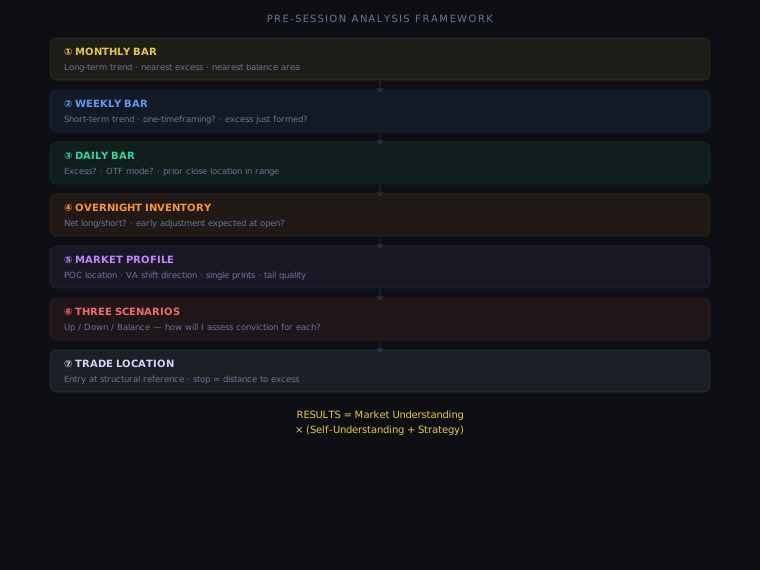
Fig S.6 — Pre-Session Analysis Framework. Seven sequential steps from monthly bar context down to specific trade location, concluding with the Results Equation.
- ① Monthly Bar: Long-term trend direction, nearest excess, nearest balance area. These levels remain relevant for weeks or months — highest-timeframe anchors.
- ② Weekly Bar: Short-term trend. One-timeframing? Excess just formed? The weekly bar shows change before the monthly does — first warning of regime change.
- ③ Daily Bar: Day-level structure, excess, overnight inventory building. The daily bar shows change before the weekly does. Note prior close location relative to the range.
- ④ Overnight Inventory: Net long or short? A significant imbalance will trigger early adjustment at the pit open. Knowing this prevents misinterpreting the opening move as a directional signal.
- ⑤ Market Profile: Prior session's POC, value migration, single prints, tail quality, poor lows/highs. Sets the specific price references for the upcoming session.
- ⑥ Three Scenarios: Write down: What if price moves up? Down? Stays in balance? How will I assess conviction for each? This cognitive scaffolding prevents reactive, price-blind decisions.
- ⑦ Trade Location: Specific entry levels at structural references — excess, bracket extremes, unfilled gaps, VAH/VAL. Trade location is the best risk control available. Good location = close stop + clear invalidation.
S.7 Chapter-by-Chapter Synopsis
- Chapter 1 — The Market Profile & How Markets Work: Markets are continuous two-way auctions driven by time, price, and volume. The Market Profile is a conduit for listening — not predicting. Objective market-generated data outperforms subjective opinion. The bell curve of price-over-time reveals where acceptance and rejection occur. This is the foundation everything else builds on.
- Chapter 2 — Novice: The six day types (Normal, Normal Variation, Trend, Double-Distribution Trend, Nontrend, Neutral) are the alphabet of structure. Each is defined by IB behaviour and OTF participation. Trend days are the most dangerous when misread — they look like Normal days early on but elongate relentlessly. Learn to identify day type in progress, not after the fact.
- Chapter 3 — Advanced Beginner: Three tools transform static observation into real-time reading: (1) TPO Count — buyer/seller ratio tells you who is in control; (2) Initiative vs. Responsive — classifies every significant move; (3) Bracket vs. Trend — the macro context that governs strategy. The key rule: initiative buying and responsive selling occur above prior value; responsive buying and initiative selling below it.
- Chapter 4 (Parts a–d) — Competent: Four major clusters — (a) The Open: four opening types, six location scenarios, range potential estimation; (b) OTF Control: two-timeframe vs one-timeframe, timeframe transitions, auction failure, tails, singles, Rotation Factor, Close, short covering, Ledge, high/low-volume areas; (c) Range/Brackets/Trends: range extension, long-term excess, composite days, VA relationships, directional performance, LTAR, T-Bond case study, corrective action; (d) Long-Term Structure: cross-timeframe profiles, 3-to-1 day, 2I-1R day, Value-Area Rule, spikes, balance area breakouts, gaps, nontrend/nonconviction days, news-influenced markets.
- Chapter 5 — Proficient: Market Understanding × (Self-Understanding + Strategy) = Results. Self-observation via the trading journal identifies behavioural patterns. Whole-brained balance: left brain for preparation, right brain for execution. Trading as a business: capital, risk, inventory, consistency, dedication, timing, information, competition. Without this chapter, even perfect structural analysis produces inconsistent results.
- Chapter 6 — The Expert Trader: "Knowledge and Experience do not necessarily speak the same language." Expert trading begins within. Belief — not just knowledge — is the prerequisite. Rules are invisible; structural recognition is automatic; the challenge is purely the application of experience to market conditions that have never been seen before. There are no checklists at this level.
- Chapter 7 — Experience: Real-world integration: S&P timeframe analysis, overnight inventory, gold gap structure, fairest price and short-covering, T-Bond cognitive dissonance, S&P Y-period analysis, poor lows signalling exponential risk, and the fiscal cliff limit-down. The core lesson: structural awareness is the only reliable antidote to price blindness. Market logic can supersede all other analysis — but structural preparation defines which side of that logic you are on.
S.8 20 Principles to Internalise
- 1. Price auctions to find acceptance, not to predict direction. A price that finds no acceptance reverses; one that finds acceptance expands.
- 2. Value is determined by time at price, not price itself. Repeated trading = fair value. A single-print probe = noise.
- 3. The POC is the fairest price. Selling below it is selling short-in-the-hole. The odds of a correction toward the POC are always present when price is far from it.
- 4. Excess marks the end of one auction and the beginning of the next. That extreme becomes a structural reference for all future sessions.
- 5. A poor low/high is an unfinished auction. No excess = the market will return. Multiple poor lows = exponential risk for longs.
- 6. Know whether you are making an Initiative or Responsive trade before you enter. Initiative = higher risk, higher reward. Responsive = better location, smaller range.
- 7. One-timeframing is the purest directional signal. Trade with it. The cessation of one-timeframing is the first warning of change.
- 8. The open is the most important moment of the day. Read the opening type and location, then plan — do not react.
- 9. Overnight inventory often causes early adjustment. Net long or short overnight positions will be liquidated near the open. This is mechanics, not direction.
- 10. An unfilled gap is a structural reference. When the market returns, its acceptance or rejection of the gap level is one of the highest-quality signals available.
- 11. Trade location is the best risk control available. Enter at structural references. Good location = close stop + clear invalidation. Poor location = wide stops + excessive risk.
- 12. Never confuse price action with structural analysis. Rising price without volume confirmation and without higher value is structurally different from rising price with both.
- 13. Context determines strategy: bracket → responsive; trend → initiative. After a confirmed bracket breakout, the boundary flips. Always reconfirm context before applying strategy.
- 14. Cognitive dissonance is a signal, not a problem. When two timeframes give contradictory readings, their resolution will produce the next large move. Prepare for both outcomes.
- 15. Bar charts and Profiles are complementary. Bar charts speed-read multi-timeframe context. Profiles reveal structural inequality between price levels. Use bar charts for context; Profiles for execution.
- 16. Volume confirms conviction; its absence reveals weakness. Higher value + lower volume on an upmove = strong directional performance (no heavy participation needed). Higher value + higher volume = powerful OTF buyer in command.
- 17. The landscape view prevents price blindness. No market trades in isolation. Sudden sentiment shifts appear on the landscape before they are visible in your primary market.
- 18. Self-understanding is not optional. The Results Equation is multiplicative. Zero self-understanding yields zero results regardless of market knowledge.
- 19. Prepare three scenarios before every session: up, down, balance. And for each: how will you assess conviction? This prevents reactive, price-blind decisions.
- 20. Experience is the teacher, not the book. Every principle above must be confirmed through personal market observation to become actionable. Show up every day, form your own opinion, and build your structural library — one session at a time.
S.9 Structural Vocabulary — Quick Reference
- Auction Failure: A directional move that fails to attract continuation. The failure itself is the trade signal — e.g., a break below the prior low that finds no sellers, followed by a reversal back above.
- Balance Area / Bracket: A price range where value has oscillated across multiple sessions without establishing a new directional extreme.
- Composite Profile: A multi-day aggregated TPO distribution revealing long-term value and structure invisible in single-day profiles.
- Corrective Action: A brief, sharp move against the primary trend that washes out weak positions before the trend resumes. Characterised by a single-period uninterrupted move.
- Downside Breakout Failure: Price tests below the bracket's lower extreme, finds aggressive buyers (excess low), traps short sellers, and sets up a strong short-covering rally back into the range.
- Excess: A single-print probe at the extreme, immediately rejected and never revisited during the session. Long tails = strong excess. No tail = poor low/high.
- Initial Balance (IB): First-hour range (periods A–B). The anchor against which range extension and day type are measured.
- LTAR (Long-Term Activity Record): A daily log of Rotation Factor, range extension, tail presence, composite day type, volume, VA width, and VA location. The structural context bar charts cannot provide.
- OTF Participant (Other Timeframe): An institution or commercial operating on a timeframe longer than the day. Recognised through tails, range extensions, and volume spikes that day-timeframe activity cannot explain.
- Point of Control (POC) / Fairest Price: The price level with the most TPO letters — the longest bar. Where buyers and sellers most agreed on fair value.
- Rotation Factor (RF): Running count of half-hour period direction changes. +1 for a period with a higher high; -1 for a lower low. Used in the LTAR to assess directional bias.
- Short Covering / Long Liquidation: Corrective rallies or selloffs driven by forced position exits rather than new directional conviction.
- Single Prints (body): TPO letters appearing only once within the body of the profile. Created by initiative activity. Act like gaps — will eventually be revisited and filled.
- Spike: A narrow, sharp price extension in the final periods of the session. Creates a two-part profile. Opening relative to the spike determines the structural bias for the following session.
- Suspended Auction: A poor low/high after a directional move with no opposing excess. The auction paused without conviction — unlike a tail, it signals resumption rather than reversal.
- Value Area (VA): ~70% of the session's TPO count. The VAH and VAL are the primary reference levels for the following session's opening analysis.
S.10 A Final Note — The Journey
— Dalton, Jones & Dalton
- What this book actually teaches: Not a system, but a language — the language of market-generated information. Once fluent, you can read any market in any timeframe and understand what is happening structurally, independent of news, opinion, or price momentum. That fluency is the edge.
- The compound interest of daily observation: Every session you complete pre-session analysis, form your own opinion, observe the actual outcome, and compare it to your expectation — you make a deposit in your structural library. These deposits compound. A trader who does this consistently for two years possesses an intuitive reservoir no book can replicate.
- The limiting factor is always internal: By the time most traders have worked through this material, market knowledge is not the bottleneck. Psychology, consistency, risk management, and the willingness to confront uncomfortable behavioural patterns are what separate the Competent trader from the Proficient one. The Results Equation is precise: strong market knowledge multiplied by zero self-understanding equals zero results.
- The practice: Keep a trading journal. Complete the LTAR for every session you monitor. Read the opening type and location every day — even on days you don't trade. Mark excess levels, balance areas, and value migration direction on a running structural chart. Over time, the market begins to speak in a voice you recognise. That recognition is experience. Experience is the expert's only true advantage.